Here’s something most people don’t tell you before you start with Japanese: Learn Katakana is probably the easiest win you’ll get on this journey.
Well, It has 46 characters. They follow a clean, predictable pattern. And a huge chunk of what’s written in Katakana? It’s English — just in a different costume. Words like コーヒー (koohii = coffee), スマートフォン (sumaatofon = smartphone), and アイスクリーム (aisukuriimu = ice cream) are already in your vocabulary. You just need to learn how to see them.
That’s the first thing I want you to hold onto: If you’re speaking English or your native language is English, you’re not learning from zero. You already know more Katakana than you think.
In this guide, I’ll walk you through every character step by step — with mnemonics to make them stick, exercises to lock them in, and a free chart you can download and keep. By the end of the week, you’ll be reading Katakana cold.
One thing before we dive in — if you’ve never encountered Japanese kana before, I’d recommend giving our Hiragana Guide a quick read first. It’ll give you a feel for how the sound system works, and Katakana will click even faster. If you’re already familiar, you’re in the right place. Let’s go!
What Is the Katakana Alphabet?
Let me give you a quick lay of the land before we start memorizing characters.
Japanese writing uses three scripts — and they’re all used at the same time, often in the same sentence. Kanji are complex meaning-based characters borrowed from Chinese. Hiragana is the rounded, flowing script used for native Japanese words and grammar. And then there’s Katakana — the angular, sharp-edged script that’s essentially Japanese’s way of flagging “this word came from somewhere else.”
Think of Katakana as the italics of Japanese. When you see it, you immediately know: foreign word, foreign name, or something the writer wants to emphasize.
Here’s what Katakana is used for:
- Foreign loanwords — by far the most common use. Over 80% of Katakana you’ll encounter comes from English. Once you learn the characters, menus, signs, and product labels start making sense almost immediately.
- Foreign names and places — Michael becomes マイケル. Paris becomes パリ. Netflix becomes ネットフリックス.
- Onomatopoeia — Japanese has an incredibly rich set of sound words. ドキドキ (heart pounding), キラキラ (sparkling), ザワザワ (crowd murmuring). These often appear in Katakana for stylistic punch.
- Emphasis — writers sometimes swap a native word into Katakana just to make it stand out, the same way you’d bold or italicize in English.
- Scientific and technical terms — plant names, animal species, and medical vocabulary frequently use Katakana.
The practical upside for you as a learner: because Katakana loanwords are so common, you’ll start getting payoffs while you’re still learning. That momentum matters more than people give it credit for.
Katakana vs. Hiragana: Key Differences
Same sounds. Completely different look. Let’s make a comparison between Katakana and Hiragana in a nutshell.
Both scripts cover the same set of ~46 syllable sounds — so if you’ve already learned Hiragana, you already know all the sounds in Katakana. What changes is the shape and the job each script does.
| Hiragana | Katakana | |
| Shape | Rounded, cursive | Angular, sharp |
| Used for | Native Japanese words, grammar particles, verb endings | Loanwords, foreign names, emphasis, onomatopoeia |
| Tone | Soft, everyday, familiar | Modern, foreign, technical |
| Example | むすび (musubi) | バーガー (burger) |
| Learn first? | ✅ Recommended | You’re here! |
The fastest rule of thumb: if a word originally came from another language, it’s almost certainly Katakana. If it’s native Japanese — grammar, common verbs, everyday nouns — it’s Hiragana.
In real Japanese text, you’ll see both scripts in the same sentence. For example:
私はコーヒーが好きです。 Watashi wa koohii ga suki desu. — “I like coffee.”
Here, コーヒー (coffee) is in Katakana because it’s a loanword — everything else is Hiragana and Kanji. Once your eye learns to separate them, reading gets much easier.
Want the full picture of how Japanese writing works? See our Japanese alphabet overview for how Hiragana and Katakana work together.
The Full Katakana Chart
| Pro Tip from Kanji123: If you haven’t learned Hiragana yet, you don’t have to wait — this guide is fully self-contained. But learning both together will speed up your reading significantly. Check out our Hiragana chart when you’re ready. |
Before we start learning individual characters, I want you to see the full picture first.
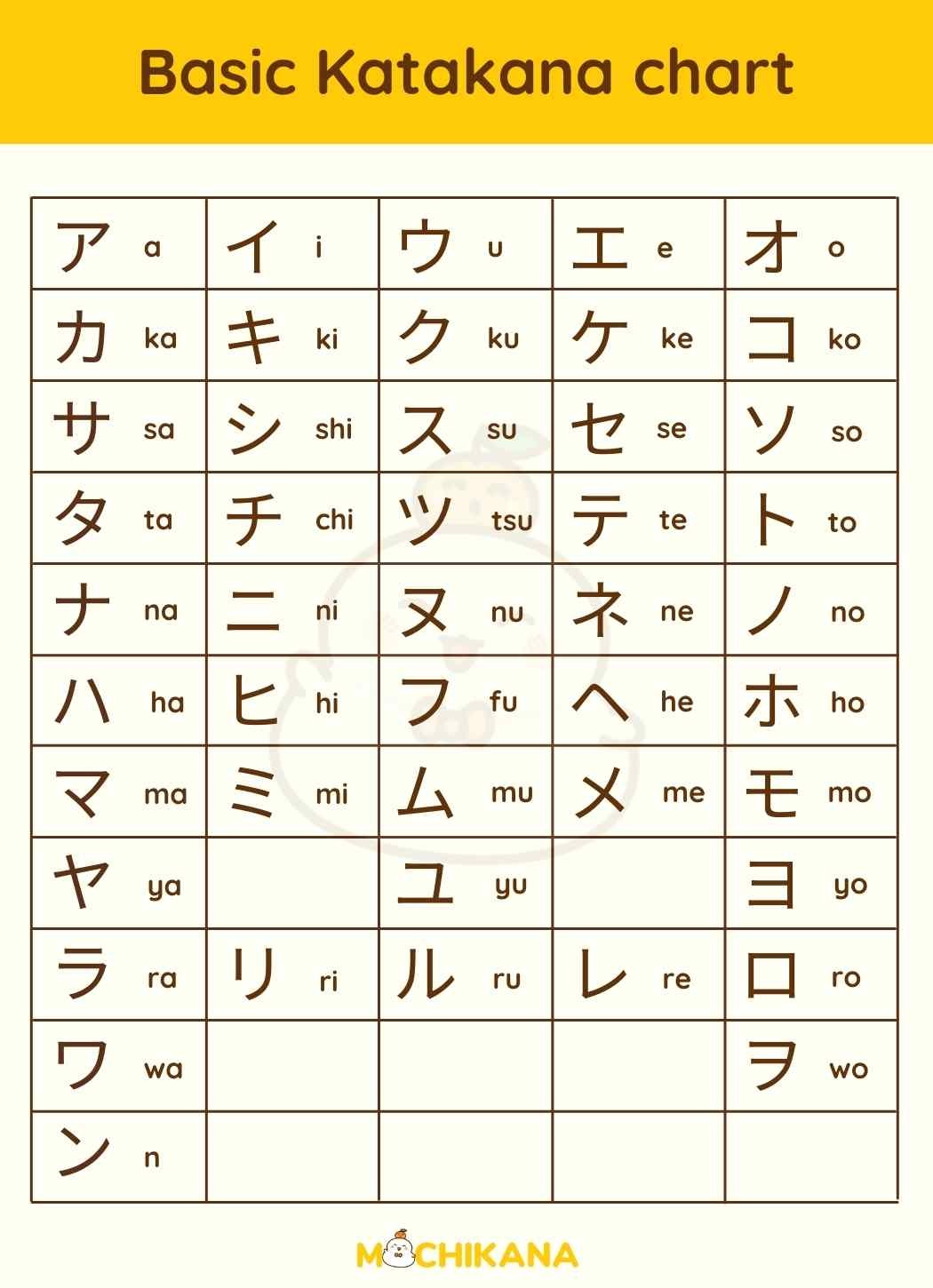
Source: MochiKana
This is the complete map of all 46 base Katakana characters. Don’t try to memorize it right now — just get familiar with the layout. You’ll come back to this chart dozens of times as you work through the sections below, and each time it’ll look a little less overwhelming.
Here’s the pattern that makes this whole system click: every row follows the same five vowel sounds — A, I, U, E, O. Learn the vowels once, and the entire grid opens up. KA-KI-KU-KE-KO. SA-SHI-SU-SE-SO. MA-MI-MU-ME-MO. Same shape, every time.
A few characters break the expected pattern slightly. SHI instead of SI. CHI instead of TI. TSU instead of TU. FU instead of HU. These are quirks of how Japanese phonetics work — I’ll flag each one when we get there so nothing catches you off guard.
A bit of housekeeping first
Want to study offline? Download the free Katakana chart PDF — clean layout, includes romaji, print-ready. A lot of learners I know tape it above their desk and glance at it every day. Passive exposure works more than you’d think.
Not sure how Katakana fits next to Hiragana? Our Hiragana chart page shows both scripts side by side — great reference if you’re learning them in parallel.
If you’re a visual learner, watch our full Katakana chart video in 15 minutes before diving in.
How to Learn Katakana Step by Step
I’ve seen a lot of people try to learn Katakana by staring at a full chart and attempting to memorize all 46 characters at once. It doesn’t work. Your brain hits overload after about 10 characters, and two days later, you remember almost nothing.
Here’s the approach that actually works — and the one we’ll follow throughout this guide.
Two principles drive the whole method:
1. Mnemonics — remember by seeing, not by drilling. Each character gets linked to a visual story or a familiar image. Instead of repeating ク twenty times until it sticks, you notice that ク looks like a cook’s hat — beak pointing right, tail swept back. Now it sticks on the first try. The images I use are designed to connect with Western cultural references, so they’ll feel natural to you.
2. Golden Time (SRS) — test yourself before you feel ready. After every group of characters, you’ll hit an exercise section. I’ll ask you to recall characters before you think you’ve fully learned them. That struggle — that moment of reaching for the answer — is exactly what locks information into long-term memory. Research in learning science backs this up consistently. Don’t skip the exercises.
A bit of instruction
Each section covers one group of 8–10 characters. Within each section:
- Every character gets its romaji, pronunciation, and a mnemonic
- Real loanword examples show the character in action
- An exercise block closes the section to lock in what you learned
By the time you finish Section 8, you’ll have covered all 46 base characters. Sections 9–11 handle the advanced rules. After that, you’re reading Katakana.
One more thing: don’t rush. It’s better to finish two sections solidly in a day than to skim five and retain nothing. Most learners I’ve seen complete this guide in 5–7 days at a relaxed pace. You can absolutely do it faster — but consistency beats speed every time.
Ready? Let’s start with the first 10.
Vowel & K Row (アイウエオカキクケコ)
These are your first 10 characters — and honestly, the most important ones you’ll learn.
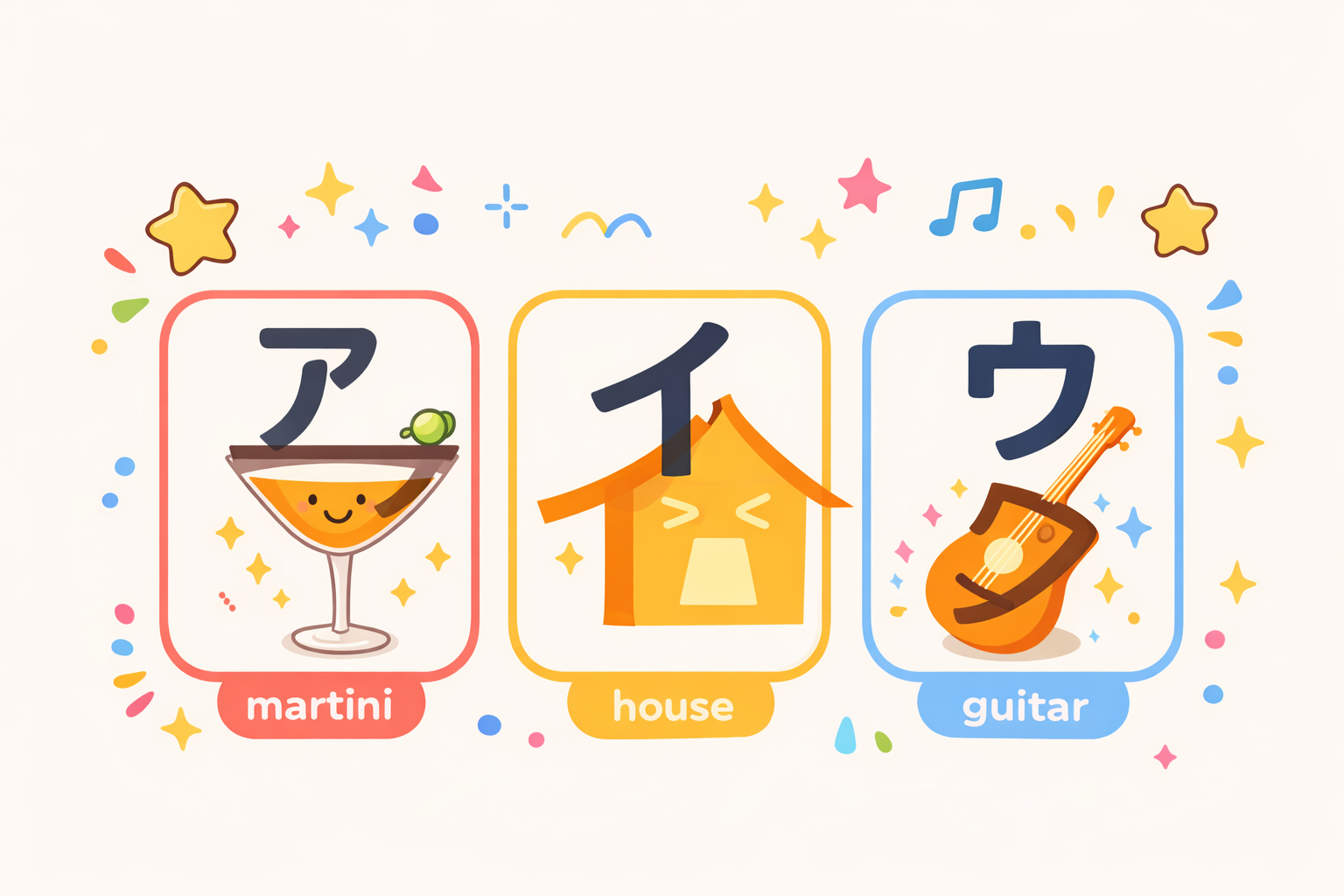
- The 5 Vowels: ア A イ I ウ U エ E オ O
- The K Row: カ KA キ KI ク KU ケ KE コ KO
The five vowels anchor every other row in the chart. Get these solid, and every column that follows becomes much easier to absorb.
Work through each character one at a time. Read the mnemonic, picture it clearly, then move on. Don’t rush — 10 characters is exactly the right amount for one focused session.
The 5 Vowels
ア — A
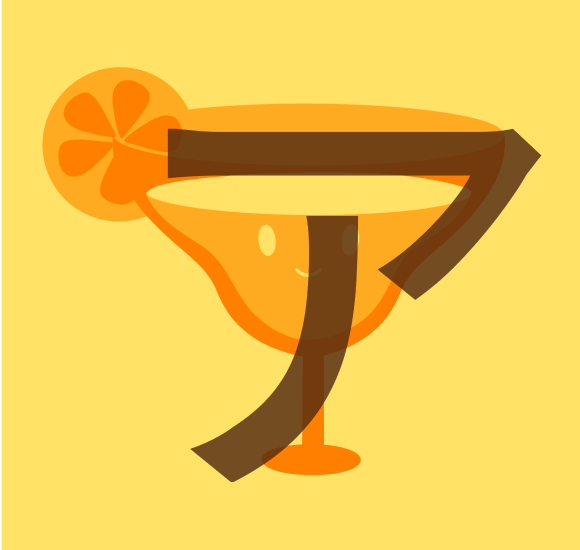
Image: A glass of martini — the angular stem, the wide rim, the whole elegant silhouette.
How to Remember: ア = martini glass. Raise it and say “ah!” — that’s your sound and your image in one.
Sound: like the “a” in car — but shorter. Open, from the back of the mouth. Not the “a” in cat, not the “a” in cake. Clean and brief.
イ — I
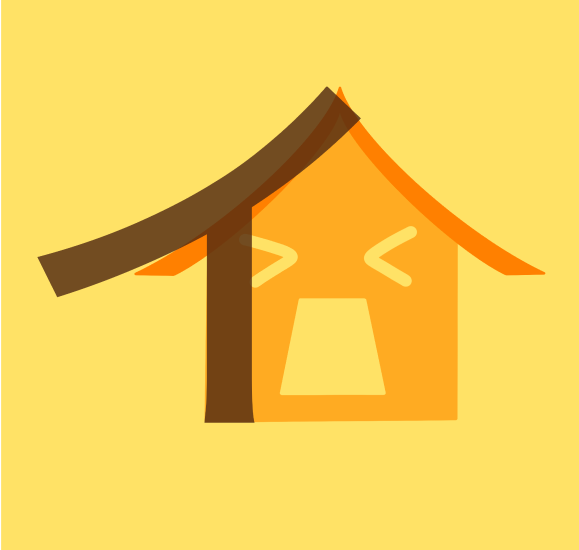
Image: A house with a roof — but half of it is hidden behind a wall. You only see one side of the roofline.
How to Remember: Half a house, half visible. “I” can only see one side. The slanted stroke is the roof, the vertical is the wall.
Sound: like the “ea” in meat — but shorter. Crisp and front of mouth. Don’t let it glide or stretch the way English “ee” tends to.
ウ — U
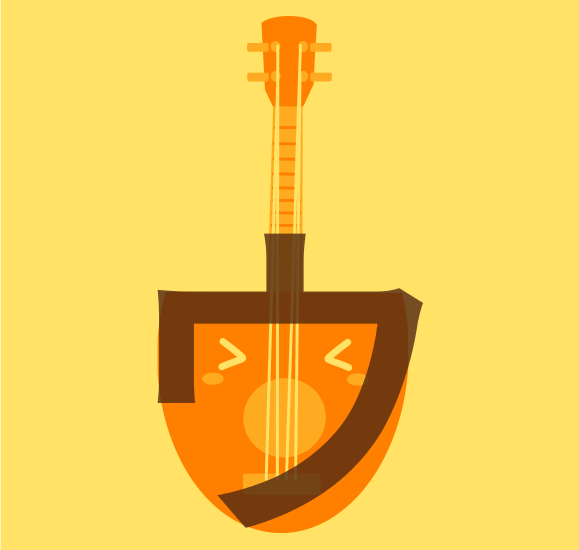
Image: A ukulele — a small rounded body with a neck rising from the top left, compact and lightly strung.
How to Remember: ウ = ukulele. Both start with “U” — and the shape matches the instrument’s silhouette almost exactly.
Sound: like the “u” in hula — but shorter. Lips barely round. It’s a compressed sound, not a full “oo.” Don’t over-round it.
エ — E
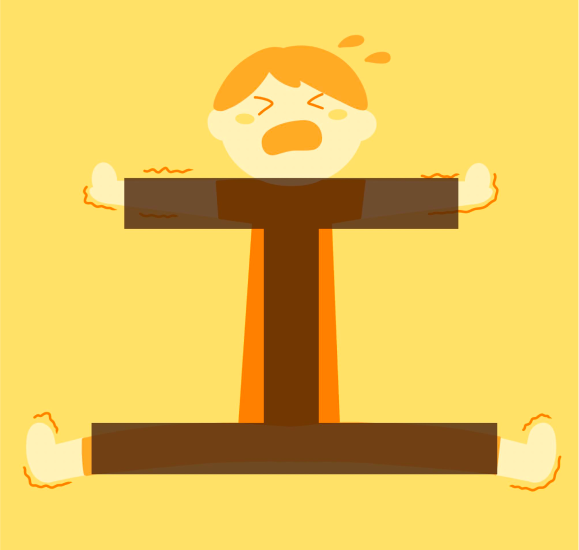
Image: A person exercising — arms extended wide to both sides, right leg stepping boldly forward.
How to Remember: The top and bottom strokes are the arms. The vertical stroke is the body. The whole character is mid-workout.
Sound: like the “e” in get — flat, short, no glide. The mouth barely moves after you say it. Think set, not say.
オ — O
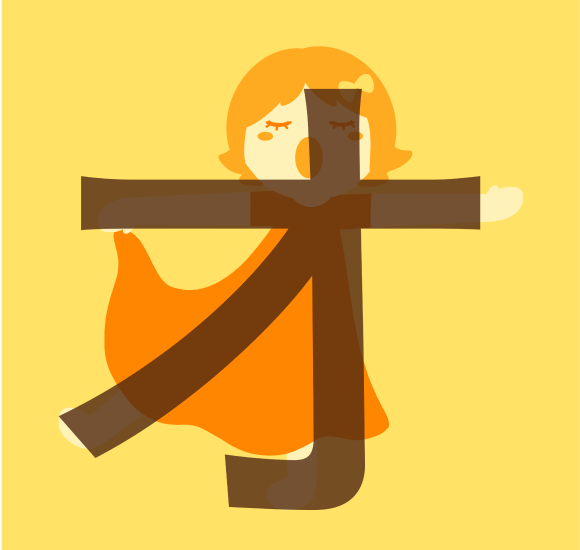
Image: A person with arms extended wide to both sides and the right leg stepping forward — same open posture as エ, but with one bold extra stroke cutting across the middle.
How to Remember: That crossing stroke is what sets オ apart from エ. Arms out, step forward, and one dramatic slash through the center — “Oh!”
Sound: like the “o” in or — but shorter. Round and open. Not the sliding English “oh” where the sound shifts at the end. Hold it steady and cut it short.
The K Row
The pattern from here is simple: take each vowel sound (A-I-U-E-O) and add a K in front. カ = KA, キ = KI, ク= KU, ケ = KE, コ = KO.
カ — KA
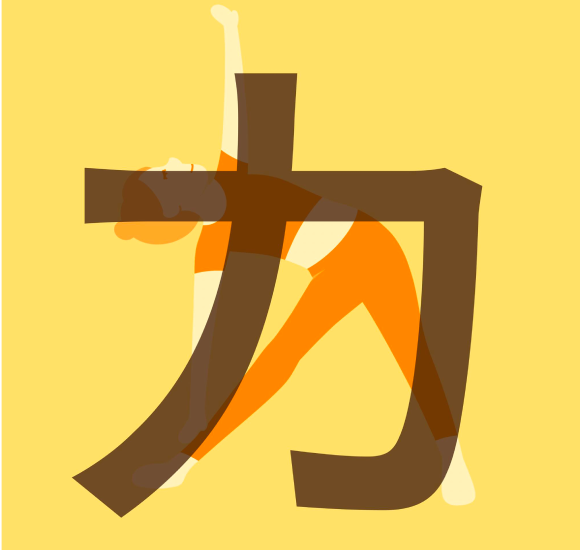
Image: A person practicing yoga — one arm raised, one leg extended back, balanced in a wide open stance.
How to Remember: The two strokes reaching outward are the limbs. カ = yoga pose. Hold the shape in your mind like holding a pose.
Sound: like the “ca” in “cappuccino. Clean “k” with minimal puff of air. Less aspiration than English. Short, punchy vowel right after.
キ — KI
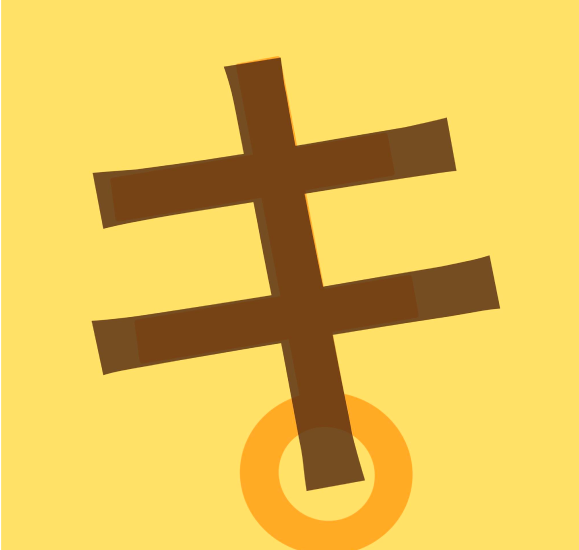
Image: A key laid flat — two horizontal bars crossed by a vertical stroke, with a small hook at the bottom like the teeth of a key.
How to Remember: キ = key. KI = kee. The shape and the sound are literally the same word. This one sticks to itself.
Sound: like キ is pronounced like “key,” but shorter. The “k” lands softly, the “ee” cuts off cleanly. Think key, clipped.
ク — KU
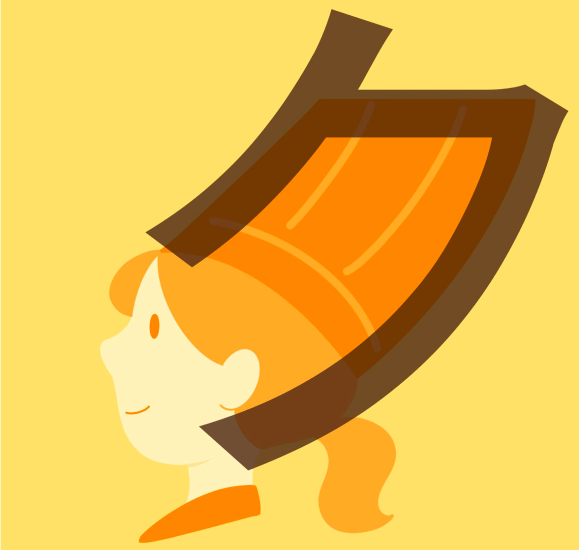
Image: A cook’s hat — an angular shape rising to a peak on the left and opening wide to the right, like the tall toque of a chef.
How to Remember: ク = cook’s hat. A cook wears a KU-shaped hat. Say “cook” and you’re halfway to “ku.”
Sound: like the “ku” in Kuwait — but shorter. Lips barely round for the U. It’s almost more “k'” than a full “koo.” Keep it tight.
ケ — KE
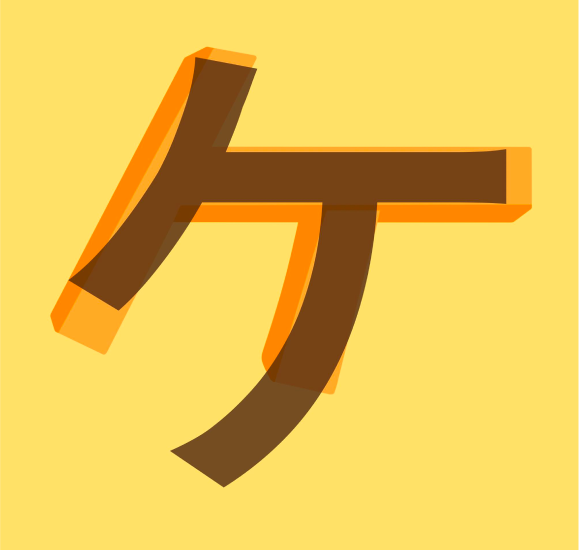
Image: The letter K in the alphabet — a vertical post with two strokes reaching out, one angled up and one angled down.
How to Remember: ケ literally looks like a simplified K. K = KE. As direct as mnemonics get.
Sound: like the “ke” in Kevin — short and flat. The “e” sits between “keh” and “kay,” closer to kept than cake. Brief and direct.
コ — KO
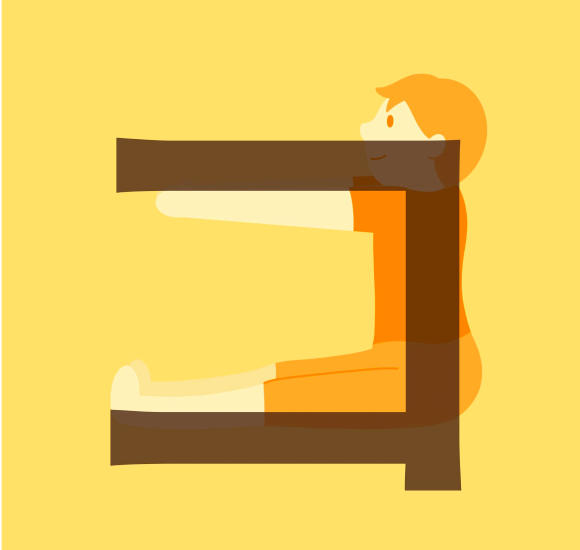
Image: A person bending forward with their head bent down too — a horizontal stroke at top, one vertical dropping at the right, like a bowed posture.
How to Remember: コ = someone hunched over. Think of a koala curved around a branch — KO-ala, コ.
Sound: like the “ko” in koala — round and brief. Pure “o,” same as オ, just with a K in front. Don’t let it slide.
Exercises: Vowel & K Rows
You’ve got 10 characters down. Now close the chart and test yourself — the slight discomfort of reaching for an answer before you feel ready is exactly what makes it stick.
What to do next:
🧠 Can you identify all 10 characters at speed? Take the interactive Katakana quiz to test your recognition.
📄 Prefer to practice writing by hand? Download the Vowel & K Rows worksheet and trace each character to build muscle memory.
Once you score 80% or higher on the quiz, move on to S & T Rows. If not — run through the mnemonics one more time, then retry. One more pass is all you need.
S & T Rows (サシスセソタチツテト)
You’re 10 characters in. Now let’s add 10 more.
The S and T rows introduce a few sounds that don’t follow the standard pattern — and two characters that trip up almost every beginner. I’ll flag both clearly so you don’t get caught off guard. Outside of those exceptions, the logic is exactly the same as the K row: one consonant, five vowel sounds, clean and consistent.
Work through each character one at a time. Mnemonic first, then the sound, then the example words. Same process as before.
- The S Row: サ SA シ SHI ス SU セ SE ソ SO
- The T Row: タ TA チ CHI ツ TSU テ TE ト TO
The S Row
The S row mostly follows the pattern — except for one: シ is SHI, not SI. That’s just how Japanese phonetics work. There’s no SI sound in standard Japanese, so the chart skips it and uses SHI instead. You’ll see this same kind of exception in the T row too.
サ — SA
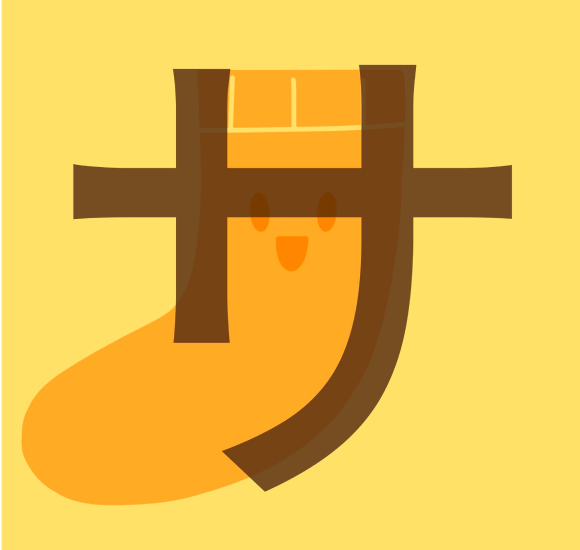
Image: A sock — the top stroke is the cuff, the two lower strokes form the foot and toe, angled like a sock laid flat.
How to Remember: サ = sock. Lay a sock flat on the floor and trace its outline — that’s the character.
Sound: like the “sa” in Saturday — but shorter. Natural “s” into an open “a.” Quick and clean.
シ — SHI

Image: A smiling face — two short dots on the left for eyes, a curved upward stroke on the right for the smile.
How to Remember: シ is literally grinning at you. A smiling face says “shee!” — that’s your sound right there.
Sound: like “she” — not “see,” not “si.” The tongue lifts toward the roof of the mouth. This is one of the S row’s irregular sounds, so say it out loud a few times until it clicks.
ス — SU
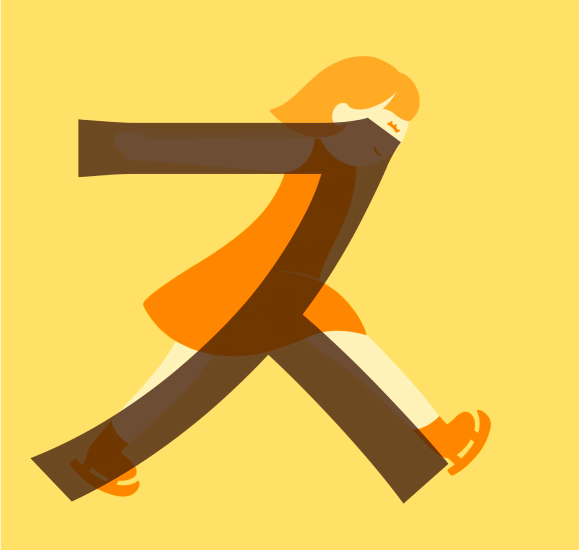
Image: A person mid-movement — a long stroke curving down and looping at the bottom, like someone bent forward in a deep swooping motion.
How to Remember: Follow the stroke with your eye from top to bottom. The body leans, the arm swings forward, the shape flows in one continuous line.
Sound: like the “su” in Susan — but shorter. Lips stay flat, barely rounded. The U is so compressed in natural speech it almost disappears — pronounce it clearly for now.
セ — SE
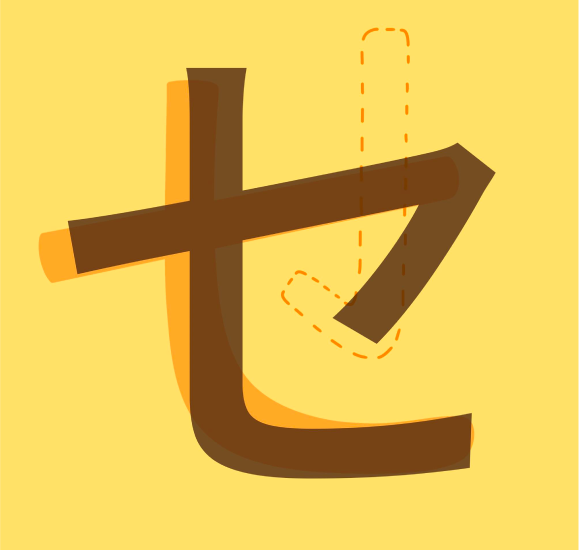
Image: The Hiragana せ with strokes missing — the same core structure, stripped back to its essentials.
How to Remember: If you’ve seen Hiragana せ, this is a free pass. Imagine someone erased a few lines and left only the skeleton.
Sound: like the “se” in set — flat and short. Same “e” you’ve practiced since エ. No glide at the end. Think set, not say.
ソ — SO

Image: Another sock — but this one is standing upright. One short stroke and one long stroke at the top, one long stroke sweeping down to the right.
How to Remember: サ and ソ are both socks. サ lies flat. ソ stands upright. Upright sock = SO.
Sound: like the “so” in sore — but shorter. Pure round “o,” same as オ. Hold it steady and cut it off clean.
The T Row
The T row has two exceptions — and they’re both ones beginners consistently stumble on. CHI and TSU replace what you might expect to be TI and TU. More importantly, this row is home to two of the most commonly confused character pairs in all of Katakana. I’ll break those down right after the row.
タ — TA
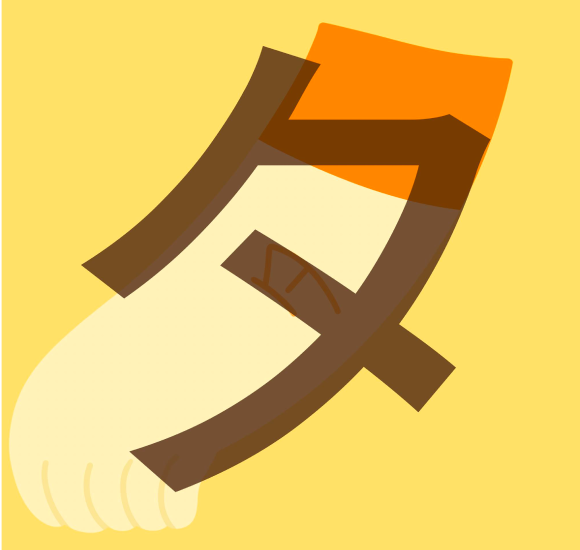
Image: An arm with a tattoo — a horizontal stroke across the top like a sleeve, a diagonal mark below like ink on the forearm.
How to Remember: タ = tattoo. TA = the first syllable of tattoo. The stroke going across is the arm, the mark below is the ink.
Sound: like the “ta” in tar — but shorter. Crisp, unaspirated “t.” Less air than English top. Short open vowel straight after.
チ — CHI
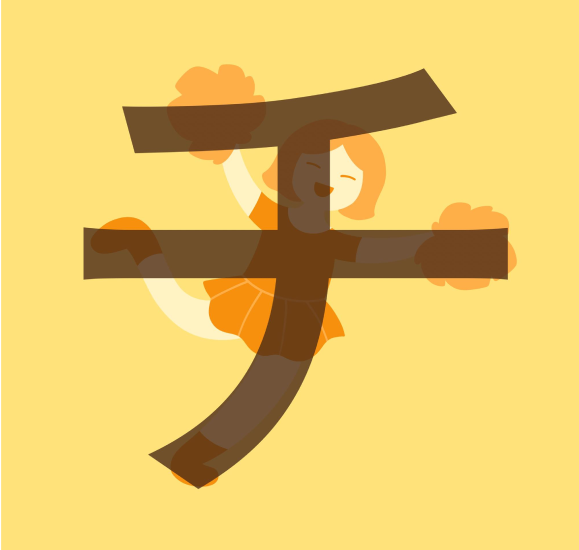
Image: A cheering fan — arms raised, body leaning forward in excitement, caught mid-cheer in the stands.
How to Remember: チ = cheer. CHI = chee — the sound you make when you cheer. Picture someone at a game throwing both arms up.
Sound: like the “chee” in cheek — but shorter. Not “tee,” not “ti.” Identical to “ch” in cheese. Say it out loud a few times before moving on.
ツ — TSU
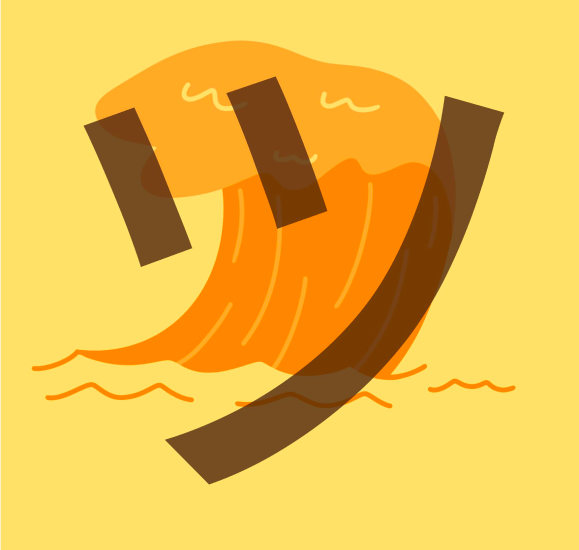
Image: A tsunami wave — Two short strokes and one long stroke like ripples, one long sweeping stroke below like a wave cresting and breaking.
How to Remember: ツ = tsunami. TSU = the first syllable of tsunami. Shape and sound are the same word — this one sells itself.
Sound: like the “tsu” in tsunami — place your tongue at the roof of your mouth as if saying “ts” in cats, then add a compressed “u.” The trickiest sound in this row. Say it slowly first, then speed up.
テ — TE
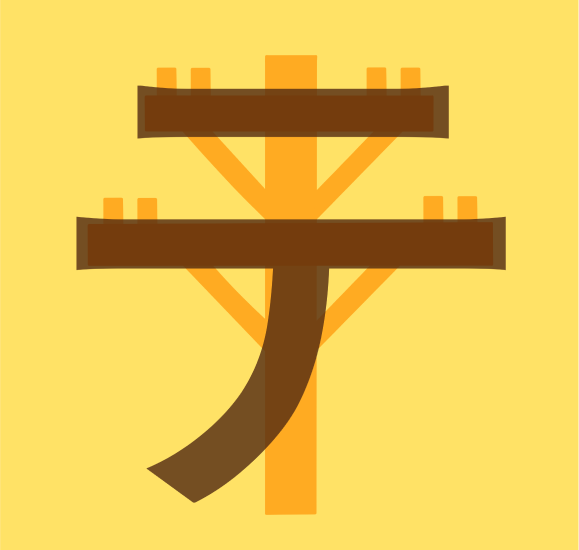
Image: An electric pole — a tall vertical post with a horizontal crossbar near the top, a line extending from the side like a utility wire connecting to it.
How to Remember: テ = telegraph pole. TE = teh — say it like the first syllable of telephone, short and flat, then stop.
Sound: like the “te” in ten — flat and short. Same “e” across every row. Think ten, not tay. Clean stop.
ト — TO
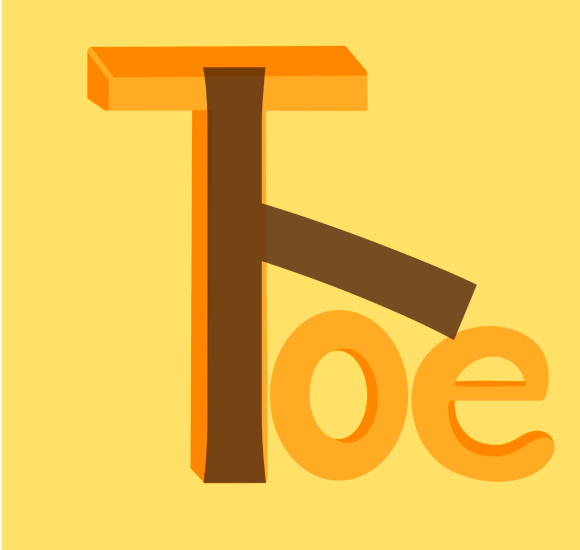
Image: The letter T from the word toe — a vertical stroke with a small horizontal bar near the top, like a capital T simplified to its core.
How to Remember: ト looks like T. T is for toe. TO = toh. Three steps, one second.
Sound: like the “to” in toe — round and brief. Pure “o,” same as always. Clean “t” in front, no extra air.
- ⚠️ Two pairs to flag now
These will be fully covered in “Tips to Avoid Common Faults” at the end of the guide — but mark them in your mind now so they’re already on your radar.
- シ (SHI) vs ソ (SO): Nearly identical structure, different orientation of the short strokes. Easy to blur at speed.
- ツ (TSU) vs ン (N): Same situation. You haven’t learned ン yet — but when you do, come straight back to this pair.
Exercises: S & T Rows
Ten more characters locked in. Now test yourself before the memory fades — that’s the whole point of doing this right after learning, not the next day.
What to do next:
- 🧠 Can you tell letters in S & T rows at speed? The practice quiz will test exactly that.
- 📄 Want to lock in the stroke patterns? Trace through the S & T columns worksheet — writing by hand is especially useful for the tricky pairs. Download this PDF Worksheet
Once you score 80% or higher, move on to next section
N & H Rows (ナニヌネノハヒフヘホ)
You’re 20 characters in — nearly halfway through the base chart. The N and H rows are some of the most beginner-friendly in the entire table. No irregular sounds, no tricky exceptions. Just clean consonant + vowel combinations all the way through.
That said, the H row has one character worth flagging before we start: フ is romanized as FU, not HU. The sound is softer than a typical English “f” — more like a gentle breath than a hard consonant. I’ll break it down when we get there.
Work through each character the same way: mnemonic first, then the sound, then the words. One at a time.
- The N Row: ナ NA ニ NI ヌ NU ネ NE ノ NO
- The H Row: ハ HA ヒ HI フ FU ヘ HE ホ HO
The N Row
No exceptions here. Every character follows the standard pattern: N + A, I, U, E, O. Clean and consistent all the way down.
ナ — NA
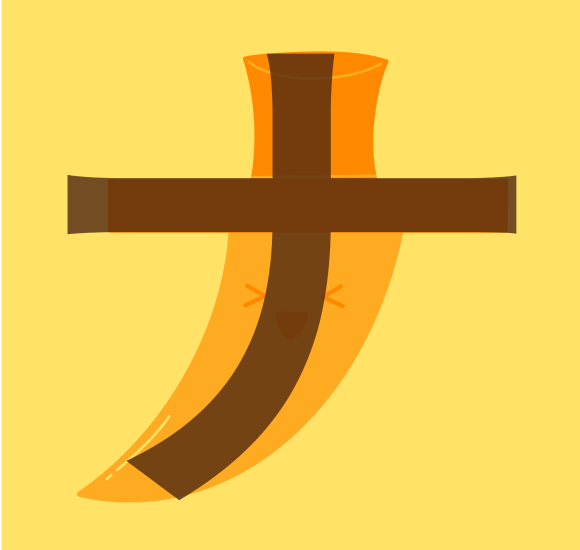
Image: A knife — a vertical blade with a small guard jutting out at the top right.
How to Remember: ナ = knife. NA = “nah” (casual English no) — sharp, quick, forward. The diagonal stroke is the blade.
Sound: like the “na” in nah — but shorter. Quick forward consonant, open vowel. Don’t hold it.
ニ — NI
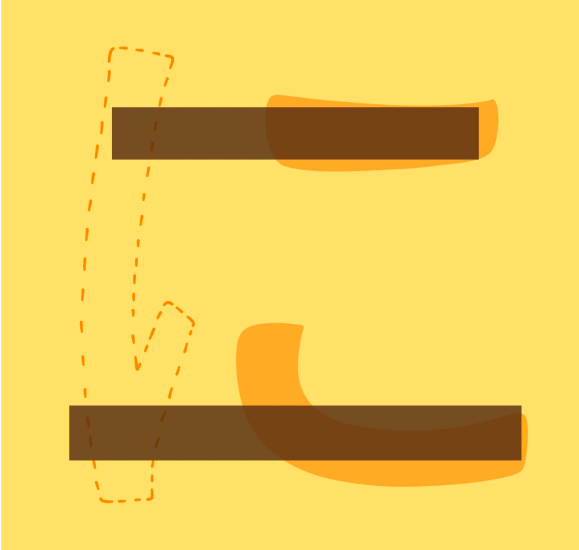
Image: The Hiragana に with strokes missing — two clean horizontal lines, nothing extra.
How to Remember: If you know Hiragana に, this is that character with everything stripped away. Two lines, done.
Sound: like the “ni” in neat — but shorter. The vowel cuts off cleanly. Think of tapping the sound, not holding it.
ヌ — NU
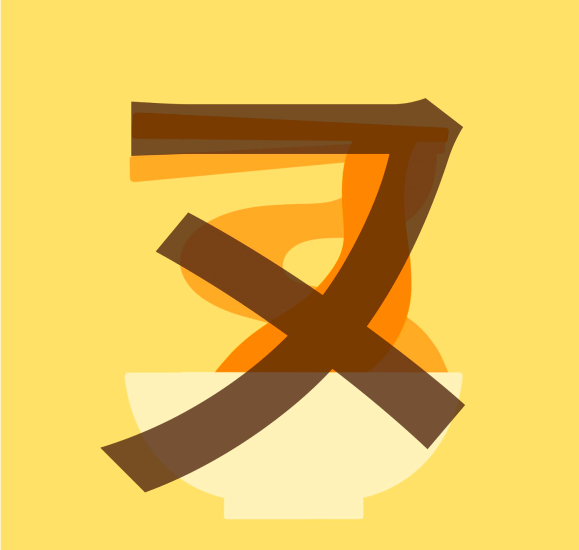
Image: A bowl of noodles — a curved stroke crossing over itself, steaming and full.
How to Remember: ヌ = noodles. NU = noo — say noodles and you’ve said the sound. Shape and word match perfectly.
Sound: like the “nu” in noon — but shorter. Lips barely round. Don’t overdo the “oo.”
ネ — NE
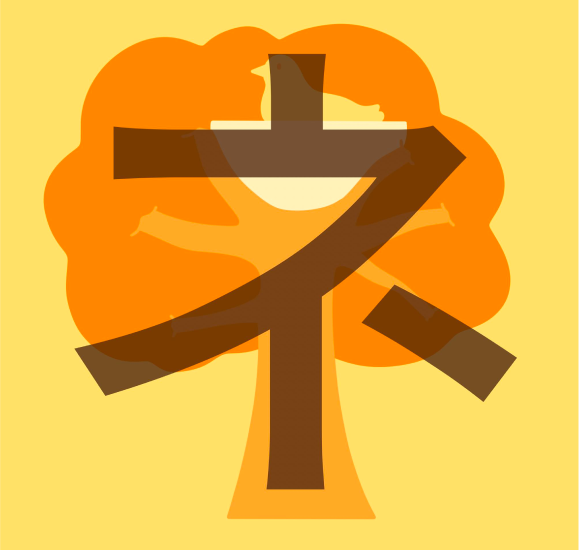
Image: A nest in a tree — a vertical trunk with branching strokes spreading outward from the middle.
How to Remember: ネ = nest. The vertical stroke is the tree, the branching strokes are the twigs holding the nest together.
Sound: like the “ne” in net — flat and short. Same “e” you’ve been practicing since エ. No glide.
ノ — NO
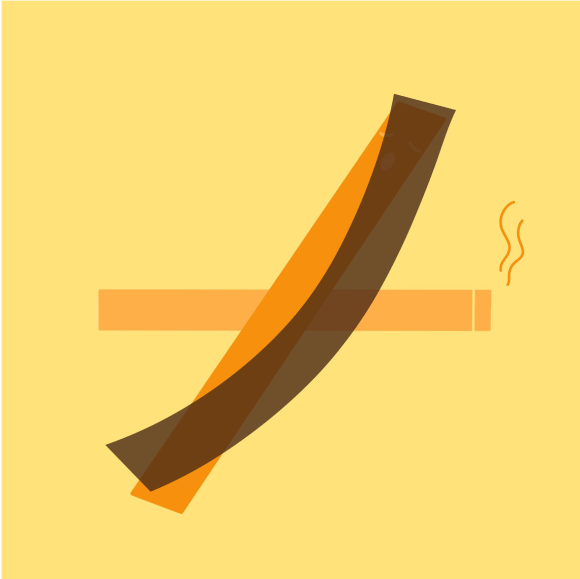
Image: A prohibition symbol — a single clean diagonal slash, like the line that means no on a road sign.
How to Remember: ノ = no. The shape is the word. One stroke, one meaning. The simplest character in the entire chart.
Sound: like “no,” with a short Japanese “o” sound. Round, clean, done.
The H Row
The H row introduces フ FU — the one character in this section that trips people up. Every other character is straightforward. Let’s address FU directly when we get there.
ハ — HA

Image: A hat — two strokes spread apart at the base like the wide brim of a hat, open and ready to wear.
How to Remember: ハ = hat. The two strokes are the two sides of the brim. HA = the first syllable of hat.
Sound: like the “ha” in harm — but shorter. A clean, light “h” followed by an open “a.” Not heavy, just natural.
ヒ — HI
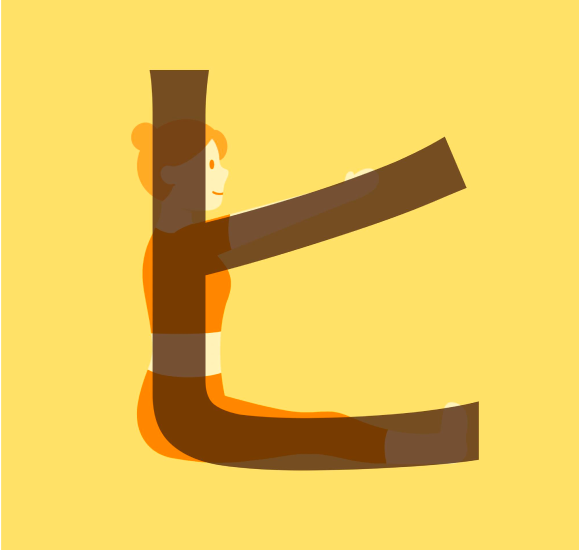
Image: A person sitting and reaching forward — one horizontal base stroke, one vertical stroke rising and curving forward like a torso mid-stretch.
How to Remember: Picture someone seated on the floor, leaning forward to touch their toes. The curve of ヒ is the lean of that body.
Sound: like the “hi” in heat — but shorter. The “h” is soft, almost whispered. The vowel is the same crisp “ee” as イ.
フ — FU

Image: A foot — a horizontal stroke at the top curving down into a toe pointing to the right.
How to Remember: フ = foot. FU = foo — say fool and stop halfway. The shape traces the top of a foot from ankle to toe.
Sound: like the “fu” in fool — but with a much softer “f.” Instead of pressing your top teeth to your lower lip, let the sound come from your lips barely parting, like a gentle breath. It sits between English “f” and “wh.”
ヘ — HE
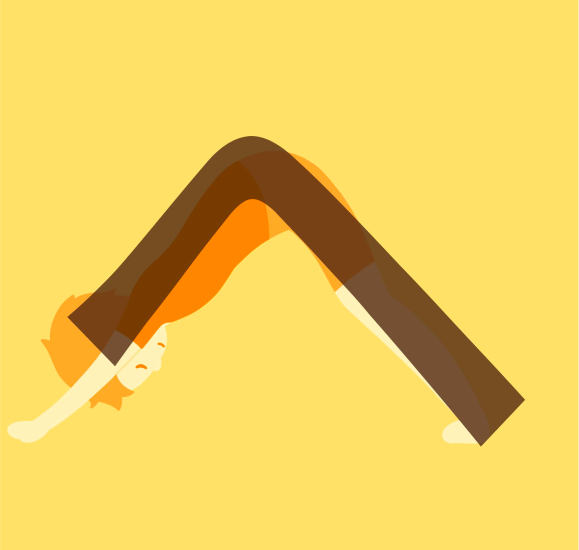
Image: A person practicing yoga — a single angled peak, like a body bent at the waist into a mountain pose. Also looks exactly like the Hiragana へ.
How to Remember: ヘ = Hiragana へ. If you know it, this is a free pass. If not — one stroke, one peak, one sound.
Sound: like the “he” in heaven — short and flat. Same “e” as in エ, ネ, and テ. Consistent all the way through.
ホ — HO
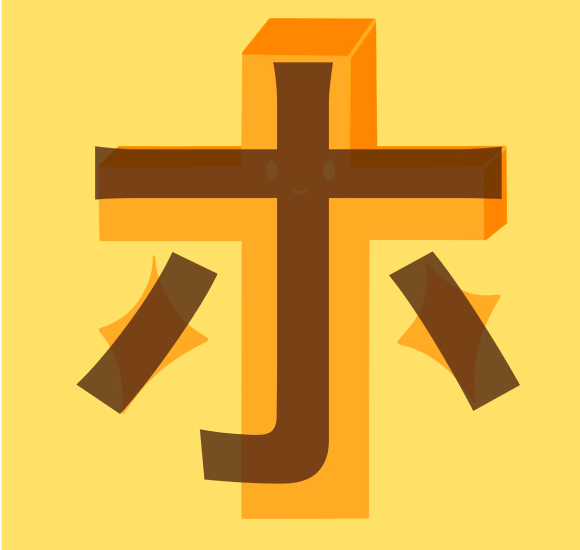
Image: A cross — a vertical stroke intersected by a horizontal, with one extra stroke dropping diagonally at the bottom right.
How to Remember: ホ = cross / plus sign with a tail. The shape is unmistakable once you see it — symmetric, solid, and centered.
Sound: like the “ho” in hold — round and open. The same pure “o” you’ve practiced across every row so far.
Exercises: N & H Rows
Thirty characters total now — you’re past the halfway point of the base chart, and the finish line is closer than it looks.
What to do next:
- 🧠 Ready to test all 10 new characters? The quiz will mix N and H row characters together so your brain has to work to tell them apart, try it!
- 📄 フ has an unusual storoke flow compared to everything else in this row — worth tracing by hand at least once before moving on. Download the PDF Worksheet
When you’re able to do these two tasks, move on to the next ten kana.
M & Y Rows (マミムメモヤユヨ)
You’ve cleared 30 characters. The M and Y rows bring you to 38 — and by the end of this section, the most common Katakana words you’ll encounter in daily life are almost entirely readable.
The M row is clean and consistent. The Y row only has three characters — ヤ, ユ, ヨ — because Japanese doesn’t use YI or YE sounds. Fewer characters, same focused approach.
One shift I want you to make starting here: begin reading the example words as whole units, not character by character. You’ve built enough foundation. Push yourself to recognize the full word at a glance.
- The M Row: マ MA ミ MI ム MU メ ME モ MO
- The Y Row: ヤ YA ユ YU ヨ YO
The M Row
マ — MA

Image: A mushroom — a flat cap on top, a short stem dropping down to the right.
How to Remember: マ = mushroom. The horizontal top stroke is the cap, the vertical below is the stem. MA = the first syllable of mark — or of mushroom in many languages.
Sound: like the “ma” in mark — but shorter. Soft nasal consonant, open vowel. Natural and easy.
ミ — MI
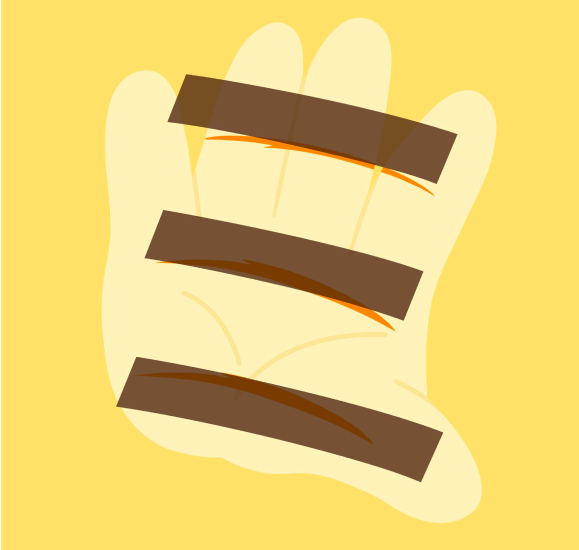
Image: A hand with three scratch marks from a cat — three short horizontal strokes, stacked and parallel.
How to Remember: ミ = three cat scratches. Count the lines: one, two, three. MI = mee — the sound a cat makes is close enough.
Sound: like the “mi” in meat — but shorter. Crisp “ee,” same as イ. Don’t let it drag.
ム — MU
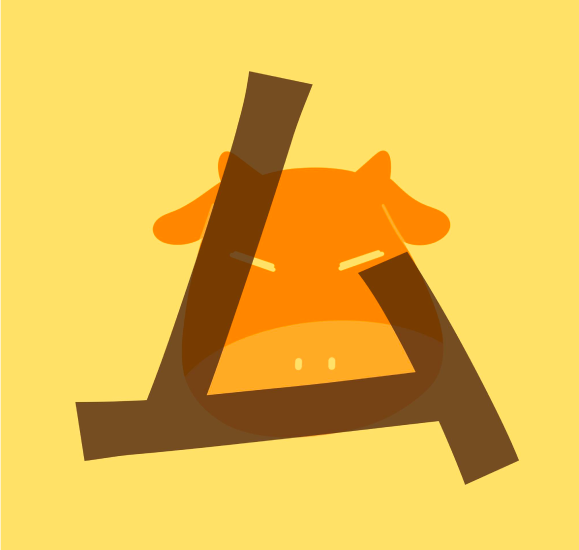
Image: A cow’s face — a curve with a small horn on top, looking straight at you.
How to Remember: ム = cow. A cow says moo — MU = moo. Shape and sound are the same animal.
Sound: like the “mu” in moon — but shorter. Lips barely round. The U is compressed, almost swallowed.
メ — ME

Image: An envelope — two crossing strokes forming an X with a tail, like a sealed letter with the flap crossed shut.
How to Remember: メ = envelope. An envelope is something you mail — ME = meh, same first consonant.
Sound: like the “me” in Mexico — flat and direct. Same short “e” you’ve heard across every row. No glide.
モ — MO
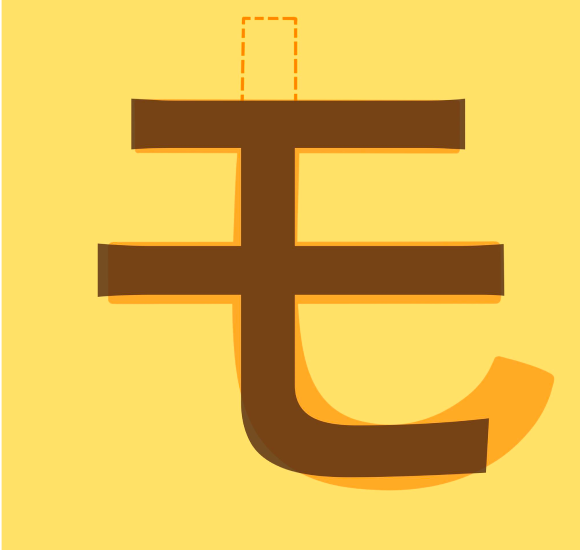
Image: The Hiragana も with strokes straightened out — two horizontal strokes crossed by a vertical, with a hook at the bottom right.
How to Remember: モ = simplified も. If you know Hiragana, this is already familiar. If not — two bars, one post, one hook.
Sound: like the “mo” in more — round, open, brief. The same pure “o” you’ve practiced since オ.
The Y Row
Only three characters here — YI and YE don’t exist in standard Japanese phonetics, so the row simply skips them. All three show up constantly in everyday Katakana words.
ヤ — YA
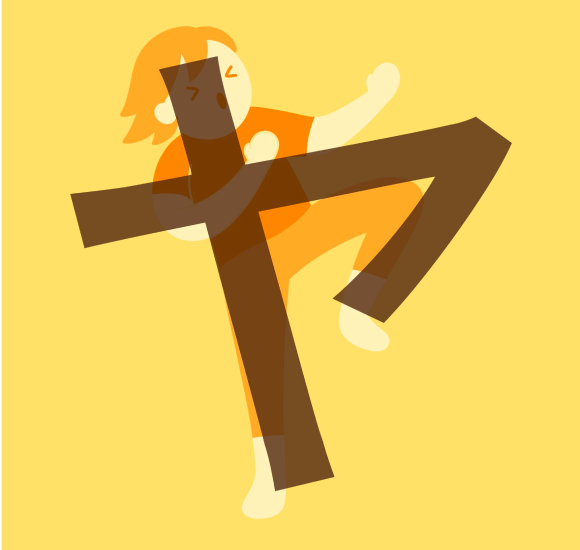
Image: A person performing a high kick — one leg planted, the other swinging up and outward in a wide arc.
How to Remember: ヤ = high kick. The diagonal strokes are the legs. YA = the sound you’d make throwing that kick — sharp and quick.
Sound: like the “ya” in yard — but shorter. A clean glide into an open “a.” Light and quick.
ユ — YU
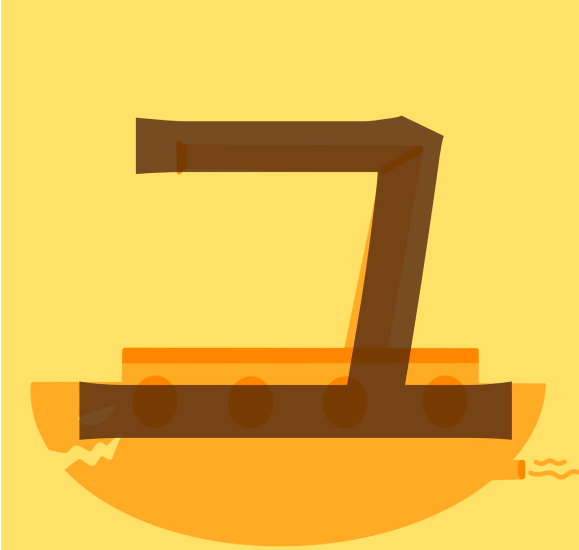
Image: A submarine — a long horizontal hull with a periscope rising from the left side.
How to Remember: ユ = submarine. The horizontal stroke is the hull underwater, the vertical stroke is the periscope breaking the surface.
Sound: like the “yu” in youth — the “y” glides naturally into “oo.” Keep the “oo” short and unrounded.
ヨ — YO
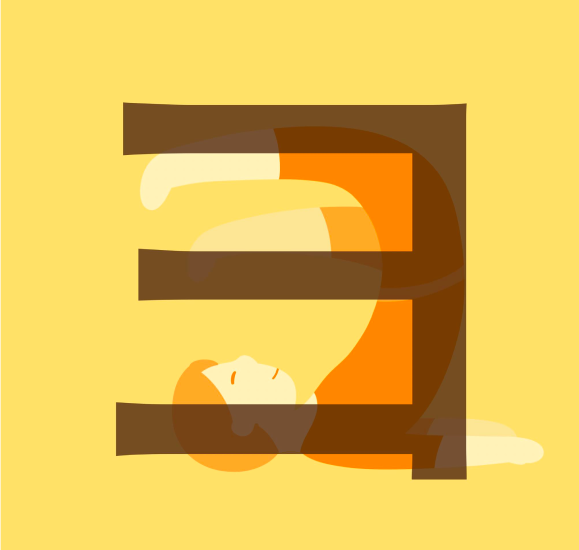
Image: Someone mimicking a movement — three horizontal strokes connected by a vertical on the right, like a figure mid-action, arms stacked.
How to Remember: ヨ = three stacked arms, like someone doing a pose. YO = yoh — short and punchy, like calling out to someone.
Sound: like the “yo” in New York — but shorter. Round “o,” no diphthong. Pure and brief.
Exercises: M & Y Rows
Eight characters, and you’re now 38 deep. From here, reading short loanwords in Katakana should be starting to feel less like decoding and more like recognizing.
What to do next:
- 🧠 This is a good checkpoint to test your cumulative recall — not just M and Y, but everything from Sections 4–7. Push yourself on speed with Katakana practice quiz
- 📄 ム and モ are worth a quick handwriting pass — both have strokes that are easy to blur together when writing fast. Download the PDF Worksheet
This should be fairly easy with only eight kana — and maybe a little quick too — but when you’re done, move on to the final set.
R, W & N Rows (ラリルレロワヲン )
This is the last section of the base chart. After this, you can read every standard Katakana character.
One thing to know about the Japanese “R” sound before you start: it’s not the English “r.” It’s produced by tapping the tip of the tongue briefly against the ridge just behind your upper teeth — almost like a very quick “d” or a flapped “l.” Think of the “tt” in American English butter. Practice it out loud as you go.
The W row is short: just ワ and ヲ. And ン closes the chart as the only Katakana character that stands alone as a single consonant — no vowel attached.
- The R Row: ラ RA リ RI ル RU レ RE ロ RO
- The W Row: ワ WA ヲ WO
- Solo: ン N
The R Row
ラ — RA
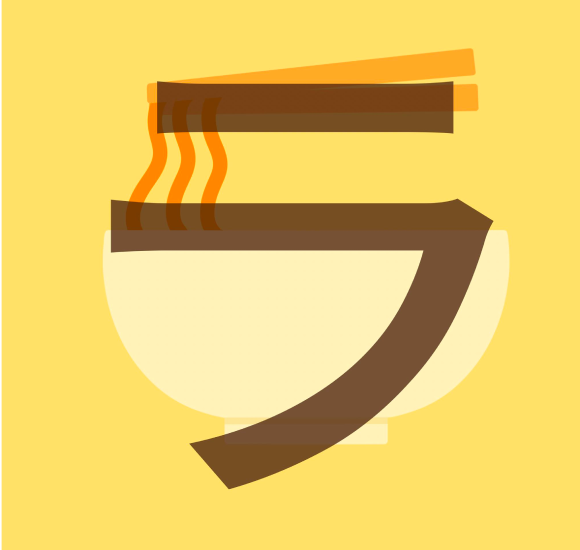
Image: A bowl of ramen noodles — a curved base holding a flat rim, steam rising above.
How to Remember: ラ = ramen. RA = the first syllable of ramen. Shape and word are the same dish.
Sound: like the “ra” in “ramen,” with a light Japanese R sound, landing on an open “a.”
リ — RI
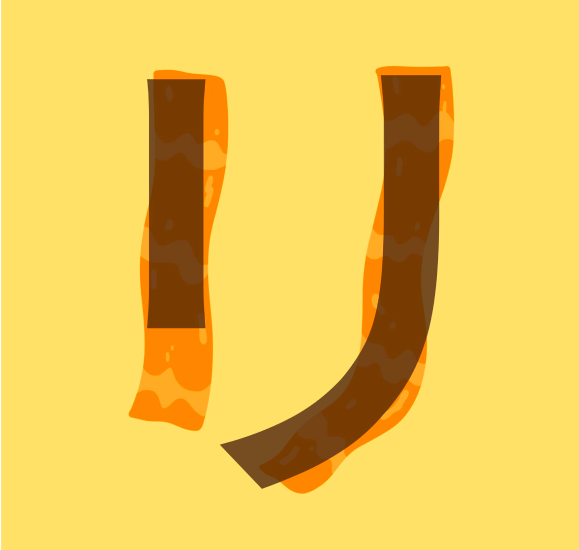
Image: Two parallel rivers running side by side — two clean vertical strokes, equal and unconnected.
How to Remember: リ = two rivers. RI = ree — rivers flow in two parallel lines, just like the character.
Sound: like the “ri” in ring — with a light Japanese R sound, into a short crisp “ee.” Quick and light.
ル — RU
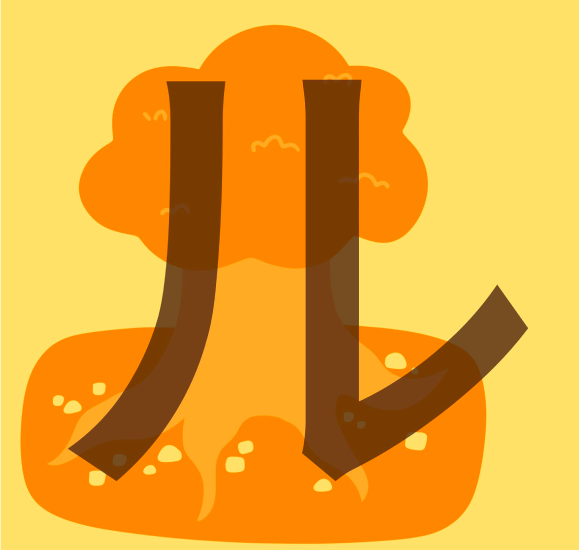
Image: Tree roots — one stroke branching down and spreading outward at the base, like roots gripping the ground.
How to Remember: ル = roots. The stroke branches at the bottom exactly the way roots split underground. RU = roo — short and grounded.
Sound: like the “ru” in ruby — with a light Japanese R sound, then a compressed “oo.” Don’t over-round the lips.
レ — RE
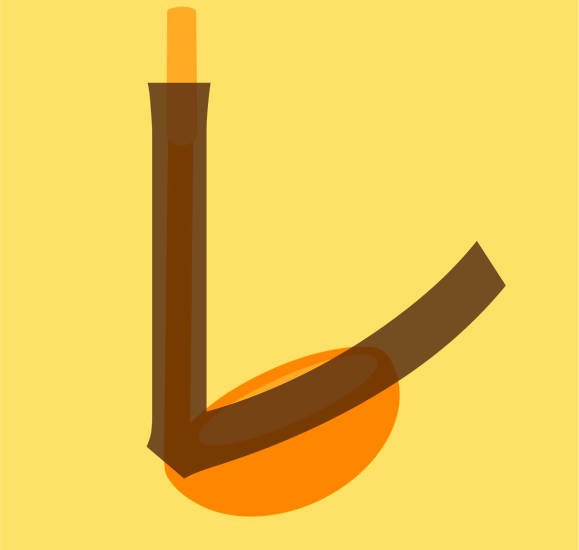
Image: A ladle — one stroke curving downward and sweeping right, like the handle and bowl of a ladle mid-pour.
How to Remember: レ = ladle. The shape traces the curve of the handle from top to tip. RE = reh, short and flat.
Sound: like the “re” in red — with a light Japanese R sound, flat short “e.” Same “e” as always. Clean and quick.
ロ — RO
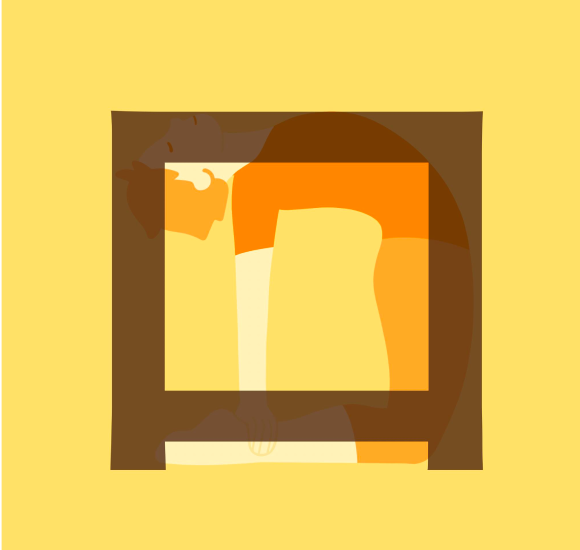
Image: A closed rectangular shape — four strokes forming a clean square loop, like a box or a window frame.
How to Remember: ロ = a square loop. Think of a revolving door seen from above — going RO-und and RO-und.
Sound: like the “ro” in roar — but shorter, with a light Japanese R sound, then a brief pure “o.”
The W Row & Solo N
ワ — WA
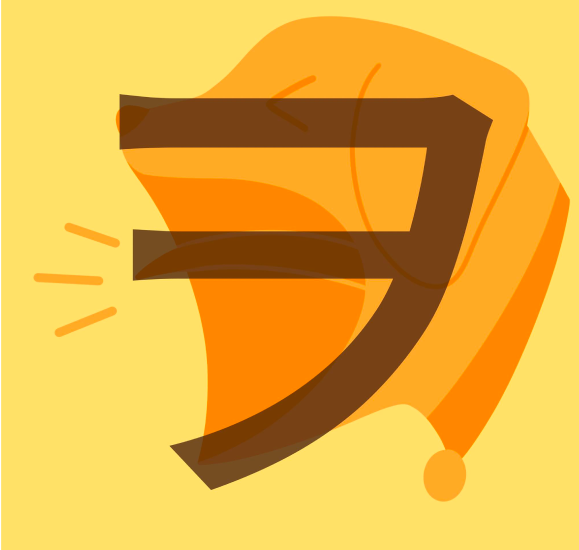
Image: A wine glass — a wide open bowl at the top, narrowing to a short stem at the base.
How to Remember: ワ = wine glass. WA = wah — the sound you make when someone hands you a glass of something good.
Sound: like the “wa” in water — a smooth glide into an open “a.” Natural and relaxed.
ヲ — WO
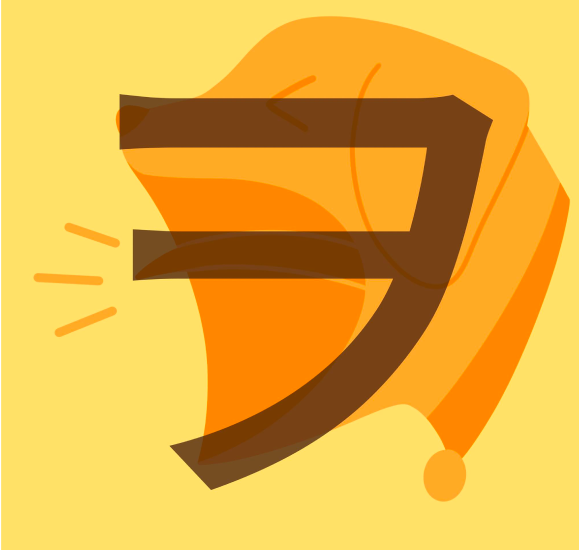
Image: A dog mid-bark — angular posture, mouth open, “Woof! Woof!”
How to Remember: ヲ = woof. The shape is a dog caught mid-bark. In modern Japanese, ヲ is almost always pronounced as a plain “o” — you’ll rarely need the “w” glide. It appears almost exclusively as a grammar particle.
Sound: like the “o” in or — but shorter. In Katakana text, seeing ヲ is uncommon — just recognize it when it appears.
ン — N
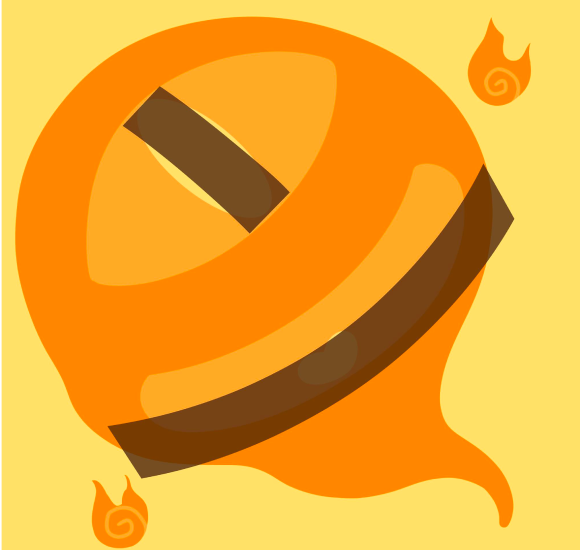
Image: A smiling one-eyed ghost — a curved stroke with a small flick at the top, like a head tilted mid-grin with one eye winking.
How to Remember: ン = ghost. The curve is the body, the flick is the eye. It’s the only character in Katakana with no vowel — it stands completely alone, like a ghost floating free.
Sound: like the “n” in sin — press the back of the tongue to the roof of the mouth, not the tip. It’s nasal, not a full consonant. In some positions it sounds closer to “m” or “ng” — the surrounding sounds shape it naturally.
Exercises: R, W & N Rows
That’s all 46 base characters. You just finished the core Katakana chart.
What to do next:
- 🧠 Full base chart recognition test — 46 characters, randomized. This is the clearest measure of where you actually stand. Let’s start the practice quiz!
- 📄 ロ and ワ are worth a handwriting pass — ロ’s closed rectangle and ワ’s open bowl are easy to blur without writing them a few times. Download this PDF Worksheet
When you are done with these exercises, it’s time to move on to the advanced rules — Sections 9 through 11 build directly on everything you now know.
Dakuten (Voiced Sounds)
Here’s where Katakana gets a useful upgrade. You’ve learned the 46 base characters. Now, by adding a single small mark — ゛called dakuten — you can unlock an entirely new set of sounds without memorizing a single new character shape. It’s one of the most efficient systems in Japanese writing.
The rule is simple: dakuten (゛) voices an unvoiced consonant. K becomes G. S becomes Z. T becomes D. H becomes B. One mark, new sound, every time.
There’s also a second mark — ゜called handakuten — which only applies to the H row and turns H into P.
The Voicing Rules
| Dakuten ゛ | Handakuten ゜ | |||
| K → G | S → Z | T → D | H → B | H → P |
| カ → ガ GA | サ → ザ ZA | タ → ダ DA | ハ → バ BA | ハ → パ PA |
| キ → ギ GI | シ → ジ JI | チ → ヂ JI(Type DI) | ヒ → ビ BI | ヒ → ピ PI |
| ク → グ GU | ス → ズ ZU | ツ → ヅ ZU(Type DU) | フ → ブ BU | フ → プ PU |
| ケ → ゲ GE | セ → ゼ ZE | テ → デ DE | ヘ → ベ BE | ヘ → ペ PE |
| コ → ゴ GO | ソ → ゾ ZO | ト → ド DO | ホ → ボ BO | ホ → ポ PO |
The Special Case: ヴ
📌 [sound] ウ → [sound] ヴ (VU/BU)
ヴ is ウ + dakuten — and it represents the “V” sound, which doesn’t naturally exist in Japanese. It’s used in loanwords that require a V: ヴァイオリン (vaiorin) = violin. In casual writing, many Japanese speakers substitute バ/ビ/ブ/ベ/ボ instead. But you’ll see ヴ in formal or stylized contexts, so it’s worth recognizing.
Combination Katakana
You know all 46 base characters. You know the voiced versions.
Now let’s combine a base character with a small ャ, ュ, or ョ to create blended sounds. Katakana goes further than Hiragana though — it also uses small vowels (ァィゥェォ) to capture foreign sounds that the base chart can’t represent on its own. That’s what makes Katakana so useful for loanwords.
The rule is always the same: small character = read both together as one single beat.
Standard Combinations (ャュョ)
キャ、キュ、キョ = KYA, KYU, KYO
ギャ、ギュ、ギョ = GYA, GYU, GYO
シャ、シュ、ショ = SHA, SHU, SHO
ジャ、ジュ、ジョ = JA, JU, JO
チャ、チュ、チョ = CHA, CHU, CHO
ニャ、ニュ、ニョ = NYA, NYU, NYO
ヒャ、ヒュ、ヒョ = HYA, HYU, HYO
ビャ、ビュ、ビョ = BYA, BYU, BYO
ピャ、ピュ、ピョ = PYA, PYU, PYO
ミャ、ミュ、ミョ = MYA, MYU, MYO
リャ、リュ、リョ = RYA, RYU, RYO
Foreign Sound Combinations (ァィゥェォ)
F-sounds (フ + small vowels)
Japanese doesn’t have native F-sounds beyond フ (FU). Combine フ with small vowels to cover the rest:
ファ = FA like “fax”
フィ = FI like “fish”
フェ = FE like “fence”
フォ = FO like “fox”
Example: フォーク (fooku) = fork
V-sounds (ヴ + small vowels)
V doesn’t exist in Japanese. ヴ (U + dakuten) is the closest approximation — in natural speech it often sounds closer to B:
ヴァ = VA ヴィ = VI ヴェ = VE ヴォ = VO
Example: ヴァイオリン (vaiorin) = violin
W-sounds (ウ + small vowels)
The standard chart only covers ワ (WA) and ヲ (WO). To fill in the missing W-sounds, combine ウ with small vowels:
ウィ = WI like “window”
ウェ = WE like “Wednesday”
ウォ = WO like “worry”
Example: ウィンドウ (windou) = window
T & D sounds (ティ ディ)
Standard Japanese has no TI or DI sound. These combinations fill that gap — and you’ll see them constantly in loanwords:
ティ = TI like “Tim”
ディ = DI like “Disc”
Examples: パーティー (paatii) = party / ディスク (disuku) = disc
The key thing to remember right now isn’t memorizing every possible combination. Instead, focus on recognizing that these patterns exist and being able to read them when they appear. Many of these sounds show up frequently in loanwords, so the more Japanese you read, the more natural they will start to feel.
The tricky part is that these sounds often come from foreign languages you may already know, but Japanese adapts them to fit its own sound system. In other words, you sometimes have to pronounce a familiar word a little “wrong” according to your native language in order to say it correctly in Japanese. With time and exposure, this adjustment becomes completely natural.
Ready to practice combination sounds? Let’s practice all Katakana letters here.
Long Vowels (ー)
This one is simple — and it makes an enormous difference in reading real Katakana.
The dash ー is called the chōonpu (長音符), or long vowel mark. It means: hold the previous vowel sound for one extra beat. That’s it.
In everyday Katakana, you’ll see it constantly — especially on menus, product labels, and brand names. Here’s what it looks like in practice:
| Word | Reading | Meaning |
| コーヒー | koohii | coffee |
| チーズ | chiizu | cheese |
| ベーコン | beekon | bacon |
| ハンバーガー | hanbaagaa | hamburger |
| コンピューター | konpyuutaa | computer |
| スーパーマーケット | suupaamaaketto | supermarket |
Notice how natural these sound when you read them aloud. The long vowel mark is one of the reasons Katakana loanwords feel so recognizable once you learn the system — the sounds stretch out in exactly the way English speakers intuitively expect.
Tips to Avoid Common Faults
Most Katakana mistakes come from a small set of recurring problems. Here’s what to watch for — and how to fix each one before it becomes a habit.
Use Loanwords as Anchors
⚠️ The fastest way to make Katakana stick is to connect every new character to a word you already know.
コーヒー is coffee. テレビ is television. スマートフォン is smartphone. These aren’t abstract symbols — they’re sounds you’ve been producing your entire life, just written in a different script. Every time you recognize a loanword in Katakana, you’re not just reading a character. You’re building a real vocabulary anchor that keeps that character in your long-term memory.
The habit to build: when you encounter a new Katakana word, say it out loud and ask — do I recognize this? More often than you’d expect, the answer is yes.
Avoid These Confusable Pairs
⚠️ These are the four pairs that trip up almost every learner, usually around the time they start reading at speed. Study them together, not in isolation.
シ (SHI) vs ソ (SO)
- シ — two short strokes are horizontal, long stroke sweeps upward to the right
- ソ — two short strokes are vertical, long stroke sweeps downward to the right
- Quick rule: シ lies flat. ソ stands up.
ツ (TSU) vs ン (N)
- ツ — three short strokes are horizontal, long stroke sweeps upward
- ン — three short strokes are vertical, long stroke curves back inward
- Quick rule: same logic as シ/ソ — horizontal = TSU/SHI, vertical = N/SO.
ウ (U) vs ワ (WA)
- ウ — has a short closing stroke on top, like a lid over the bowl
- ワ — open at the top, wider, no lid
- Quick rule: ウ is closed. ワ is open.
ロ (RO) vs 口 (mouth — kanji)
- These appear identical at first glance. In Katakana context, 口 won’t appear — but as you start reading mixed Japanese text, the distinction matters.
- Quick rule: context tells you everything. In Katakana words, it’s always ロ.
Whenever any of these pairs feel blurry, come back here and run through the rules once before quizzing again. One focused pass is usually all it takes.
Additional Practice
You’ve covered all 46 base characters, voiced sounds, combinations, and long vowels. What you need now is volume — more reading, more recognition, more speed.
Here’s what to use:
For writing practice: The advanced worksheet covers the full chart — base characters, dakuten, handakuten, and common combinations. Print it out. Work through it with a pen. Writing each character by hand, even once, creates a different kind of memory than reading alone.
For reading speed: The full quiz pulls from everything — base characters, voiced variations, and combination sounds, randomized. The goal at this stage isn’t just accuracy. It’s accuracy under pressure. Push for recognition in under 3 seconds per character.
For extra practice, try the interactive Katakana exercise and reinforce the characters you just learned:
Most learners who complete this guide reach comfortable reading speed within a week of consistent daily practice — even 10 minutes a day makes a measurable difference. The chart is finite. The exposure is cumulative. Keep going.
Frequently Asked Questions
How long does it take to learn Katakana?
Most learners can recognize all 46 base characters within 1 week of consistent daily practice — around 15–20 minutes a day. Reading speed and fluency take a little longer, typically another 1–2 weeks of regular exposure to real Katakana words. The timeline varies depending on how much time you put in, but Katakana is genuinely one of the fastest wins in Japanese learning. It’s a finite set of characters with a consistent system — there’s no vocabulary to memorize, no grammar to untangle. You just learn the shapes and the sounds, then practice until they’re automatic.
Should I learn Hiragana or Katakana first?
Hiragana first — and here’s why. Hiragana covers native Japanese words and almost all of the grammar you’ll encounter early on. It also gives you a feel for how the Japanese sound system works, which makes Katakana significantly easier to absorb afterward. That said, both scripts represent the same 46 sounds, so if you already have a feel for Japanese pronunciation, jumping straight into Katakana is perfectly fine. Many learners study both in parallel and do well. What matters more than the order is consistency — pick a direction and stick with it.
Haven’t learned Hiragana yet? Start with our Hiragana guide and come back here when you’re ready.
What’s the difference between Katakana and Kanji?
Additionally, Katakana and Kanji are two completely different systems. Katakana is a phonetic script — each character represents a sound, not a meaning. There are only 46 base characters, and once you learn them, you can read any Katakana word out loud, even if you don’t know what it means. Kanji, on the other hand, are meaning-based characters borrowed from Chinese. Japanese uses around 2,000 Kanji in everyday writing, and each one carries its own meaning and multiple readings. Katakana is where most beginners start because it’s finite, learnable quickly, and immediately useful for reading loanwords. Kanji is a longer-term project — but a rewarding one.
Ready to start Kanji? Check out our beginner’s guide to Kanji to see what the learning path looks like.
What’s Next
For most learners, Katakana takes a little longer to learn comfortably with than Hiragana — and that’s completely normal. Katakana simply shows up less often in everyday Japanese, which means fewer natural opportunities to practice it. But that’s exactly why it’s worth putting in the extra effort now. A focused 3–4 hours of deliberate study today will save you 20+ hours of friction down the road — no more stopping mid-sentence because a Katakana word threw you off. Front-load the work while it’s fresh. In the future, you will be grateful.
So — besides continuing to learn Katakana — where should you go from here?
Hiragana
If you haven’t learned Hiragana yet, that’s your immediate next step on MochiKana. Hiragana is the other half of the kana system, and together with Katakana it unlocks the phonetic layer of Japanese completely. Most grammar textbooks and beginner resources assume you know both scripts before anything else.
Kanji
If you’ve done both Hiragana and Katakana, it’s time to start on MochiKanji. Kanji are the meaning-based characters borrowed from Chinese that make up the majority of written Japanese. There are around 2,000 in common use, but the learning system is far more structured than most people expect. The same mnemonic approach you used here applies directly.
Speaking
And if you complete Hiragana, Katakana, Kanji and want to try speaking out, the MochiKaiwa app is built to take you from where you are right now to genuine speaking fluency, step by step.
© Kanji123 — Free JLPT Kanji Test Online