
Kanji has a reputation problem. People talk about it like it is a giant wall waiting to ruin your motivation, eat your weekends, and laugh at your flashcards.
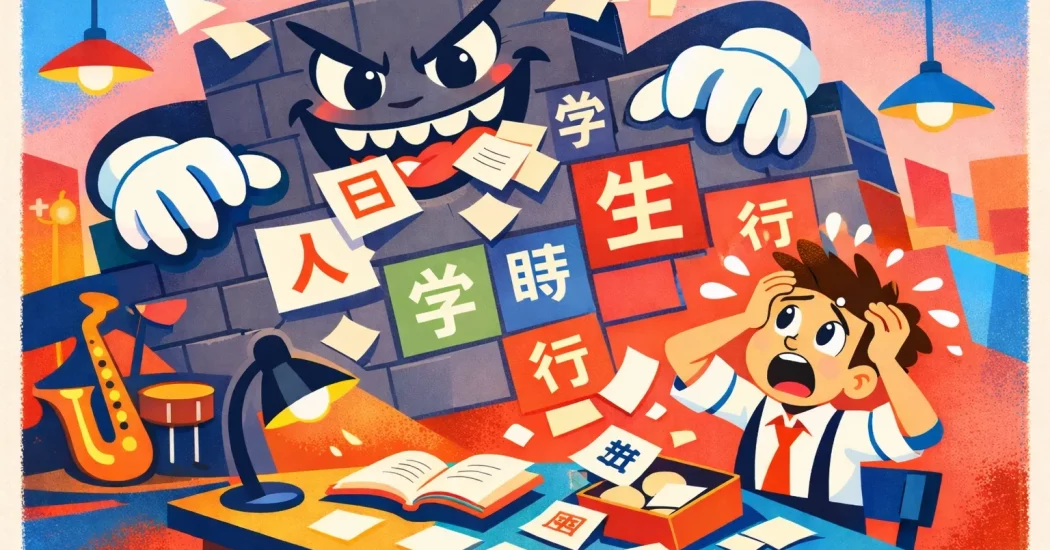
Honestly? That fear makes sense. If you grew up with an alphabet, kanji can look like chaos at first. But most beginners are not losing to kanji itself — they are losing to random study. Once you swap panic for a system, things get a lot less dramatic.
So this guide is not about memorizing a thousand characters by sheer force. It is about learning kanji in a way that feels sane, useful, and actually sustainable. And if you still feel wobbly on the basics, take ten minutes with the Mochi Japanese beginner guide first. A stronger foundation makes the kanji part feel much less cursed.
The real problem is not kanji. It is chaos.
Most beginners do one of three things: they memorize isolated shapes, they try to learn every reading at once, or they bounce between five methods in one week. None of that is smart. It just makes your review pile bigger and your confidence smaller.
A better plan is simple: learn common kanji first, spot the pieces inside them, attach each character to a real word, and review before your brain politely throws it in the trash.
That is the whole vibe of this article. Less heroic suffering. More repeatable progress.

Start with the kanji that actually show up.
You do not need rare newspaper kanji on day one. You need high-frequency characters that show up in beginner materials, early JLPT study, and real everyday words. Think 日, 人, 学, 生, 時, 行 — not obscure flexes you will not meet again for six months.
This is why JLPT-style progression is so useful. It gives your study a lane. If you want a reality check, run through one Kanji123 N5 test and see which characters already feel friendly. When that starts feeling too easy, jump to an N4 test and let the gap show you what to study next.
And yes, if reading still feels slow because kana is not automatic yet, it is absolutely worth spending a week with MochiKana’s hiragana page and katakana page before you ask your brain to juggle three writing systems at once.
Radicals are your cheat codes.
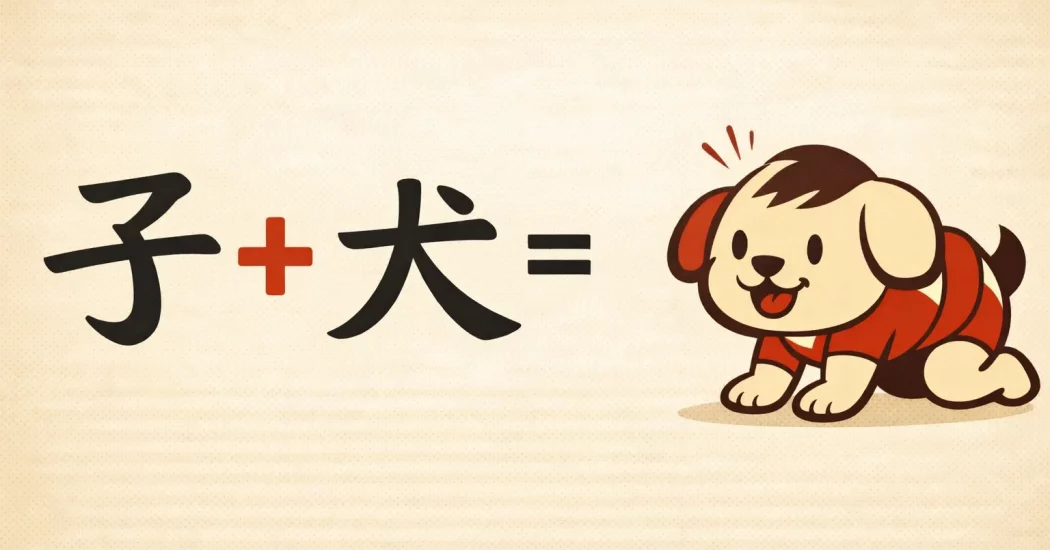
The fastest mindset shift in kanji study is this: stop seeing each character as one giant mystery blob. Kanji is made of smaller chunks, and those chunks show up again and again.
That is where radicals come in. Once you learn to notice them, characters stop looking random. 町 is not just 町 anymore. It becomes familiar pieces you can recognize, remember, and compare. Suddenly your brain has handles to grab onto.
You do not need to learn every radical in existence this week. Just learn the common ones that keep reappearing. A small radical vocabulary goes a long way.
Meaning alone will not save you. Readings and real words will.
A lot of beginners memorize a keyword for a kanji and call it a day. That is better than nothing, but it is not enough if your actual goal is reading Japanese.
The sweet spot is smaller and smarter: one core meaning, one useful reading, one real vocabulary word. That is it. Learn 学 as “study,” then attach it to 学生 and 学校. Now the character is doing actual work inside Japanese instead of floating around your notes like decorative wallpaper.
This is also why learning kanji through vocabulary works so well. You are not just collecting symbols. You are building reading ability. If you want a companion tool for that side of the process, MochiKanji leans hard into learning kanji through words and spaced review, which makes it a nice complement to quick recall checks on Kanji123.

Do not try to collect every reading like Pokémon.
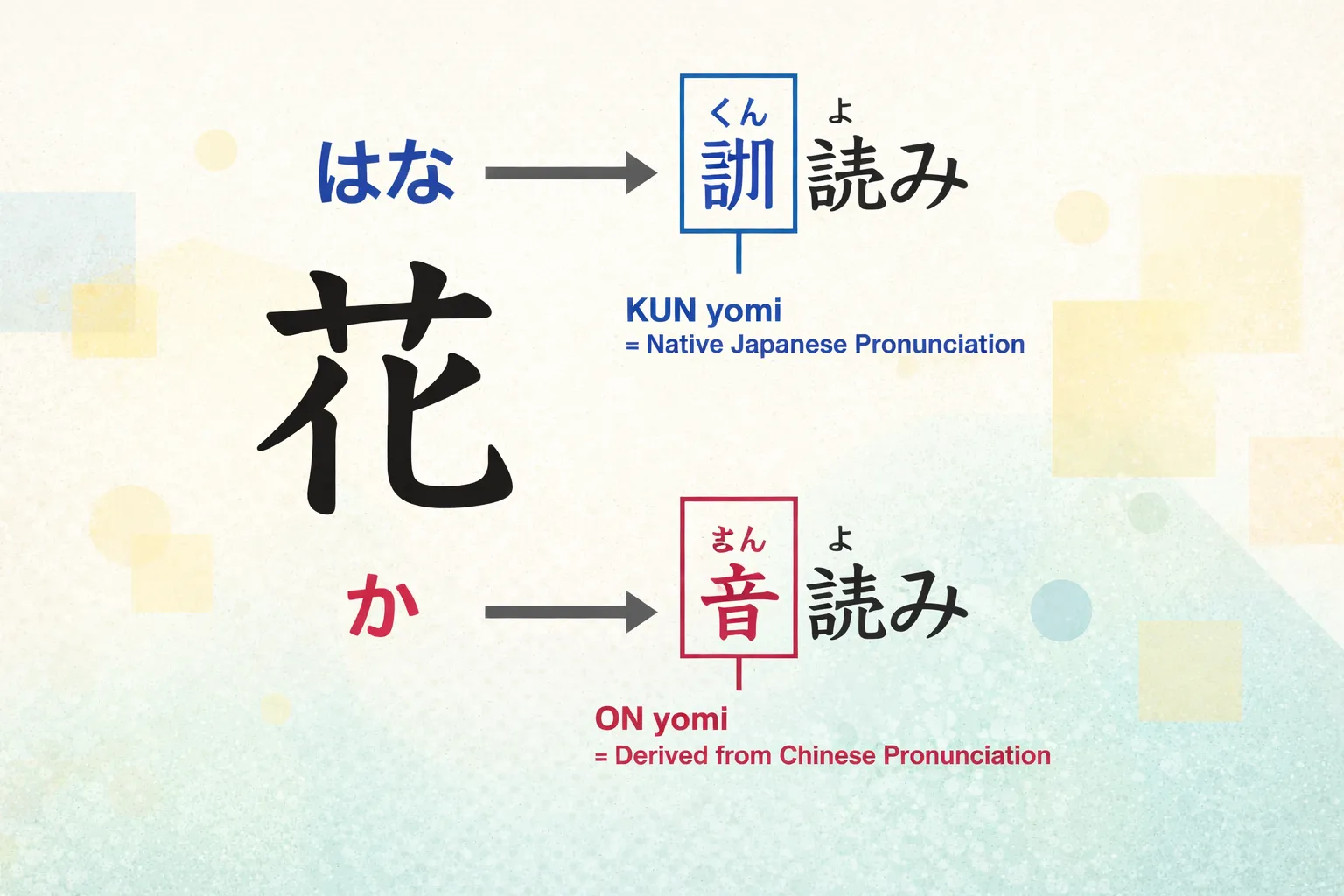
Yes, on’yomi and kun’yomi exist. Yes, some kanji have multiple readings. No, you do not need to memorize all of them the first time you meet a character.
For example, focus on ‘Sei’ (as in 学生 – Gakusei) and ‘生きる’ (to live) first.
That is one of the easiest ways to fry your own brain. Start with the reading used in the most common word you are actually learning. Add more later when they show up in context. Kanji is not a boss battle you clear in one sitting. It is a long game of repeated contact.
If that takes some pressure off, good. It should.
Review before your brain ghosts you.
This is where spaced repetition stops sounding nerdy and starts sounding useful. The idea is simple: review a kanji right before you are about to forget it, not three months after it vanished.
That timing matters. Cramming can make you feel productive for one night, but smart review is what makes a character stay. Even a short five-minute check-in beats an epic, once-a-week meltdown session.
This is also why mixing article reading with low-friction practice works so well. Read the idea here, then test yourself on Kanji123’s free kanji quizzes. That jump from recognition to recall is where the memory really sticks.
Context is not optional. It is the whole point.
Kanji gets dramatically easier once it lives inside something real: vocabulary, short sentences, level-appropriate reading, or tiny quiz prompts. Context tells your brain why the character matters.
It also keeps lookalikes from blurring together. When you see a kanji in the same word a dozen times, it stops being abstract. It becomes familiar. That is a completely different feeling from staring at a lonely flashcard with no life around it.
And if you are building a broader Japanese routine, pair your kanji work with the Mochi Japanese learning roadmap or the longer Mochidemy step-by-step guide so your reading practice grows alongside kana, vocabulary, and basic grammar.
A beginner routine that does not melt your brain.
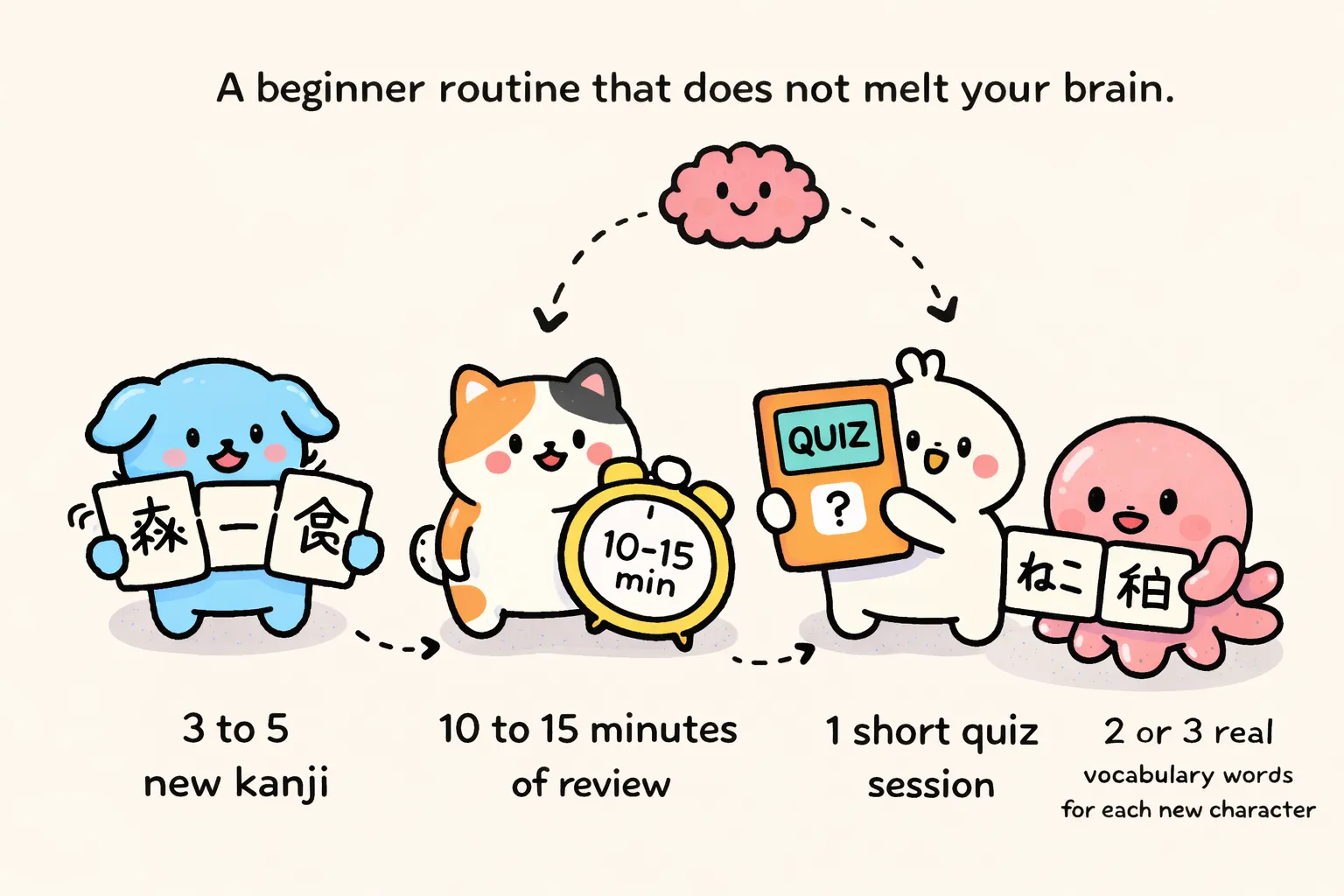
You do not need a cinematic study routine. You need one that still works on a Tuesday.
Try this:
· 3 to 5 new kanji
· 10 to 15 minutes of review
· 1 short quiz session
· 2 or 3 real vocabulary words for each new character
Then once a week, do a reset day: review weak kanji, compare similar characters, and test yourself without peeking. If you want an easy benchmark, rotate between N5, N4, and eventually N3 quizzes as your comfort level grows.
That kind of routine is boring in the best possible way. It is stable, repeatable, and very hard to quit.
Mistakes to stop making today
Here are the classics:
· Learning too many new kanji at once.
· Skipping review because it feels less exciting than new content.
· Memorizing meanings but ignoring vocabulary.
· Treating every kanji like it needs every reading immediately.
· Switching methods so often that nothing has time to work.
If any of those sound familiar, great. That means you can fix them. Most kanji pain is not permanent. It is procedural.
So what is the smart way to learn kanji?
Radicals -> Meaning -> Word (which includes Reading)
Start small. Learn common kanji first. Use radicals as anchors. Pair each character with one useful reading and one real word. Review before you forget. Read a little. Test a little. Repeat.
That is the whole engine.
If you want to keep going right now, start with a free Kanji123 test, then keep your wider Japanese routine moving with MochiKana’s hiragana lessons, katakana lessons, or the broader learn Japanese guide from Mochidemy. And if you want a companion article on the same topic from another angle, the existing Kanji123 post about how to learn kanji is a useful supporting read.
Kanji still work. But it does not have to be messy work.
FAQ
What is the best way to learn kanji?
Start with common kanji, break them down into radicals, connect them to real vocabulary, and review them with spaced repetition instead of random cramming.
How many kanji should a beginner learn per day?
For most beginners, 3 to 5 new kanji per day is enough. The real question is whether you can still review them next week.
Should I learn meanings or readings first?
Learn the core meaning first, then attach one common reading through a real vocabulary word. You can add other readings later.
Do I need to write kanji by hand?
Writing can help, especially with lookalike characters, but reading, recognition, and consistent review matter more for many beginners.
What should I study before kanji?
If kana still feels shaky, spend time on hiragana and katakana first. That makes every kanji session easier to process.




Pingback: Is Learning Japanese Hard? Here's What Nobody Tells You! - Kanji123
Pingback: How Many Letters in the Japanese Alphabet?
Pingback: How to Find the Kanji Radical: A Literal Life-Saver
Pingback: Learn Japanese: A Roadmap That Actually Works - Kanji123
Pingback: How Long Does It Take to Learn Japanese? - Kanji123
Pingback: Kanji Radicals and Mnemonics: The Only Strategy That Sticks.
Pingback: Why Does Japanese Have 3 Alphabets?
Pingback: Hiragana Chart: Free Printable PDF for Every Learning Style
Pingback: The Japanese Writing System: Hiragana, Katakana, and Kanji
Pingback: How to Install Japanese Keyboard
Pingback: Japanese Honorifics and How to Use ALL of Them
Pingback: Japanese Onomatopoeia: The Complete Guide
Pingback: Kanji Radicals: What They Are and How to Find Them
Pingback: How to Type in Japanese: Kana, Kanji and More - Kanji123
Pingback: What is the Japanese Language Proficiency Test (JLPT)?
Pingback: The "Zero Panic" Beginner Kanji List: 50 Must-Know Characters