How to learn katakana is one of the first real challenges you face in Japanese. The good news is that it does not have to take weeks. In fact, most learners can master all 46 characters in just a few days — as long as they use the right approach.
Before you start: This guide builds directly on our hiragana guide. It uses the same learning approach, practice style, and exercise format — so if you haven’t gone through that one yet, start there first. Pronunciation basics are also covered there and won’t be repeated here, except where a katakana character sounds different from its hiragana equivalent. If you haven’t studied hiragana yet: Read our hiragana guide first. If you have, then you already know the drill — let’s get into katakana.
Many beginners make the mistake of ignoring katakana at first. Because hiragana appears more often in beginner textbooks, students put katakana off until later. However, skipping it early means you will miss a huge amount of real Japanese content. Therefore, the sooner you tackle katakana, the faster your overall reading improves.
In this guide, you will find everything you need: a clear explanation of what katakana is, how long it takes to learn, and proven step-by-step methods that actually stick. In addition, we cover the tools and apps that make the process faster and more enjoyable.
What is Katakana and why do you need it?
Katakana is one of three Japanese writing systems, alongside hiragana and kanji. While hiragana handles native Japanese words and grammar, katakana serves a different purpose. It represents foreign loanwords, onomatopoeia, scientific terms, and words used for emphasis.
For example, common everyday words like コーヒー (coffee), テレビ (television), and アメリカ (America) all use katakana. Moreover, you will see it on menus, signs, product packaging, and in manga and anime constantly.
Because katakana is everywhere in real Japanese life, you cannot skip it. Fortunately, there are only 46 basic katakana characters. That number is very manageable, especially since they share the exact same sounds as hiragana. The shapes differ, but the pronunciation is identical.
Is it hard to learn katakana?
Honestly, no. Most learners find katakana slightly easier than hiragana, because by the time they start, they already understand how Japanese sounds work. Your brain already knows the five vowel sounds and how consonants combine with them.
The real challenge is not difficulty — it is motivation. Katakana appears less often in beginner study materials, so students sometimes feel less urgent about it. However, this is a mistake. Learning katakana early unlocks menus, brand names, and borrowed vocabulary that makes Japanese feel real and alive.
The answer to ‘can I self-teach katakana?’ is absolutely yes. You do not need a classroom or an expensive course. Therefore, with the right method and about one to two hours a day, you can achieve solid recognition within a week.
How to learn Katakana quickly: A step-by-step method
Because katakana has a clear structure, you can learn it systematically. The following steps work together to build recognition fast. However, the key is consistency — short daily sessions beat occasional marathon cramming every time.
Step 1: Start with the katakana chart
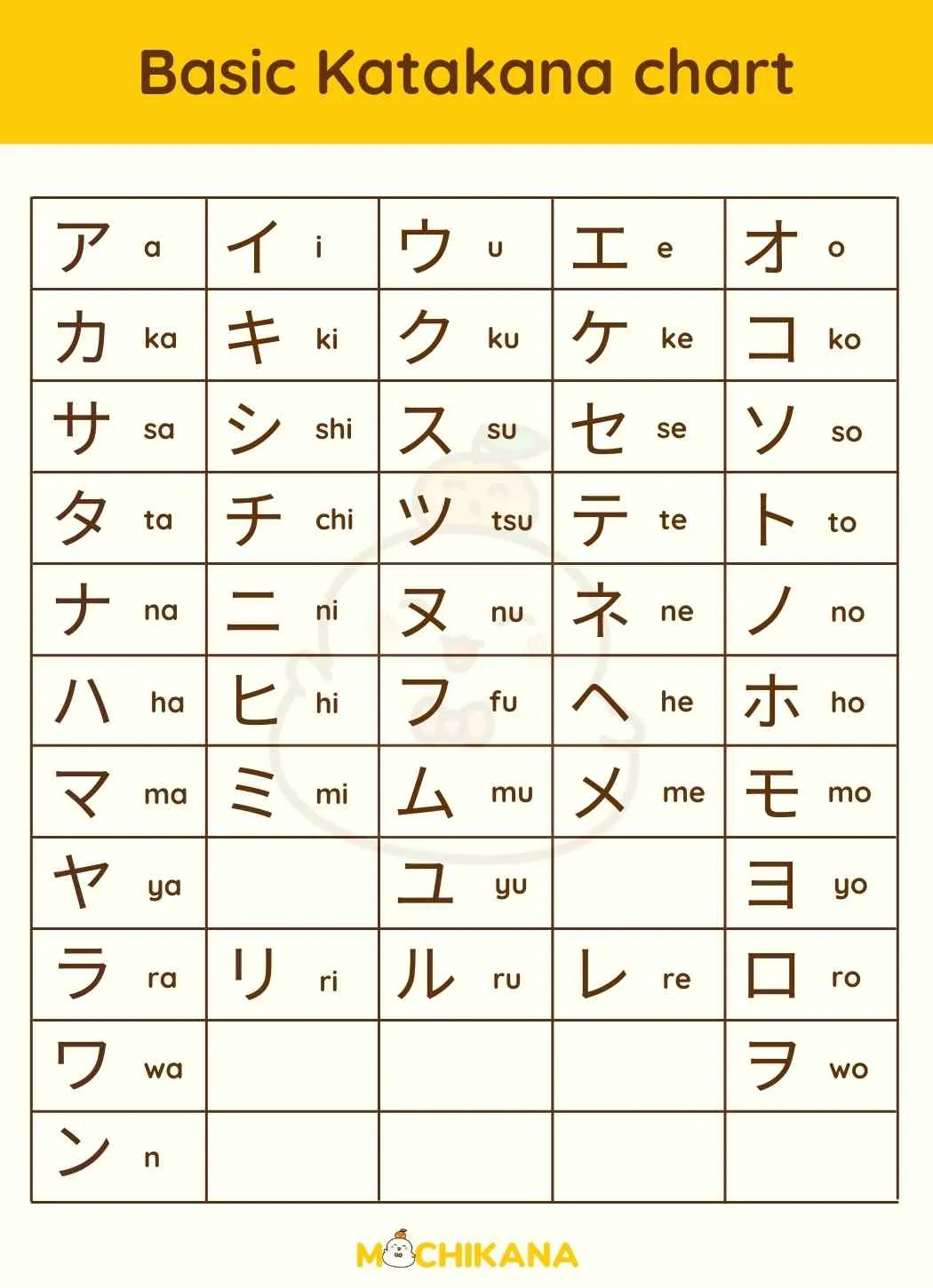
First, get a clear katakana chart that organizes all 46 characters by vowel columns and consonant rows. The five vowels — ア (a), イ (i), ウ (u), エ (e), オ (o) — form the foundation. Then, each consonant row builds on those sounds.
Do not try to memorize everything at once. Instead, work column by column. Start with the vowel row, then move to the K-column, then the S-column, and so on. Paying attention to stroke order from the start also helps you write more confidently later.
Step 2: Use mnemonics for tricky characters
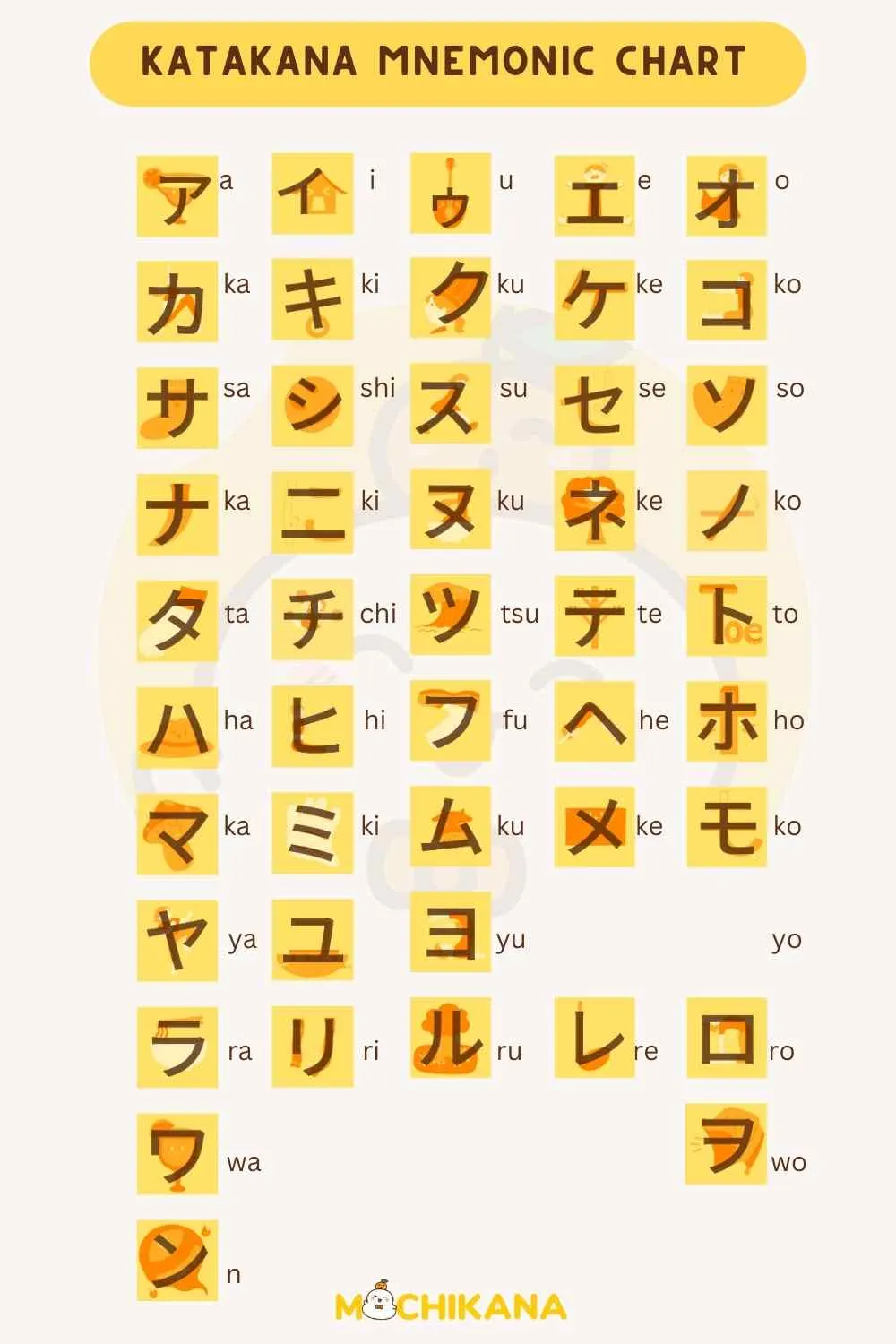
Mnemonics speed up memorization dramatically, especially for characters that look similar. The trick is to link each shape to a visual story that reminds you of the sound. Moreover, the more personal and vivid the story, the better it sticks.
Here are some mnemonic examples that work well:
- シ (shi) — the strokes look like a face smiling sideways
- ツ (tsu) — it resembles a bird with two dots as eyes
- ソ (so) — a single slanted stroke, like a zigzag lightning bolt
- ン (n) — a simple hook shape, easy to recall as the final sound ‘n’
- ヌ (nu) — the curves look like a noodle looping down
Pay special attention to look-alike pairs. シ and ツ confuse almost every beginner. The key difference is stroke angle — シ has more vertical strokes, while ツ tilts horizontally. Practice writing them side by side until the difference feels obvious.
Step 3: Practice with flashcards and spaced repetition
Active recall beats passive reading every time. Therefore, flashcards are one of the most effective tools for memorizing katakana. Set up cards with the katakana character on one side and the romaji reading on the other.
Apps like MochiKana use spaced repetition, meaning they show you cards at optimal intervals. This method reduces review time while improving long-term retention. In addition, free online quizzes let you test your recognition speed, which is just as important as accuracy.
Step 4: Write by hand every day
Typing on your phone builds reading recognition, but handwriting builds deeper memory. Therefore, use paper and pen for at least part of your daily practice. The physical act of writing activates different memory pathways and reinforces what you have already studied.
Follow this simple daily writing routine:
- Write each new character 10 times while saying its sound out loud.
- After writing it 10 times, close your notes and write it from memory.
- Spend 15 to 20 minutes total — short, focused, and consistent.
- Review the previous day’s characters before adding new ones.
Short sessions beat long sessions because your brain consolidates memory during rest. As a result, daily practice of 20 minutes outperforms a three-hour weekend session every time.
Learn dakuten and handakuten variations
Once you know the 46 basic katakana characters, add the dakuten ( ゛) and handakuten ( ゜) variations. These small marks change certain consonant sounds and follow a predictable pattern. Therefore, you do not need to memorize them as entirely new characters.
Dakuten variations (voiced sounds)
The dakuten mark turns unvoiced consonants into voiced ones. For example:
- カ (ka) → ガ (ga)
- サ (sa) → ザ (za)
- タ (ta) → ダ (da)
- ハ (ha) → バ (ba)
Handakuten variations (p-sounds)
The handakuten mark only applies to the H-column, turning those sounds into P-sounds:
- ハ (ha) → パ (pa)
- ヒ (hi) → ピ (pi)
- フ (fu) → プ (pu)
- ヘ (he) → ペ (pe)
Because these rules follow a consistent system, learning them takes less time than learning the base characters. Practice them in context — reading real Japanese words that use these variations speeds up recognition significantly.
Use real Japanese words immediately

The fastest way to cement katakana in your memory is to use it with real Japanese words right away. Because katakana mostly represents foreign loanwords, many of them are words you already know from English. This gives you an instant advantage.
Start reading these common katakana loanwords:
| Katakana | Pronunciation | English meaning |
| コーヒー | kō-hī | Coffee |
| テレビ | te-re-bi | Television |
| レストラン | re-su-to-ra-n | Restaurant |
| インターネット | in-tā-ne-tto | Internet |
| チョコレート | cho-ko-rē-to | Chocolate |
| アイスクリーム | a-i-su-ku-rī-mu | Ice cream |
Reading real words shows you how katakana functions in practice. You will also notice interesting patterns — English sounds get adapted to fit Japanese phonology. For example, ‘chocolate’ becomes チョコレート because Japanese does not have a ‘tl’ ending.
In addition, try spotting katakana in manga, anime, video games, or Japanese websites. Even if you cannot understand everything yet, picking out katakana words gives you real reading experience and builds momentum.
What to do after you learn katakana
Once you achieve solid katakana recognition, keep using it so you do not forget. The biggest mistake learners make is treating kana as a completed checkbox. However, like any skill, it fades without consistent exposure.
Here is what to focus on next:
- Start learning basic kanji alongside your kana review. You will need all three writing systems to read Japanese naturally.
- Begin consuming beginner-level Japanese content. Graded readers and children’s books use furigana, which lets you practice without getting stuck.
- Build vocabulary that uses katakana naturally — food words, technology terms, and country names all rely heavily on it.
- Set a weekly review session specifically for katakana to keep your recognition automatic.
Because Japanese writing mixes hiragana, katakana, and kanji together, you will get katakana practice naturally as your reading level grows. Therefore, once you start consuming real content, reinforcement happens on its own.
Tools and apps to help you learn katakana
Several tools make learning katakana faster and more effective. In addition to your chart and flashcards, these resources add variety and keep practice fresh:
- MochiMochi App: The best app for memorizing Katakana using Spaced Repetition. It features a unique “Golden Time” algorithm that calculates the perfect moment for you to review, helping you learn 1,000 kanji/kana in just one month.
- Mochi Kana Quiz: a free browser-based quiz that tests your recognition speed. Accuracy plus speed is the goal.
- YouTube katakana tutorials: watching someone write and pronounce characters adds an audio-visual layer that reinforces reading practice.
The best tool is the one you actually use every day. Therefore, pick one or two and stick with them rather than jumping between many apps at once.
Frequently asked questions
How long does it take to learn katakana?
Most learners achieve solid recognition in two to five days of focused study. If you spend one to two hours daily using mnemonics, handwriting practice, and flashcards, you will read katakana reliably within a week. However, fluent automatic recognition — the kind where you do not have to think — takes a few more weeks of consistent exposure in real content.
Should I learn hiragana or katakana first?
Learn hiragana first. It appears far more often in beginner materials, and most Japanese courses introduce it before katakana. Once you know hiragana, katakana is easier because you already understand the kana sound system. Therefore, do not wait long between the two — knock out hiragana first, then move to katakana immediately.
Is it possible to self-teach katakana?
Absolutely. You do not need a class or tutor. A good chart, a set of flashcards, and daily writing practice are all you need to start. In addition, free online quizzes and YouTube tutorials cover everything a beginner needs for katakana recognition.
What is the difference between hiragana and katakana?
Both systems represent the same sounds, so ア (katakana) and あ (hiragana) are both pronounced ‘a.’ The difference is functional, not phonetic. Hiragana handles native Japanese words and grammar markers. Katakana handles foreign loanwords, onomatopoeia, and emphasis. Because of this, you need both to read real Japanese text.