So you want to know how many letters are in the Japanese alphabet. The short answer is: it depends on which writing system you mean. Japanese uses three overlapping systems — and together, they create one of the most layered writing systems in the world.
Most beginners expect a single alphabet with 26 letters, like English. However, Japanese works very differently. In fact, Japanese has two phonetic syllabaries with 46 symbols each, plus thousands of logographic characters borrowed from Chinese. Because of this, your question — how many letters in the Japanese alphabet — deserves a full, clear answer.
In this guide, we break down each writing system so you know exactly what you are learning and why. Therefore, whether you are a complete beginner or a curious student, read on.
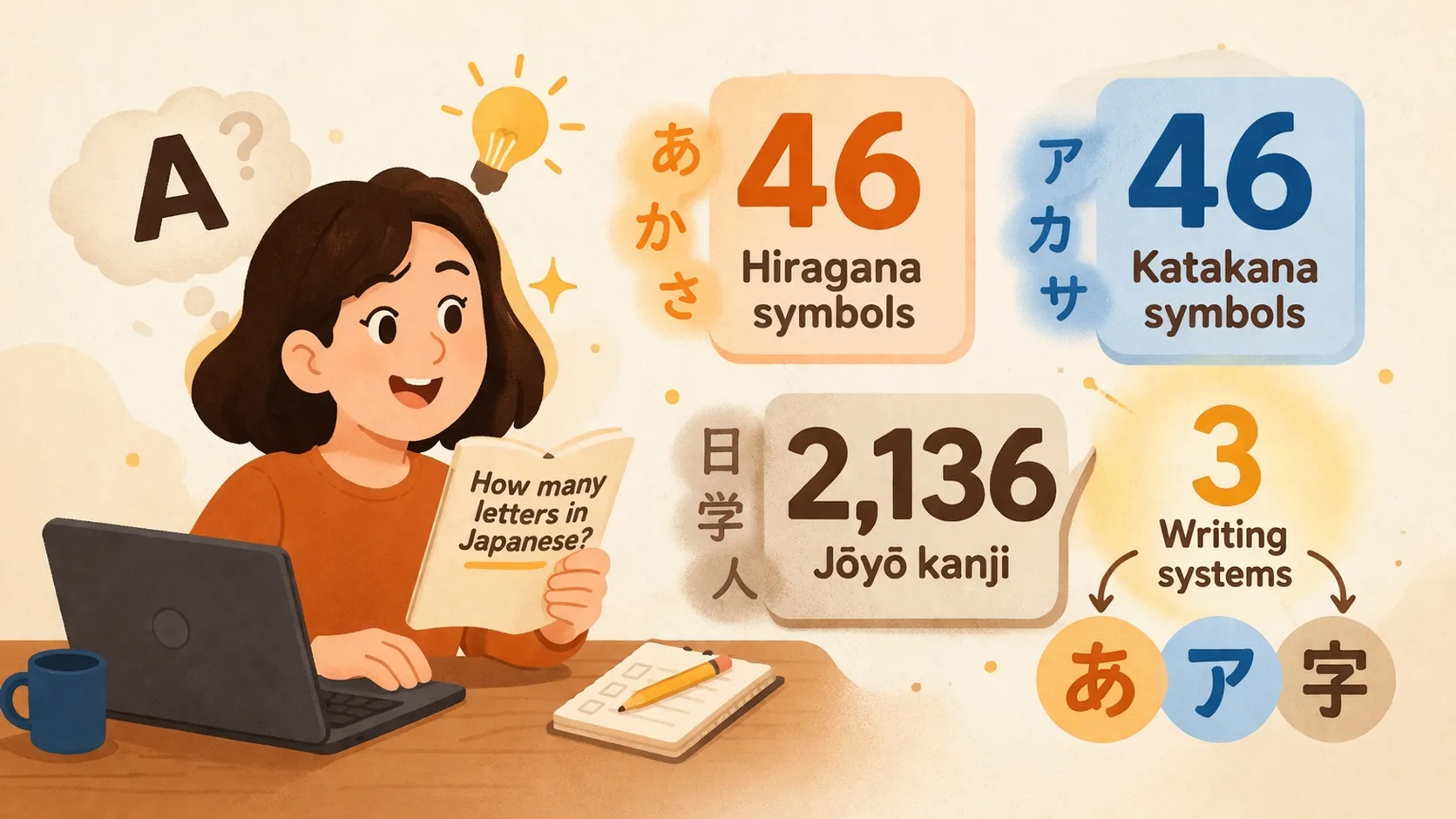
| 46 Hiragana symbols | 46 Katakana symbols | 2,136 Jōyō kanji | 3 Writing systems |
Japanese Does Not Have One Alphabet
First, it helps to understand why “Japanese alphabet” is a tricky term. In English, an alphabet assigns one symbol to each sound. Japanese, however, assign one symbol to each syllable. Therefore, linguists call these systems syllabaries, not alphabets.
Japanese uses three distinct scripts side by side. In fact, a single Japanese sentence often combines all three in one line. Because of this, the total number of letters you need to learn grows quite large 2014 but the learning path is more manageable than it first appears.
The three systems are:
- Hiragana — 46 core symbols for native Japanese words
- Katakana — 46 core symbols for foreign loanwords and emphasis
- Kanji — thousands of Chinese-origin characters with meaning
Hiragana: The Foundation of Written Japanese
What is hiragana?
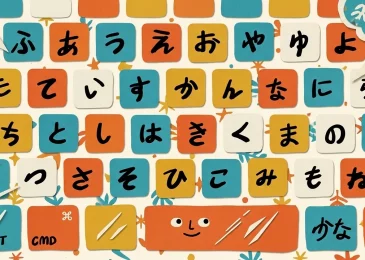
Hiragana is the first script every learner should master. Consequently, Japanese schools teach it to children before anything else. It contains 46 core characters, and each character represents one syllable for example, ka, mi, or su.
Moreover, hiragana covers all the sounds of the Japanese language. Therefore, even if you never learn kanji, you can technically write anything in hiragana alone. In practice, though, you will always see it mixed with the other two systems.
How hiragana works
Each hiragana symbol maps to a fixed pronunciation. Because the sounds never change, beginners often find hiragana easier to memorise than English spelling rules. The chart below shows the five vowel sounds that anchor the entire system.
| Romaji | Hiragana | Pronunciation |
| a | あ | “ah” as in father |
| i | い | “ee” as in feet |
| u | う | “oo” as in moon (short) |
| e | え | “eh” as in pen |
| o | お | “oh” as in boat |
Furthermore, small diacritic marks can modify consonant sounds. For example, adding two small strokes to か (ka) gives you が (ga). This system extends the 46 base characters to roughly 71 distinct sounds. However, most learners still count the core 46 when answering the question of how many letters are in the Japanese alphabet.
| 🎯 Ready to learn hiragana? Read our Learn Hiragana guide to master all 46 characters step by step. |
This video provides beginners with specific information and methods to acquire Hiragana:
Katakana: Japanese Letters for Loanwords and Emphasis
What is katakana?
Katakana is the second syllabary. It also contains 46 core characters, and it represents the exact same sounds as hiragana. However, katakana looks more angular and geometric in style.
So why does Japanese need two separate scripts for the same sounds? The answer is context. Writers use katakana mainly for:
- Foreign loanwords
- Onomatopoeia and sound effects in manga
- Emphasis — similar to how English uses italics
Katakana in daily life
Because Japan imports many English words, katakana appears everywhere. As a result, English speakers often recognise katakana words quickly once they learn the script. For example, テレビ (terebi) means television and アイスクリーム (aisukurīmu) means ice cream.
In addition, katakana helps you read product labels, menus, and advertising signs much faster than you might expect.
| 💡 Quick tip: Because hiragana and katakana share the same 46 sounds, learning both together is surprisingly efficient. Most learners can read both scripts within four to six weeks of consistent practice. |
| 📝 Practice katakana today: Read our Learn Katakana guide and master all characters in just a few days. |
How Many Letters in the Japanese Alphabet When You Include Kanji?
This is where the answer to how many letters in the Japanese alphabet gets much bigger. Kanji are logographic characters — each one carries a meaning, not just a sound. Japanese borrowed these characters from Chinese over many centuries.
How many kanji do you need?
The Japanese government publishes a list called the Jōyō Kanji — the general use characters taught in schools. As of the most recent revision, this list contains 2,136 characters. Therefore, that is the benchmark for basic adult literacy in Japan.
However, a fluent adult reader typically knows closer to 3,000 kanji. Moreover, specialised fields such as law, medicine, and literature introduce even more. In total, major kanji dictionaries list over 50,000 characters — though most of these are historical or extremely rare.
| Level | Kanji count | What it represents |
| School graduation (Grade 6) | ~1,006 | Basic literacy for children |
| Jōyō Kanji (official list) | 2,136 | General adult literacy standard |
| Fluent adult reader | ~3,000 | Reading newspapers and novels |
| Full dictionary | 50,000+ | Historical & specialised usage |
Because kanji carry meaning rather than just sound, they make written Japanese faster to read. Consequently, a skilled reader can skim a sentence and grasp the meaning from the kanji alone, then use hiragana to fill in grammar and pronunciation details.
| 📚 Start your kanji journey: How to Learn Kanji the Smart Way (Beginner-Friendly Guide) |
Romaji: Japanese Written in Latin Characters
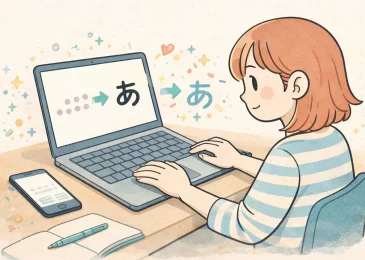
Beyond the three main scripts, there is also romaji — the representation of Japanese sounds using the Latin alphabet. Therefore, romaji is not a native Japanese script; instead, it is a transliteration tool.
You will see romaji in three common situations:
- Train station signs and road signs aimed at tourists
- Typing Japanese on a smartphone or computer keyboard
- Beginner textbooks that help learners pronounce new words
However, most Japanese teachers warn against relying on romaji for too long. Because romaji feels familiar, learners sometimes avoid the harder work of reading hiragana and katakana. In addition, romaji does not prepare you for real-world Japanese text, which almost never uses it.
The Total: How Many Letters in the Japanese Alphabet?
Let’s put all the numbers together. If someone asks you how many letters are in the Japanese alphabet, here is the clearest answer:
| Short answer for beginners: 92 core symbols (46 hiragana + 46 katakana), plus 2,136 jōyō kanji for everyday reading and writing. |
In reality, the word letters do not fit perfectly because hiragana and katakana are syllabaries and kanji are logograms. However, this breakdown gives you a practical target. Furthermore, the good news is that hiragana and katakana together only take a few weeks to learn.
Japanese Grammar: Simpler Than the Writing System Suggests
Many learners discover that, once they get past the writing systems, Japanese grammar is surprisingly logical. Because Japanese does not use grammatical gender, verb conjugations do not change based on who is speaking.
In addition, Japanese follows a Subject–Object–Verb (SOV) word order. Therefore, I sushi eat is grammatically correct Japanese rather than the English I eat sushi. This difference takes some adjustment, but it follows consistent rules.
Furthermore, Japanese uses small grammatical words called particles to mark the role of each word. For example, は (wa) marks the topic and を (wo) marks the object. Because these particles signal meaning clearly, Japanese sentences rarely become ambiguous — even when the subject is dropped entirely.
Japanese Pronunciation: Easier Than You Think
One reason learners enjoy Japanese pronunciation is that it uses a limited set of sounds. In contrast to English which has over 40 phonemes – Japanese has roughly 25 core sounds. Therefore, most foreign learners can achieve clear, intelligible pronunciation quite quickly.
Moreover, Japanese words are usually pronounced exactly as they are written in hiragana. Because there are no silent letters and no unpredictable vowel shifts, pronunciation is far more consistent than English.
However, Japanese does use pitch accent — a system where the pitch of your voice rises and falls to distinguish word meaning. For example, the word hashi can mean chopsticks, a bridge, or an edge, depending on pitch. As a result, pitch accent is one of the few pronunciation challenges that requires deliberate study.
Japanese Proficiency Tests: How Many Kanji Per Level?
If you plan to use Japanese for work or study, you will likely encounter the JLPT — the Japanese Language Proficiency Test. It runs from N5 (beginner) to N1 (near-native). Understanding the kanji count at each level helps you set realistic goals.
JLPT kanji targets by level
| JLPT Level | Approx. kanji | Vocabulary (words) |
| N5 (Beginner) | ~80 | ~800 |
| N4 (Elementary) | ~300 | ~1,500 |
| N3 (Intermediate) | ~650 | ~3,750 |
| N2 (Upper-intermediate) | ~1,000 | ~6,000 |
| N1 (Advanced) | ~2,000+ | ~10,000+ |
In addition to the JLPT, Japan offers two other important tests. The BJT (Business Japanese Test) focuses on workplace communication. The JFT-Basic is the newest test, linked to Japan’s Specified Skilled Worker visa program. Because the JFT-Basic targets practical daily situations, it is ideal for workers planning to live and work in Japan.
| 🎓 Prepare for the JLPT: Explore our JLPT study guides for flashcards, grammar notes, and practice tests at every level. |
How to Start Learning the Japanese Writing System
Now that you understand how many letters the Japanese alphabet contains, here is a practical learning order. Because hiragana is the foundation, start there first.
- Week 1–2: Learn all 46 hiragana — use stroke-order charts and flashcards daily.
- Week 3–4: Learn all 46 katakana — your phonetics knowledge transfers directly.
- Month 2 onwards: Begin the 80 JLPT N5 kanji alongside basic vocabulary and grammar.
- Ongoing: Add 10–15 new kanji per week using spaced repetition systems (SRS).
Furthermore, immersion matters. Therefore, start reading real Japanese text as early as possible — even if you only recognise a few characters. Because context helps memory, real exposure accelerates your progress far more than textbooks alone.
In addition, consistency beats intensity. Consequently, 20 focused minutes every day produces better long-term results than a three-hour study session once a week.
| 🚀 Start today: Visit our MochiKana — learn faster with smart spaced repetition, interactive lessons, and real progress tracking. |
Frequently Asked Questions
Is Japanese hard to learn for English speakers?
The writing system is the steepest challenge. However, Japanese grammar is actually quite regular — because verbs do not change for person or number, and gender does not exist. Therefore, many learners find the grammar phase enjoyable once the scripts feel familiar.
Do I need to learn all three scripts?
Yes, because all three appear together in everyday Japanese text. However, you can reach a useful, conversational level with hiragana, katakana, and around 300–500 kanji.
How long does it take to learn kanji?
It depends on your daily study time. Moreover, it depends on your method. With spaced repetition and consistent daily practice, many learners reach the Jōyō 2,136 target within two to three years.
What is the fastest way to memorise hiragana?
Mnemonics combined with handwriting practice is the most effective approach. Furthermore, reviewing flashcards in short, daily sessions — rather than long cramming sessions — speeds up long-term retention significantly.
Conclusion
So how many letters in the Japanese alphabet? The honest answer covers three scripts. Hiragana gives you 46 syllabic characters. Katakana gives you another 46 for loanwords and emphasis. Kanji adds 2,136 characters for general literacy, and fluent readers know around 3,000.
Together, that totals roughly 92 kana symbols plus over 2,000 kanji. However, this does not mean the task is impossible. Because Japanese is logically structured, each step builds naturally on the last.
Therefore, start with hiragana, move to katakana, and then build your kanji base one level at a time. Kanji123 is here to help at every stage.