If you’re just starting Japanese, the Japanese Romaji Alphabet is often the first thing you see. It feels familiar because it uses the Latin alphabet. However, it only acts as a temporary bridge into Japanese.
In this guide, you’ll learn how the Japanese Romaji Alphabet works, how to read it correctly, and when to stop relying on it. More importantly, you’ll see how to move beyond romaji and start reading real Japanese through hiragana learning and katakana learning.
This video provides you with resources and methods needed to practice basic Japanese step by step:
What Is the Japanese Romaji Alphabet?
The word “romaji” (ローマ字, rōmaji) literally means “Roman letters.” Essentially, it is the system for writing Japanese using the Latin alphabet that English speakers already know. Because of this, it lets beginners read Japanese words before they fully learn hiragana, katakana, or kanji.
Japanese children learn romaji in elementary school. Moreover, it is the standard input method for typing Japanese on computers and smartphones. So even fluent Japanese speakers use the Japanese Romaji alphabet daily — just not for reading printed text.
Why Learn the Japanese Romaji Alphabet First?
At the beginning, the Japanese Romaji Alphabet feels easy and familiar. Because it uses letters you already know, you can focus on pronunciation first.
Here are the main benefits:
- You can start reading immediately
- You don’t need to memorize kana yet
- You can type Japanese using a keyboard
In addition, romaji helps you build confidence early. However, this advantage is temporary, not long-term.
The Complete Japanese Romaji Alphabet Chart
Below are all five romaji tables in Hepburn format. Each cell shows the hiragana character, katakana character, and romaji together — so you can learn all three writing forms at once.
Table 1: Basic Syllables (Monographs)
These 46 sounds form the foundation of the Japanese Romaji alphabet. Each column represents one of the five Japanese vowels.
| Row | a | i | u | e | o |
| Vowels | あ ア a | い イ i | う ウ u | え エ e | お オ o |
| K-row | か カ ka | き キ ki | く ク ku | け ケ ke | こ コ ko |
| S-row | さ サ sa | し シ shi | す ス su | せ セ se | そ ソ so |
| T-row | た タ ta | ち チ chi | つ ツ tsu | て テ te | と ト to |
| N-row | な ナ na | に ニ ni | ぬ ヌ nu | ね ネ ne | の ノ no |
| H-row | は ハ ha | ひ ヒ hi | ふ フ fu | へ ヘ he | ほ ホ ho |
| M-row | ま マ ma | み ミ mi | む ム mu | め メ me | も モ mo |
| Y-row | や ヤ ya | — | ゆ ユ yu | — | よ ヨ yo |
| R-row | ら ラ ra | り リ ri | る ル ru | れ レ re | ろ ロ ro |
| W-row | わ ワ wa | — | — | — | を ヲ wo |
| Nasal | ん ン n | — | — | — | — |
Table 2: Voiced Sounds (Diacritics)
These sounds add a voiced mark (dakuten) to the basic kana. As a result, they follow the same five-vowel pattern as the monographs above.
| Row | a | i | u | e | o |
| G-row | が ガ ga | ぎ ギ gi | ぐ グ gu | げ ゲ ge | ご ゴ go |
| Z-row | ざ ザ za | じ ジ ji | ず ズ zu | ぜ ゼ ze | ぞ ゾ zo |
| D-row | だ ダ da | ぢ ヂ ji | づ ヅ zu | で デ de | ど ド do |
| B-row | ば バ ba | び ビ bi | ぶ ブ bu | べ ベ be | ぼ ボ bo |
| P-row | ぱ パ pa | ぴ ピ pi | ぷ プ pu | ぺ ペ pe | ぽ ポ po |
Table 3: Compound Sounds (Digraphs)
Digraphs combine two kana into one syllable. In addition, they always end in -ya, -yu, or -yo — so you only need to learn three columns.
| Row | -ya | -yu | -yo |
| K (き) | きゃ キャ kya | きゅ キュ kyu | きょ キョ kyo |
| S (し) | しゃ シャ sha | しゅ シュ shu | しょ ショ sho |
| T (ち) | ちゃ チャ cha | ちゅ チュ chu | ちょ チョ cho |
| N (に) | にゃ ニャ nya | にゅ ニュ nyu | にょ ニョ nyo |
| H (ひ) | ひゃ ヒャ hya | ひゅ ヒュ hyu | ひょ ヒョ hyo |
| M (み) | みゃ ミャ mya | みゅ ミュ myu | みょ ミョ myo |
| R (り) | りゃ リャ rya | りゅ リュ ryu | りょ リョ ryo |
| G (ぎ) | ぎゃ ギャ gya | ぎゅ ギュ gyu | ぎょ ギョ gyo |
| Z (じ) | じゃ ジャ ja | じゅ ジュ ju | じょ ジョ jo |
| B (び) | びゃ ビャ bya | びゅ ビュ byu | びょ ビョ byo |
| P (ぴ) | ぴゃ ピャ pya | ぴゅ ピュ pyu | ぴょ ピョ pyo |
Table 4: Long Vowels
Japanese distinguishes short and long vowels. Because this changes meaning, always pay attention to the macron (the bar over the letter) in romaji.
| Vowel | Short | Long (Romaji) | Example |
| A | a | ā | obāsan (おばあさん) — grandmother |
| I | i | ī | onīsan (おにいさん) — older brother |
| U | u | ū | yūki (ゆうき) — courage |
| E | e | ē / ei | onēsan (おねえさん) — older sister |
| O | o | ō / ou | Tōkyō (とうきょう) — Tokyo |
Table 5: Double Consonants (Small Tsu っッ)
A small tsu (っ / ッ) doubles the following consonant in romaji. Therefore, it creates a short pause before that sound.
| Japanese | Romaji | Meaning |
| にっぽん (日本) | Nippon | Japan |
| きって (切手) | kitte | Postage stamp |
| ざっし (雑誌) | zasshi | Magazine |
| がっこう (学校) | gakkō | School |
How to Read the Japanese Romaji Alphabet
The Five Core Vowels
First, you need to know the five Japanese vowels. Because Japanese pronunciation is very consistent, these vowels always sound the same — unlike English vowels, which shift depending on the word.
- a — sounds like ‘ah’ (as in ‘father’)
- i — sounds like ‘ee’ (as in ‘see’)
- u — sounds like ‘oo’ (as in ‘moon’), but shorter and unrounded
- e — sounds like ‘eh’ (as in ‘bed’)
- o — sounds like ‘oh’ (as in ‘go’)
Therefore, once you memorize these five sounds, you can pronounce almost any romaji word correctly.
Sounds That Differ From English
A few romaji sounds surprise English speakers. For example, the Japanese ‘r’ sits between an English ‘r,’ ‘d,’ and ‘l’ — tap your tongue lightly behind your upper teeth. In addition, ‘tsu’ is a single syllable, not two. Similarly, ‘chi’ sounds like the ‘ch’ in ‘cheese,’ and ‘fu’ is softer than the English ‘f.’ Because of these differences, listening practice is essential alongside reading the chart.
Hepburn vs. Kunrei: The Two Main Romaji Systems
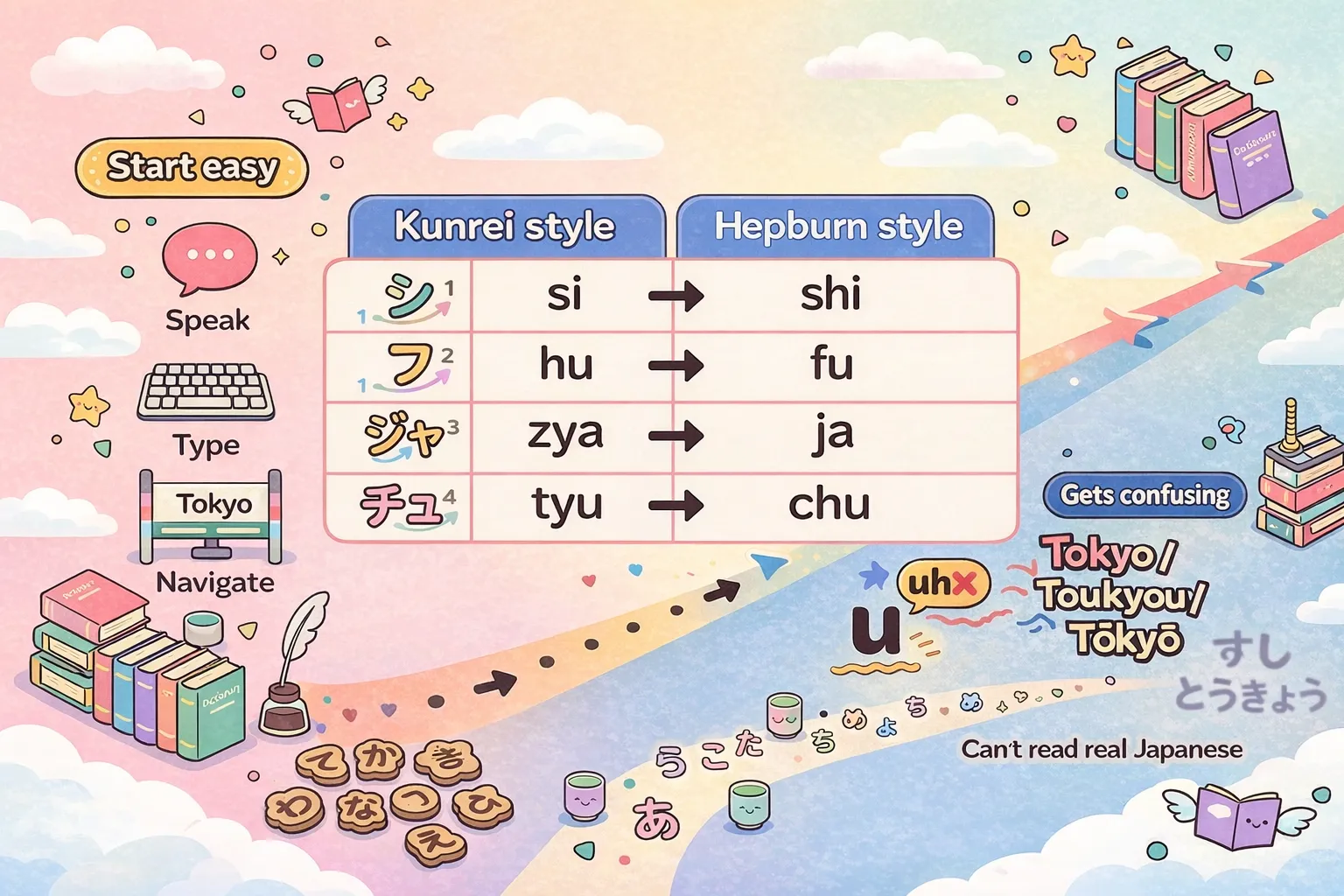
Not all romaji looks the same. In fact, two systems dominate in practice, and they sometimes produce different spellings for the same sound.
The Hepburn system is the most widely used internationally. Consequently, most textbooks, travel guides, and foreign-language resources use Hepburn. It maps Japanese sounds to the closest English equivalents, so it is the easiest for English speakers to read. The tables above all use Revised Hepburn.
The Kunrei-shiki (訓令式) system is the one taught to Japanese children in school. However, it uses letter combinations — like ‘si’ instead of ‘shi,’ or ‘tu’ instead of ‘tsu’ — that feel unnatural to English speakers. As a result, most English-language learners stick with Hepburn.
Advantages of Using Romaji
Romaji offers real benefits at the start of your Japanese journey. Because it uses letters you already know, it removes the initial barrier completely.
- It lets you start speaking Japanese right away. Therefore, you can practice pronunciation before tackling kana.
- It is the standard input method for typing Japanese. As a result, you will use romaji keyboard input even after you become fluent.
- Signs, menus, and train stations in Japan often use romaji. So basic familiarity helps you navigate without prior study.
- It helps you recognize Japanese loanwords you already know — karate, sushi, tsunami, anime.
In addition, most beginner apps and textbooks introduce romaji first. Because of this, new learners encounter it naturally from day one.
Disadvantages of Relying on Romaji
Despite its early usefulness, romaji creates serious problems if you depend on it too long. Therefore, understanding its limits is just as important as understanding its benefits.
It Creates Misleading Spellings
Romaji can obscure correct Japanese spelling. For example, the word for ‘to shrink’ (縮む) is chijimu in romaji. However, the correct hiragana is ちぢむ — not ちじむ. Because romaji collapses this distinction, it trains you to ignore important spelling differences. Similarly, Tokyo can appear as Tokyo, Tōkyō, or Toukyou depending on the system used.
It Causes Pronunciation Errors
English speakers who use only romaji apply English phonics by default. For instance, they read ‘u’ as in ‘but’ instead of the short ‘oo’ sound. In addition, they often stress the wrong syllables, since Japanese uses pitch accent rather than stress accent. Because of this, romaji-only learners develop habits that are difficult to correct later.
It Cannot Help You Read Real Japanese
Native Japanese speakers do not use romaji in daily life. Therefore, if you only know romaji, you cannot read a menu, a sign, or a text message in Japanese. Because real-world Japanese uses hiragana, katakana, and kanji exclusively, romaji has almost no practical reading value beyond the classroom.
When Should You Stop Using Romaji?
Most teachers recommend moving away from romaji as quickly as possible. Because hiragana and katakana are learnable in just a few weeks, there is no good reason to linger.
Specifically, aim to stop using romaji as a reading aid once you can recognize all 46 hiragana characters. Then, move on to katakana. After that, you can begin learning the most common kanji. Because each step builds on the last, the full journey is more manageable than it first appears.
In addition, switching away from romaji early forces your brain to process Japanese as Japanese — not as romanized English. As a result, your reading speed, pronunciation, and vocabulary retention all improve faster.
At Kanji123, we suggest using romaji only as a pronunciation reference — never as a reading method. Instead, start our hiragana guide from day one. Furthermore, our katakana guide and kanji learning path will walk you step by step toward real fluency.
Final Thoughts
The Japanese Romaji alphabet is an excellent entry point for absolute beginners. Because it uses familiar letters, it lets you start reading and pronouncing Japanese words from your very first lesson. However, it is only a temporary tool — not a path to fluency on its own.
Therefore, use the charts above to get started, but set a clear goal to move beyond romaji. In addition, explore our hiragana guide, katakana overview, and beginner kanji lessons at Kanji123. Because the sooner you leave romaji behind, the sooner you start reading real Japanese.