Learning Japanese grammar for the first time can feel a little like opening a toolbox and realizing nobody labeled the drawers.
You hear words like particles, conjugation, plain form, polite form, and suddenly your brain is doing the linguistic equivalent of slowly backing out of the room.
The good news? Beginner Japanese grammar is not impossible, and it definitely does not require becoming a tiny grammar monk who lives inside a textbook.
What you do need is a clear starting point, the right learning guide, and a study order that does not make you learn fifteen confusing sentence patterns before you can even read the examples.
In this guide, we’ll break down the Japanese grammar basics beginners should focus on first, explain what each resource is good for, and show you how to build a study routine that actually sticks. We’ll also point you to beginner-friendly resources, so you can move from “What is は doing here?” to “Okay, I see the logic now.”
If you’re still at the stage where Japanese writing looks like decorative soup, you’re not alone. Before Japanese grammar starts to feel logical, it helps to get a basic sense of what you’re looking at on the page. If you need a quick overview, these guides to the Japanese Writing System can make Hiragana, Katakana, and Kanji feel much less mysterious.
This video provides you with resources and methods needed to practice basic Japanese step by step:
What Is Japanese Grammar, Exactly?
At its simplest, Japanese grammar is the system that tells you how Japanese sentences are built.
That includes things like:
- word order
- particles such as は, が, を, に
- verb endings
- adjective forms
- polite vs. casual speech
- ways to connect ideas together
English depends a lot on word order. Japanese also has patterns, but it leans heavily on markers and endings. That means the sentence can look surprisingly flexible at first, while still following its own rules.
A very beginner-friendly way to think about it is this:
Japanese grammar is less about memorizing giant rules and more about noticing what each little piece is doing in the sentence.
That one mindset shift helps a lot.
For example:
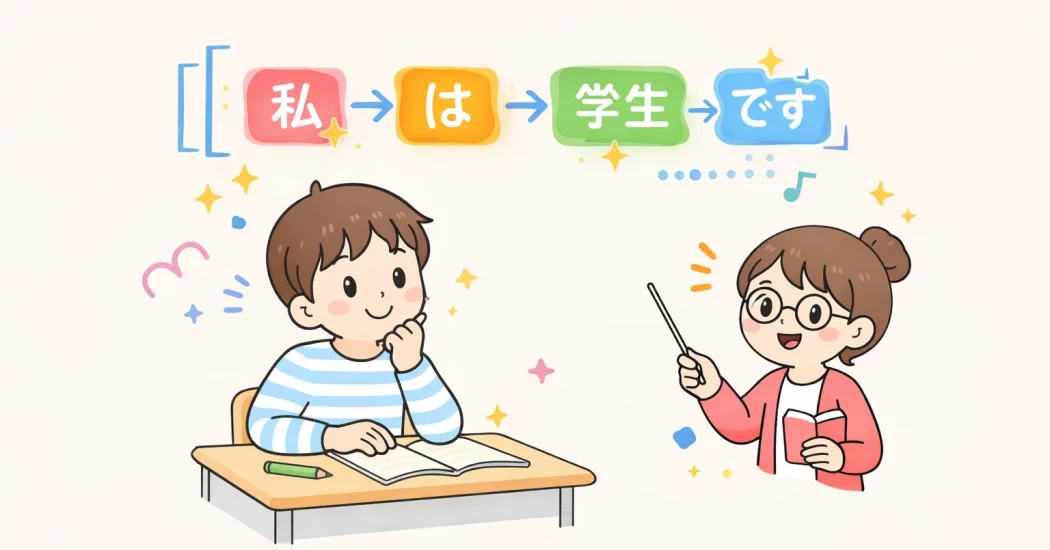
- わたしは学生です。
- Watashi wa gakusei desu.
- “I am a student.”
Here, は marks the topic, 学生 means “student,” and です makes the sentence polite.
Tiny pieces. Big job.
Grammar also works best when you keep seeing it in real sentences, not as isolated rules on a page.
Japanese Grammar Basics Beginners Should Learn First
Before you collect grammar resources like a digital squirrel preparing for winter, it helps to know what to study first.
Here are the core Japanese grammar basics most beginners should focus on.
1. Basic sentence order
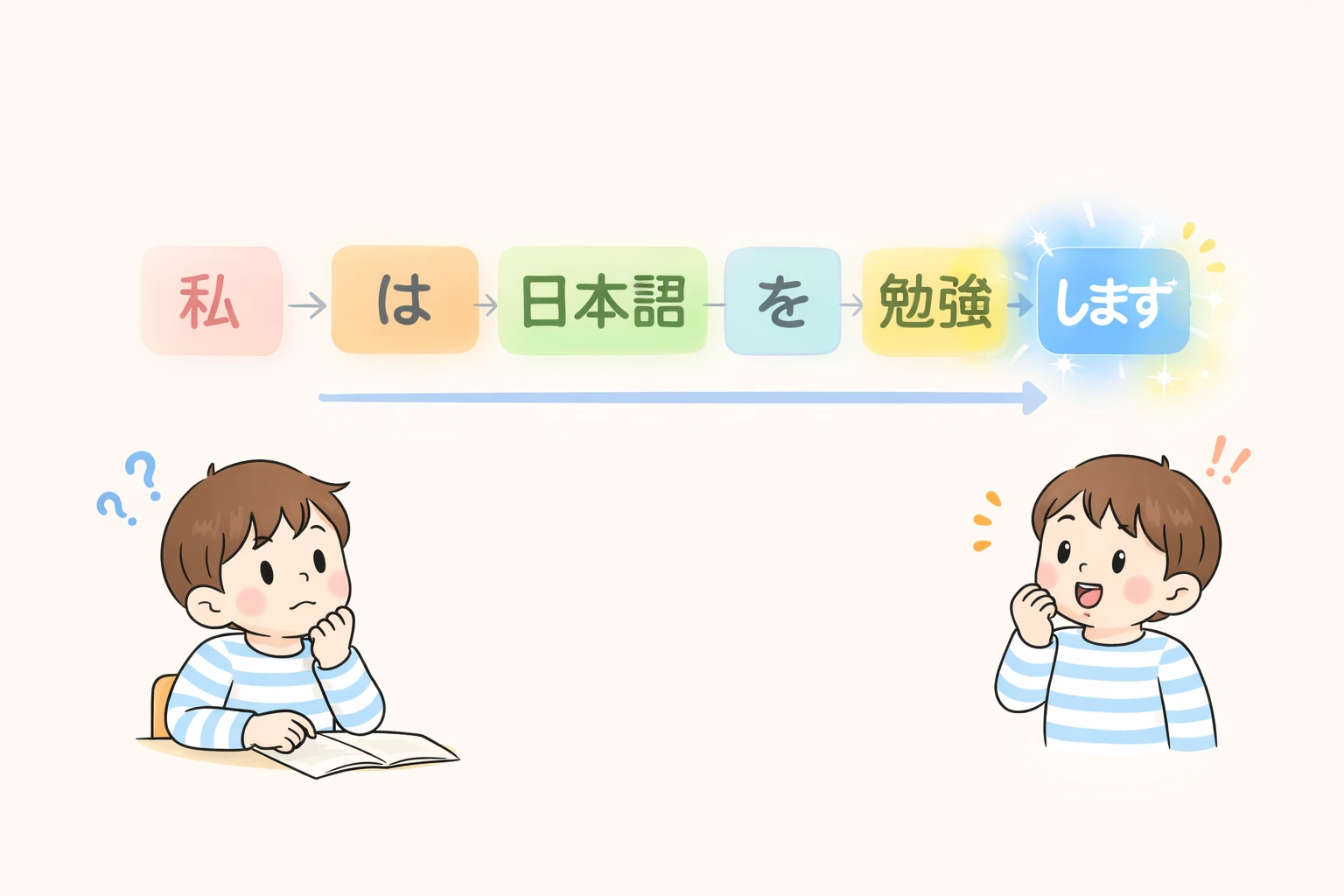
Japanese sentences often follow a topic-comment structure, and the verb usually comes at the end.
A very common pattern looks like this:
[Topic] + [time/place/object details] + [verb]
Example:
- わたしは日本語を勉強します。
- Watashi wa nihongo o benkyou shimasu.
- “I study Japanese.”
This is one reason Japanese can feel backward to English speakers at first. The sentence waits until the end to tell you what actually happens. Suspense, but grammatical.
2. Particles
Particles are short markers that show how words function in a sentence.
A few of the first ones you’ll see are:
- は (wa): marks the topic
- が (ga): often marks the subject
- を (o): marks the direct object
- に (ni): can mark time, destination, or target
- で (de): marks where an action happens
- の (no): shows possession or connection
If beginners struggle with grammar, particles are usually somewhere in the crime scene.
That’s normal.
You do not need to master every nuance immediately. You just need to understand the most common jobs each particle does in beginner sentences.
3. Polite form first
Most beginner materials teach polite Japanese first, and honestly, that’s a pretty kind choice.
Polite forms like です and ます are useful, common, and safer in real-life situations.
Examples:
- 学生です — “(I am) a student.”
- 食べます — “eat / will eat” in polite form
- 行きます — “go / will go” in polite form
Once you’re comfortable with polite forms, casual forms start making a lot more sense.
4. Verb conjugation basics
Japanese verbs change form to show tense, negation, and other meanings.
The beginner essentials are:
- present/future affirmative
- present negative
- past affirmative
- past negative
- て-form
Example with 食べる / 食べます:
- 食べます — eat / will eat
- 食べません — do not eat / will not eat
- 食べました — ate
- 食べませんでした — did not eat
This is the part where some learners panic and open twelve tabs. Please don’t. One good resource plus repetition beats panic-tabs every time.
5. Adjectives aren’t just adjectives
Japanese adjectives can behave in ways that feel new to English speakers.
There are two main types:
- い-adjectives like おいしい (delicious)
- な-adjectives like しずか (quiet)
They change differently depending on tense and politeness, which matters for sentence building. It sounds like a lot, but in practice, it becomes manageable once you see a few repeated patterns.
6. Question forms and everyday sentence patterns
You do not need advanced grammar to start communicating.
Beginners get a lot of mileage from patterns like:
- 〜ですか for questions
- 〜が好きです for likes
- 〜たいです for wants
- 〜てもいいですか for permission
- 〜てください for requests
These are practical, high-frequency, and immediately useful.
The Best Way To Start Learning Japanese Grammar
A lot of beginners ask the same question in different outfits:
“Should I learn grammar first?”, “Should I do vocabulary first?”, “Should I wait until I know kana?”, Should I buy six books and a color-coded spreadsheet?”.
Here’s the practical answer:
The best way to learn Japanese grammar is to study grammar in small, useful chunks and review it through real example sentences.
In other words:
- Start with the most common beginner grammar patterns.
- Learn them through short, clear example sentences.
- Reuse those patterns with familiar vocabulary.
- Review them often enough that they stop feeling new.
- Add new grammar only when the older material still feels reasonably stable.
The biggest beginner mistake is trying to “finish grammar” instead of building usable understanding.
A better approach is to focus on the highest-value areas first:
- basic sentence order
- essential particles
- polite forms like です / ます
- common verb conjugations
- question patterns
- request and preference expressions
That keeps beginner Japanese grammar practical from day one.
How To Study Beginner Japanese Grammar Without Getting Overwhelmed
Let’s keep this practical.
A lot of beginners don’t quit because Japanese grammar is too hard. They quit because their study method quietly becomes ridiculous.
Here’s a beginner-safe way to study.
Learn one grammar point at a time
Do not study particles, verb conjugations, adjective forms, question patterns, and casual speech all in one sitting unless you enjoy educational chaos.
Instead, pick one point such as:
- は vs が
- です / ます
- 〜ません
- 〜てください
- 〜が好きです
Then do three things:
- Read a simple explanation.
- Look at 5–10 example sentences.
- Make or review your own examples.
That’s already enough for one session.
Study grammar with vocabulary you already know
A grammar point feels much harder when every example sentence contains three unknown words and a kanji you’ve never met before.
Whenever possible, use simple, familiar vocabulary.
For example:
- ねこが好きです。 — I like cats.
- 水を飲みます。 — I drink water.
- 学校に行きます。 — I go to school.
Not exciting, but extremely useful.
Revisit old grammar in new contexts
A grammar point is not “learned” because you nodded at an explanation once.
You learn it by seeing it again in:
- reading
- listening
- drills
- flashcards
- your own sentences
That repeat exposure is what turns “I kind of get it” into “Oh, that structure again.”
Keep your reading level embarrassingly manageable
This is good, actually.
Beginner reading material should feel simple enough that you can notice the grammar. If everything is too hard, your brain spends all its energy surviving.
Common Japanese Grammar Mistakes Beginners Make
You do not need to make all of these mistakes yourself. I made that list for you. Very generous, I know.
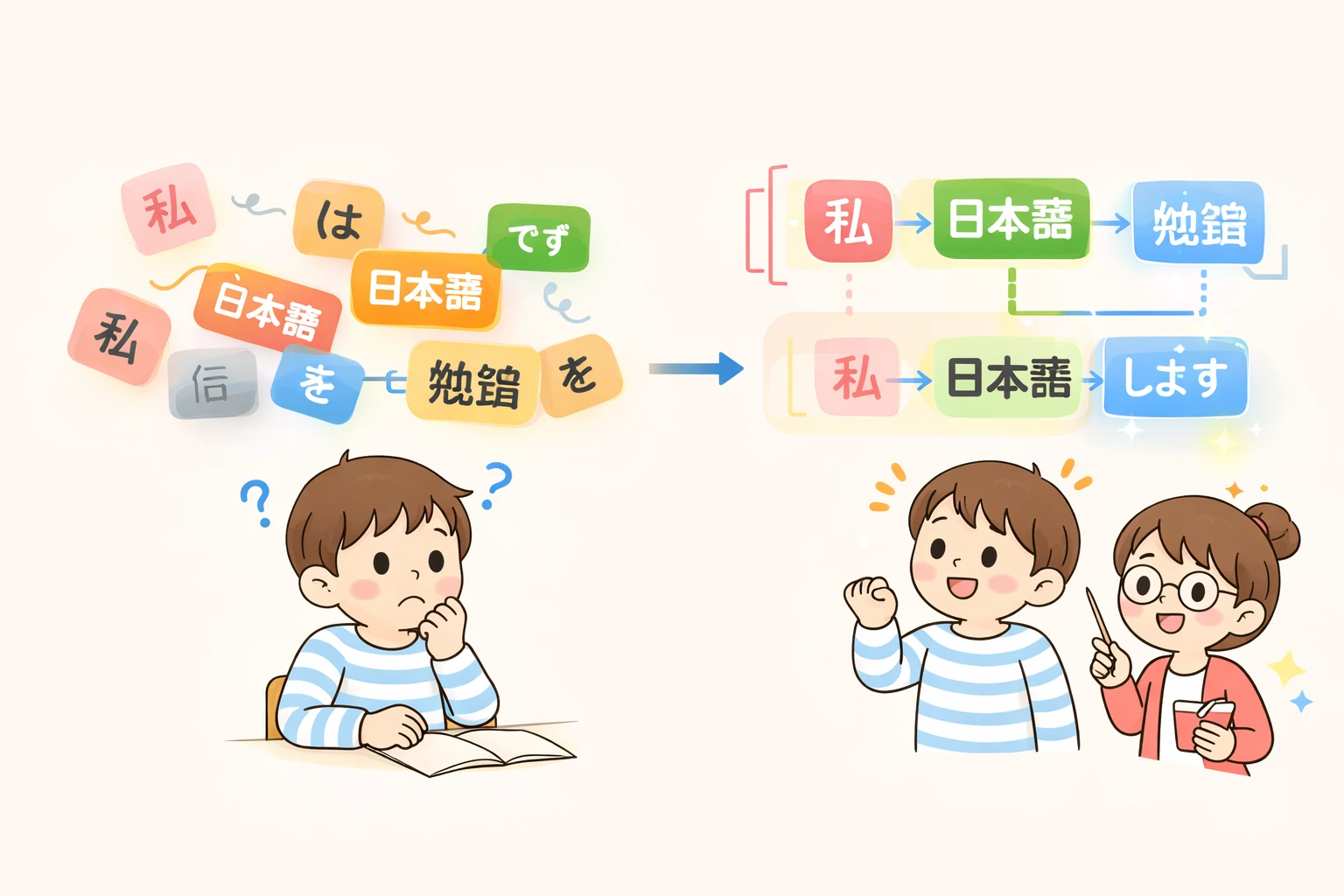
Trying to translate word-for-word from English
Japanese and English do not build meaning the same way.
If you force Japanese into English sentence logic every time, grammar will seem way more mysterious than it really is.
Instead of asking, “What is the exact English equivalent?” ask:
What job is this part doing in the sentence?
That question usually gets you closer.
Ignoring the writing system too long
Romaji can help for about five minutes. After that, it becomes training wheels duct-taped to a bicycle you actually need to ride.
If you haven’t done so yet, use MochiKana and the beginner kana lessons to move into real Japanese text as early as possible.
Collecting resources instead of using them
You do not need seventeen tabs, four apps, three notebooks, and a philosophical commitment to “research.”
You need a small number of good resources and the willingness to revisit them.
Studying grammar without review
Grammar is pattern recognition. If you don’t review, the patterns fade.
That does not mean your memory is bad. It means your brain is behaving like a brain.
A Simple Beginner Study Plan for Japanese Grammar
If you want a practical starting routine, try this:
Week 1–2: Start with core Japanese grammar basics
- basic sentence order
- です / ます
- は, を, に, で
- simple question forms
- common everyday verbs
Week 3–4: Expand Japanese grammar basics
Focus on:
- present/past forms
- negative forms
- adjective patterns
- 〜て-form basics
- everyday expressions like 〜たいです and 〜てください
At this stage, the goal is not “advanced grammar.” It is comfort with common patterns.
Week 5 and beyond: Add broader sentence patterns and reading support
Start building reading strength with:
As your reading improves, grammar stops feeling like isolated rules and starts feeling like a language.
Which, to be fair, is the whole point.
Final Thoughts on Japanese Grammar
Japanese grammar gets much less scary once you stop treating it like a giant wall of rules and start treating it like a set of patterns you’ll meet again and again.
For beginners, the goal is not mastering every edge case. The goal is building a clean foundation:
- understand basic sentence structure
- learn the most useful particles first
- get comfortable with polite forms
- practice common verb and adjective patterns
- review through simple, repeated examples
That’s how beginner Japanese grammar becomes manageable instead of overwhelming.
FAQ About Japanese Grammar
Is Japanese grammar hard for beginners?
Japanese grammar can feel unfamiliar at first, especially because of particles, verb endings, and sentence order. But the basics are very learnable when you study them in the right order and use simple example sentences.
What should I learn first in beginner Japanese grammar?
Start with basic sentence order, essential particles like は and を, polite forms such as です and ます, and a few common verb patterns. Those are the foundations that unlock a lot of early Japanese.
How long does it take to learn beginner Japanese grammar?
That depends on your study time and consistency, but many learners can build a solid beginner foundation in a few months. The key is regular review, not speed-running grammar like it owes you money.
Do I need kanji before learning Japanese grammar?
Not necessarily. You can begin grammar before learning much kanji. But adding kanji and vocabulary early helps grammar feel more real and improves reading faster.
What are the most important Japanese grammar basics?
The most important Japanese grammar basics for beginners are sentence order, particles, polite forms like です and ます, basic verb conjugation, adjective types, and common question and request patterns.
© Kanji123 — Free JLPT Kanji Test Online