Have you ever looked at a Japanese grammar structure and had absolutely no idea what was going on? Maybe you came across the particle に and found five different explanations online — all of them slightly contradictory in a sentence. Or perhaps you tried to conjugate a verb into its て-form and ended up more confused than when you started.
That’s the reality of learning japanese grammar. It’s deep, it’s nuanced, and finding a trustworthy explanation can feel like a scavenger hunt.
The good news, however, is that there are some genuinely excellent free resources out there. You just need to know where to look.
In this guide, we’ve rounded up the best free online japanese grammar references worth bookmarking — plus some practical advice for making the most of them. Whether you’re brand new to the language or pushing past the intermediate plateau, there’s something here for you.
But first, let’s cover the basics. Because before you can use any grammar guide effectively, it helps to understand what you’re actually studying.
What Exactly Is a Japanese Grammar Guide?
For this article, a japanese grammar guide means any free, browser-accessible reference that covers grammar points, patterns, and example sentences. Some work like textbooks, with a recommended learning order. Others function more like dictionaries — you search for a specific grammar point and read that entry.
Neither approach is better than the other. In fact, the best strategy is to use both types together.
Also worth noting: all the resources in this list are 100% free. No paywalls, no subscriptions, no strings attached.
Why Japanese Grammar Feels So Different
Before we dive into the resource list, let’s address the elephant in the room. Japanese grammar operates very differently from English grammar — and the sooner you accept that, the easier everything becomes.
Sentence Structure Is (Almost) Backwards
In English, you say: “I eat sushi.” In Japanese, you say: “I sushi eat.” — 私はお寿司を食べます。
The verb always comes at the end. Additionally, the subject is often dropped when context makes it obvious. At first, this feels disorienting. Over time, however, it starts to feel surprisingly logical.
Particles Do the Heavy Lifting
Japanese uses small grammatical markers called particles to show the role of each word in a sentence. Think of them as traffic signs — they tell you who’s doing what, where, and to whom.
Here are some of the most essential ones:
- は (wa): marks the topic of the sentence
- が (ga): marks the grammatical subject
- を (wo): marks the direct object
- に (ni): marks a specific point in time, a destination, or where something exists (used with iru/aru)
- で (de): marks the location where an action happens , or the tools/means used to do it.
Learning particles is, without question, the highest-return grammar investment a beginner can make. Therefore, any good grammar guide should explain not just what a particle means — but why it works the way it does.
Verbs and Adjectives Both Conjugate
Japanese verbs change form based on tense, politeness, and mood. But unlike English, they don’t change based on who’s performing the action. So “I eat,” “he eats,” and “they eat” all use the same verb form. Instead, you get different inflections for things like:
- Plain form: 食べる (taberu)
- Polite form: 食べます (tabemasu)
- て-form: 食べて (tabete) — used for connecting actions and making requests
- Negative: 食べない (tabenai)
Here’s the twist that surprises most learners: Japanese adjectives conjugate too. There are two types — い-adjectives and な-adjectives — and they each follow different rules. Once you get a handle on this, a whole layer of grammar patterns suddenly starts to click.
What to Look For in a Japanese Grammar Guide
Not every online resource is worth your time. Therefore, before you bookmark anything, here’s a quick checklist of what separates great japanese grammar resources from mediocre ones.
- Rich example sentences. A grammar point without examples is essentially useless. You need to see the pattern in real sentences before it sticks.
- Conceptual explanations, not just translations. Many grammar points don’t map neatly onto English. A strong guide explains the underlying logic — not just a one-to-one translation that breaks down the moment context changes.
- Clear organization. Whether by level (beginner / intermediate / advanced) or by category (particles, verb conjugation, sentence-ending expressions), structure saves you time.
- Enough depth for your level. Some resources are great for quick reminders. Others offer the kind of detailed explanation you need when you’re encountering a pattern for the first time.
Pro tip: no single resource covers everything. Japanese grammar is vast, and even the most comprehensive guides have gaps. The best learners use two or three resources together and pull from each one’s strengths.
The Best Free Online Japanese Grammar Guides
Now for the good stuff. Here are the online japanese grammar resources we think are genuinely worth your time.
Tae Kim’s Guide to Learning Japanese
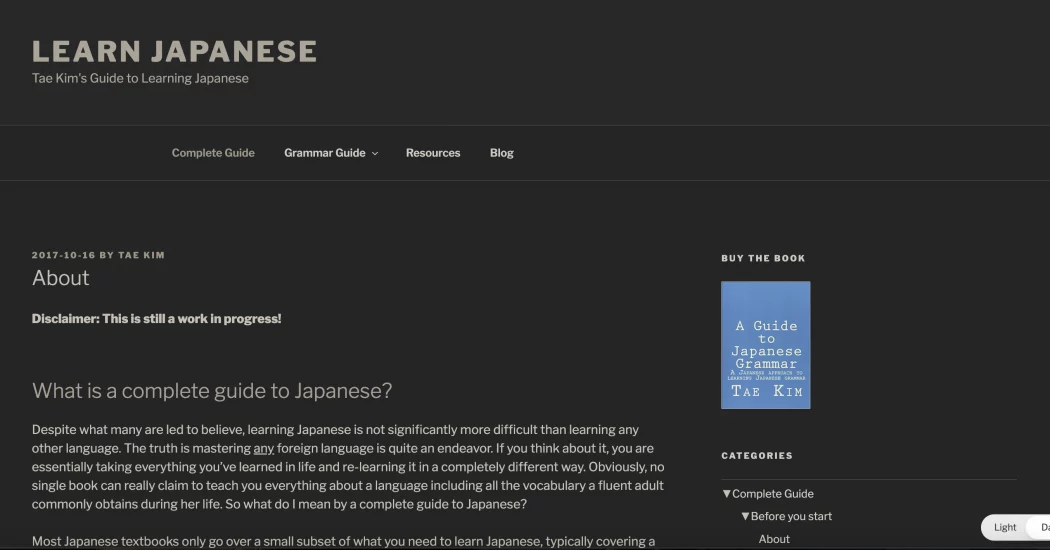
Tae Kim’s guide is often the first result when you search for free japanese grammar resources — and it deserves that position. It covers the full foundation of Japanese grammar in a logical, step-by-step order. Lessons build on one another, so it works well as a standalone beginner curriculum.
The explanations, however, tend to be brief and direct. They do a solid job of conveying the general idea, but they often lack the nuance that more curious learners are after. If you find yourself wanting more depth on a specific grammar point, you’ll want to supplement with other sources.
The site also has two versions: The Grammar Guide and The Complete Guide, which adds written-language content. Both are completely free. Overall, treat it as your grammar foundation — not your only resource.
- Best for: Beginners who want a structured, textbook-style introduction to japanese grammar.
- Cost: Free
- Link to Tae Kim’s Guide
Maggie Sensei
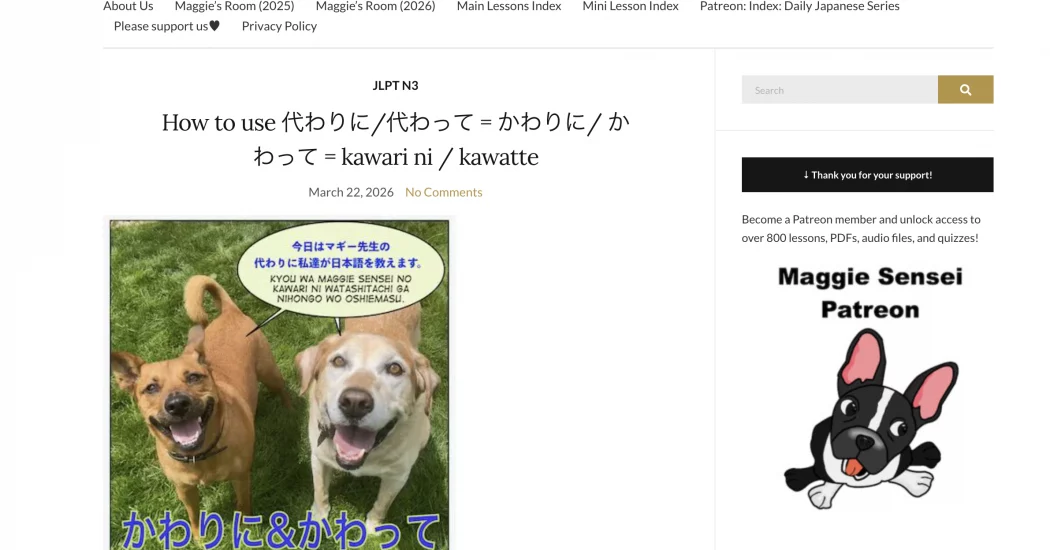
Don’t let the kawaii dog mascot fool you. Maggie Sensei has been publishing japanese grammar explanations since 2008, and the content library is genuinely massive.
What makes this site stand out is its focus on everyday Japanese — the kind of language people actually use in conversation, not just textbook-perfect sentences. Each article digs into multiple usages of a grammar point and includes a generous number of example sentences. Articles are also tagged by JLPT level (N5 through N1), which makes it easy to filter by exam target.
One thing to keep in mind: the site is organized like a blog, not a textbook. Therefore, there’s no recommended learning path. Instead, you search for the grammar point you need and read that specific article. It’s best used as a reference tool rather than a cover-to-cover curriculum.
- Best for: Intermediate learners who want real-life japanese grammar usage and JLPT prep.
- Cost: Free
- Link to Maggie Sensei
Wikipedia
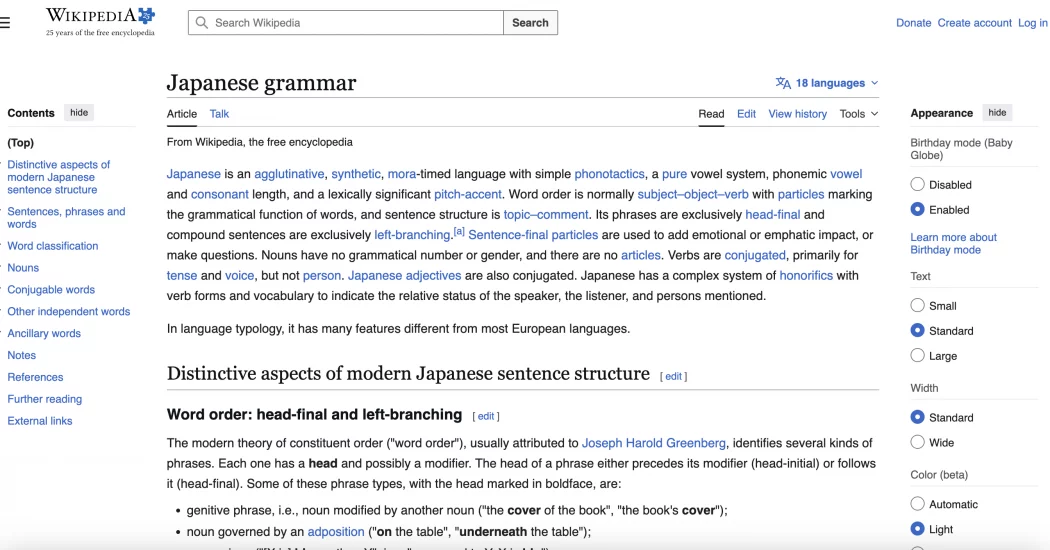
It might surprise you to see Wikipedia on this list. However, the Japanese Grammar article on Wikipedia is actually one of the most well-structured overviews available online — and it’s completely free.
The page covers a surprisingly wide range of topics: sentence structure, particles, verb conjugation classes, adjective types, honorific speech, and more. Because each section links out to deeper dedicated articles, it functions almost like a grammar map — a great place to get your bearings and then follow the thread wherever you need to go.
That said, Wikipedia reads more like an encyclopedia than a language-learning resource. The tone is academic, examples are less abundant than in dedicated grammar guides, and there’s no learning path to follow. Therefore, it works best as a high-level reference or a starting point for research — not as your primary study tool.
- Best for: Learners who want fast, comparative explanations of japanese grammar points.
- Cost: Free
- For further reading in Wikipedia
An Introduction to Japanese Syntax, Grammar & Language (Pomax)
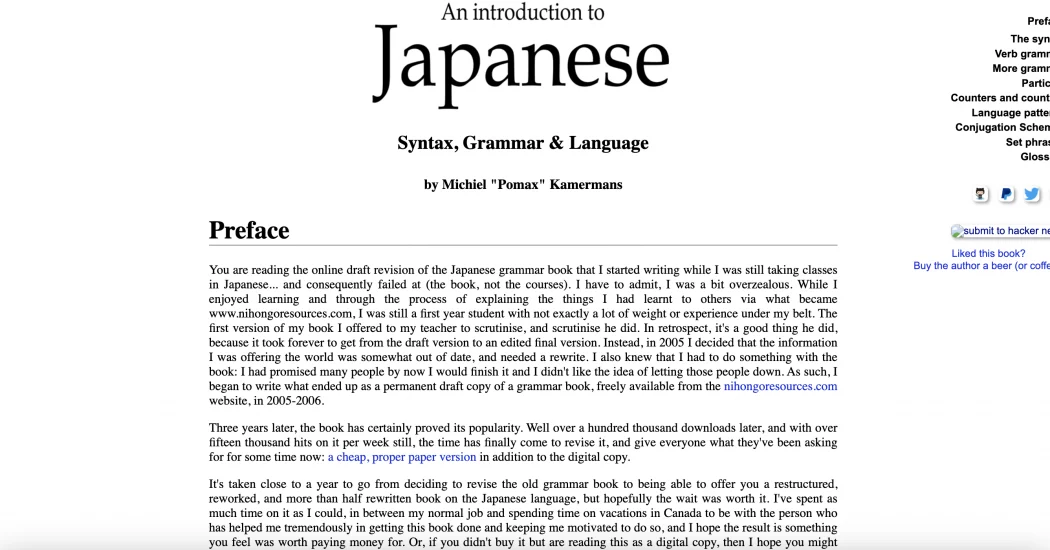
This one is a hidden gem. Written by Michiel “Pomax” Kamermans, it’s a single, long-form webpage that covers Japanese grammar from the absolute basics all the way through complex sentence structures. And when we say long-form, we mean it — this resource goes deep.
For learners who genuinely love understanding the “why” behind grammar rules, it’s incredibly satisfying. However, because it’s a single page rather than a searchable database, finding a specific grammar point takes a bit more effort than with other guides.
Think of it as a thorough, well-written grammar textbook that lives in your browser tab. It’s best read front-to-back when you have time to really dig in — not consulted on the fly mid-study session.
- Best for: Curious beginners who want a thorough, conceptual understanding of japanese grammar from the ground up.
- Cost: Free
- Link to the site
How to Use Multiple Japanese Grammar Resources Effectively
One of the most common mistakes language learners make is picking one resource and sticking to it exclusively. In reality, each guide has different strengths. Therefore, combining them is almost always the smarter move.
Here’s a simple approach that works well in practice:
- Use Tae Kim for structure. Start there to build your grammar foundation and learn the basics in order.
- Use Maggie Sensei for real-world usage. When you want to see how a pattern shows up in everyday conversation, search Maggie Sensei first.
- Use Wasabi for comparisons. When two similar grammar points confuse you, check Wasabi’s side-by-side breakdowns.
- Use Pomax for deep dives. When you want to truly understand a concept from the ground up, Pomax delivers the detail.
Additionally, pairing grammar study with vocabulary and kanji work makes everything click faster. If you’re working on JLPT prep, Kanji123 offers free kanji tests at every level — a great way to reinforce your reading skills while you build grammatical fluency.
Tips for Getting the Most Out of Japanese Grammar Study
Knowing where to study is important. But knowing how to study makes the real difference. Here are a few habits that genuinely help.
Get Comfortable with Hiragana and Katakana First
This one is non-negotiable. Almost every japanese grammar guide assumes you can read hiragana. If you’re still relying on romaji, that’s the first thing to fix.
Check out our beginner’s guide to the Japanese alphabet to get oriented, and then move into our dedicated hiragana learning guide and katakana guide to build that foundation solid.
Say the Example Sentences Out Loud
Reading grammar explanations is helpful. However, actually saying example sentences out loud — and then writing your own — locks the pattern in significantly faster. Your brain remembers what your mouth has practiced. So don’t just highlight; speak.
Don’t Ignore Kanji
Grammar and kanji are not separate topics. Most grammar patterns appear in real texts, and real texts use kanji. Therefore, building your kanji knowledge alongside your grammar study gives you a massive advantage.
If you’re newer to kanji, start with our kanji for beginners guide, then explore how to learn kanji the smart way. Once you’ve got some basics down, understanding kanji radicals will help you decode unfamiliar characters you encounter in grammar examples.
Chase Down the Nuances
Japanese grammar is full of subtle distinctions that can’t be learned by memorizing a rule. For instance, the difference between onyomi and kunyomi readings affects how kanji behave in different grammatical contexts. Our guide to onyomi vs kunyomi breaks it down clearly.
Similarly, once you’re reading more complex texts, understanding the full Japanese alphabet system — not just kana, but how hiragana, katakana, and kanji interact — becomes essential. These pieces don’t exist in isolation; they all work together inside real japanese grammar.
Build Your Japanese Grammar Toolkit
Here’s the key takeaway: there’s no single perfect japanese grammar resource. Each guide covers different ground and explains things from a different angle. Because of that, the best learners treat their grammar resources as a toolkit — not a single textbook.
Bookmark the resources above. Try each one with a grammar point you’re currently studying and notice which explanation clicks for you. Over time, you’ll develop an instinct for which tool to reach for and when.
And while you’re building that toolkit, don’t neglect the other pieces of the puzzle. If you want a broader overview of the best tools for all aspects of Japanese learning — not just grammar — our Japanese learning resource guide is a great next stop.
Japanese grammar takes time and patience. However, with the right resources in your corner, it’s absolutely learnable. So go ahead: bookmark this page, open a new tab, and start exploring.
Found this guide helpful? Test your kanji knowledge at Kanji123 — free JLPT kanji quizzes, no signup needed.
© Kanji123 — Free JLPT Kanji Test Online