The hiragana alphabet is the first thing every Japanese learner needs to tackle — and the good news is that it is far easier than it looks. In fact, most learners can read all 46 basic characters within one to two weeks. Because hiragana forms the backbone of written Japanese, mastering it unlocks textbooks, subtitles, menus, and so much more. Therefore, if you are serious about learning Japanese, this is where your journey begins.
In this guide, you will find everything you need: pronunciation tips, transformation rules, and memory tricks that actually stick. It is also part of our broader Learn Hiragana guide, where you will find everything from character charts to practice sheets — all in one place. So, let us get started.
This video provides beginners with specific information and methods to acquire Hiragana:
What Is the Hiragana Alphabet?
Hiragana is one of the three Japanese writing systems, alongside katakana and kanji. However, hiragana holds a special place — it is the foundational script that children in Japan learn first. Students of Japanese also start here, because hiragana appears in virtually every Japanese text.
Unlike kanji, each hiragana character does not represent a meaning. Instead, each character represents a sound — specifically, a vowel or a consonant-vowel syllable. This makes the hiragana alphabet a phonetic system, and that makes it wonderfully learnable.
Because hiragana is phonetic, you can start reading real Japanese words as soon as you learn the characters. That is a huge early win for motivation.
How Many Characters Does Hiragana Have?
The hiragana alphabet contains 46 basic characters. Beyond those, you will also encounter:
- Dakuten — a small mark that changes a consonant’s sound
- Handakuten — a small circle used for the ‘p’ sound column
- Combination characters — two hiragana joined to form a new syllable
So, in total, you will work with around 70–80 distinct sounds. That sounds like a lot. However, once you understand the logic of the system, it all falls into place quickly.
The Structure of the Hiragana Alphabet
The 5 Core Vowels
Everything in the hiragana alphabet starts with the five vowels. These are the most important characters to learn first, because every other row builds on them.
| Character | Romaji | Sound | Mnemonic |
| あ | a | “ah” | A skater doing an ah-mazing trick |
| い | i | “ee” | Two drips of water — “Ee! That’s wet!” |
| う | u | “oo” | Someone straining at weight — “Oogh!” |
| え | e | “eh” | A runner sprinting — “I’ve never run this fast!” |
| お | o | “oh” | Cogs turning — “Oh, that’s how it works!” |
Importantly, these vowel sounds stay consistent throughout the entire hiragana system. So once you know them, you can predict the pronunciation of every other character.
The Consonant Rows
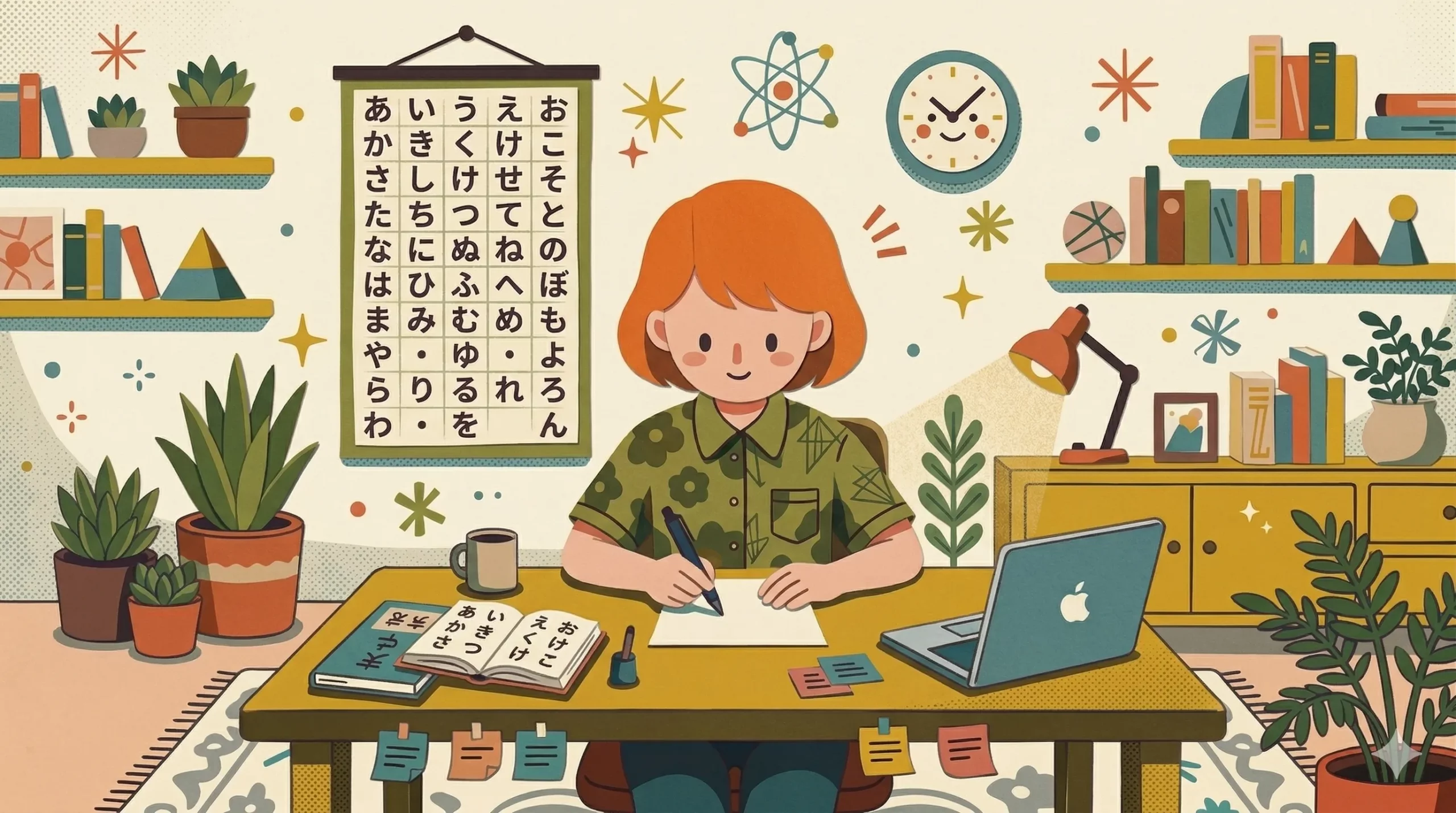
After the vowels, hiragana characters are grouped into rows by their consonant sound. Each row follows the same vowel order: a, i, u, e, o. For example, the K-row looks like this:
| か | き | く | け | こ |
| ka | ki | ku | ke | ko |
This pattern continues through the N, H, M, Y, R, and W rows, plus the standalone character ん (n). Because the structure is so consistent, you do not need to memorise each character in isolation — you learn the system, and the characters follow.
💡 Tip: Study one row per day. In one week, you will know the full hiragana alphabet.
How to Memorise Hiragana Characters Fast
Use Mnemonics — The Best Trick for Beginners
A mnemonic is a memory aid that links something new to something you already know. For hiragana, image-based mnemonics work especially well. This is because each character has a unique shape, and shapes are easy to connect to pictures or stories.
Here are mnemonics for all five vowels to get you started:
| Character | Romaji | Sound | Mnemonic |
| あ | a | “ah” | A skater doing an ah-mazing trick |
| い | i | “ee” | Two drips of water — “Ee! That’s wet!” |
| う | u | “oo” | Someone straining at weight — “Oogh!” |
| え | e | “eh” | A runner sprinting — “I’ve never run this fast!” |
| お | o | “oh” | Cogs turning — “Oh, that’s how it works!” |
Practice with Real Words Early
Additionally, you should connect new characters to words you already recognise. For example, once you learn す (su) and し (shi), you can read すし — sushi. Seeing familiar words in hiragana gives your brain a meaningful hook. You can find structured exercises in our Hiragana Practice Sheets a great companion to this guide.
Hiragana Transformations: Going Beyond the Basics
Dakuten and Handakuten
The hiragana alphabet would not be complete without its transformation marks. Dakuten (゛) is a small pair of strokes added to the top right of a character. It shifts a voiceless consonant to its voiced equivalent. Handakuten (゜) is a small circle used exclusively with the H-row to produce P sounds.
| Base | Changed | Shift | |
| か (ka) | → | が (ga) | k → g |
| さ (sa) | → | ざ (za) | s → z |
| た (ta) | → | だ (da) | t → d |
| は (ha) | → | ば (ba) | h → b |
| は (ha) | → | ぱ (pa) | h → p (handakuten ゜) |
Because these marks are small, beginners sometimes overlook them in text. However, missing a dakuten completely changes the meaning of a word — so train your eye to spot them from day one.
Combination Characters
Combination characters are formed by pairing a character from the ‘i’ row with a small や (ya), ゆ (yu), or よ (yo). The result is a two-character unit that represents a single blended sound. You will recognise these sounds in words like gyoza (ぎょうざ) and shamisen (しゃみせん).
| や (ya) | ゆ (yu) | よ (yo) |
| きゃ kya | きゅ kyu | きょ kyo |
| ぎゃ gya | ぎゅ gyu | ぎょ gyo |
| しゃ sha | しゅ shu | しょ sho |
| じゃ ja | じゅ ju | じょ jo |
| ちゃ cha | ちゅ chu | ちょ cho |
| にゃ nya | にゅ nyu | にょ nyo |
| ひゃ hya | ひゅ hyu | ひょ hyo |
| びゃ bya | びゅ byu | びょ byo |
| ぴゃ pya | ぴゅ pyu | ぴょ pyo |
| みゃ mya | みゅ myu | みょ myo |
| りゃ rya | りゅ ryu | りょ ryo |
The Small っ: Hard Stops in Hiragana
One more character deserves special attention: the small っ (tsu). When written small, it does not represent a sound on its own. Instead, it signals a brief pause or a doubled consonant in the following syllable. This tiny character makes a real difference in meaning:
| Without っ | Meaning | With っ | Meaning |
| ろく | roku | ろっく | rokku |
| ざし | zashi | ざっし | zasshi |
Therefore, pay close attention to the size of つ whenever you encounter it. Furthermore, this doubled-consonant pattern appears frequently in everyday Japanese words.
How Hiragana Fits into the Broader Japanese Writing System
Hiragana vs. Katakana
Both hiragana and katakana represent the same set of sounds. However, they look completely different and serve different purposes. Katakana is used mainly for foreign loanwords, scientific terms, and emphasis. By contrast, hiragana handles native Japanese grammar. Because the two scripts share the same sound system, learning katakana after hiragana is much faster. You can read more in our Hiragana vs Katakana guide.
Hiragana vs. Kanji
Kanji characters represent meaning, not sound. Therefore, they work very differently from hiragana. For beginners, hiragana is your bridge into kanji study. Check out our Beginner’s Guide to Kanji to see how the two scripts work together.
Common Mistakes Beginners Make with Hiragana
Confusing Similar-Looking Characters
Several hiragana characters look nearly identical to each other. These pairs trip up almost every beginner:
- ぬ (nu) vs. め (me) — both have a looping stroke on the right
- は (ha) vs. ほ (ho) — very similar shape, one extra stroke
- わ (wa) vs. れ (re) vs. ね (ne) — all share a curved top-left stroke
The best solution is to study confusable pairs together, side by side. Additionally, writing the characters by hand helps your brain encode the small differences much more reliably.
Skipping Stroke Order
Stroke order matters more than many beginners expect. Because stroke order affects how your handwriting flows and looks, ignoring it leads to messy, hard-to-read characters. Moreover, proper stroke order makes writing faster once it becomes habit. Therefore, learn the correct stroke direction from the start.
Trying to Learn Too Many Characters at Once
Cramming all 46 characters in a single sitting leads to rapid forgetting. Instead, spread your study across several sessions and use spaced repetition. Our Hiragana Flashcard is built around exactly this method.
How Long Does It Take to Learn the Hiragana Alphabet?
Most beginners can read all 46 basic hiragana characters within one week of consistent daily practice. If you study for 20–30 minutes a day, that is a very achievable goal. Some motivated learners cover the full alphabet in a weekend.
However, reading hiragana fluently — recognising characters instantly without sounding them out — takes longer. Expect two to four weeks of regular reading practice to reach that level. Therefore, do not stop after memorising the chart. Instead, start reading hiragana in real sentences as soon as possible.
Frequently Asked Questions
Is hiragana the same as the Japanese alphabet?
Not exactly. Japanese has three writing systems: hiragana, katakana, and kanji. However, hiragana is the most foundational of the three — so calling it ‘the Japanese alphabet’ is a common and understandable shorthand.
Can I learn Japanese without learning hiragana?
Technically, you can learn some spoken Japanese using only romanisation. However, this approach severely limits your progress. Because almost all Japanese learning materials use hiragana, skipping it leaves you unable to use textbooks, apps, or real-world reading practice.
Do I need to learn hiragana before katakana?
Yes — learning hiragana first is the standard approach. Because hiragana and katakana share the same sounds, knowing hiragana makes katakana much easier to pick up. Most learners study hiragana, then katakana, and then begin kanji.
Is hiragana used in modern Japan?
Absolutely. Hiragana appears in every form of Japanese writing — books, newspapers, websites, signage, and children’s media. Furthermore, it is the script used for all grammatical elements of the Japanese language. So hiragana never becomes obsolete, even at advanced levels.
Start Reading the Hiragana Alphabet Today
Now you have everything you need to begin. The hiragana alphabet has 46 characters, a logical structure, and a mnemonic-friendly shape for every single one. Because it is phonetic and consistent, it rewards focused study quickly.
Start with the five vowels. Then work through one consonant row per day. Additionally, pair your chart study with real reading practice as early as you can. Before long, hiragana will feel effortless — and the rest of Japanese will open up in front of you.
Ready to put this into practice? Explore our full Hiragana with charts, mnemonics, stroke order guides, and spaced-repetition flashcards all in one place.