You can memorize vocabulary, review grammar, and even recognize a decent number of kanji. Then a native speaker starts talking, and suddenly your brain files for early retirement.
If that sounds familiar, you are not failing. Japanese listening practice is simply a different skill. Reading Japanese and hearing Japanese are not the same thing. In fact, many learners discover this the hard way.
The good news is that listening improves much faster when you train it the right way. You do not need magic ears. You need smart practice, good material, and a routine you can actually stick to.
If you are still building your foundation, start with this guide on how to learn Japanese so your listening work fits into a bigger study plan. Also, if kana still slow you down, polishing your hiragana learning and katakana skills will help more than you might think.
In this guide, we will break down Japanese listening practice into methods that work for beginners, intermediate learners, and more advanced students. No fluff. No heroic “just watch anime for six hours a day” advice. Just practical steps.
Why Japanese listening feels so hard at first
Japanese can feel slippery when you hear it. Words blend together. Particles get swallowed. Native speakers shorten phrases in casual conversation. As a result, even familiar words can sound brand new.
There is also the issue of speed. When you read, you control the pace. However, when you listen, the sentence keeps moving whether you are ready or not. That creates pressure, and pressure makes everything sound harder.
Another problem is that many learners know words only in their written form. You may recognize a word in kanji, but not catch it when someone says it quickly. This is one reason kanji for beginners should always connect with real pronunciation, not just memorization.
Still, this stage is normal. Japanese listening feels difficult at first because your ear is learning patterns it has never tracked before. Once those patterns become familiar, comprehension improves more quickly than most learners expect.
Japanese listening practice starts with active listening
If you do only one thing consistently, make it active listening. It gives structure to your study, and it teaches your brain to notice what it usually ignores.
Active listening means you do not just press play and hope for the best. Instead, you listen with a clear goal.
Here is a simple method:
- Choose audio that you understand at about 60 to 70 percent.
- Listen once for the general meaning.
- Listen again and focus on missed words or sounds.
- Check the transcript, subtitles, or notes.
- Listen one more time to confirm what changed.
That middle zone matters a lot. If the audio is too easy, you coast. If it is too hard, your brain turns into soup. Therefore, aim for material that challenges you without completely destroying your confidence.
This is also where beginner-friendly resources help. A curated Japanese learning resource list can save you from wasting time on content that is way above your level.
How to find the right listening level
A good rule is simple: you should understand enough to follow the topic, but not every detail. If you miss almost everything, step down. If you understand nearly every line, step up.
For absolute beginners, slow Japanese with transcripts works best. For intermediate learners, short podcasts or YouTube clips are ideal. Advanced learners should spend more time with natural conversations, interviews, and unscripted content.
Because difficulty matters so much, picking the right audio is often more important than studying longer.
Shadowing: one of the best Japanese listening practice methods
Shadowing sounds fancy, but it is straightforward. You listen to a sentence and repeat it as closely as possible. You copy the rhythm, tone, and timing. In other words, you train your ears and mouth together.
This works because speaking and listening support each other. When you learn how Japanese sounds in your own mouth, you also become better at hearing it in real speech.
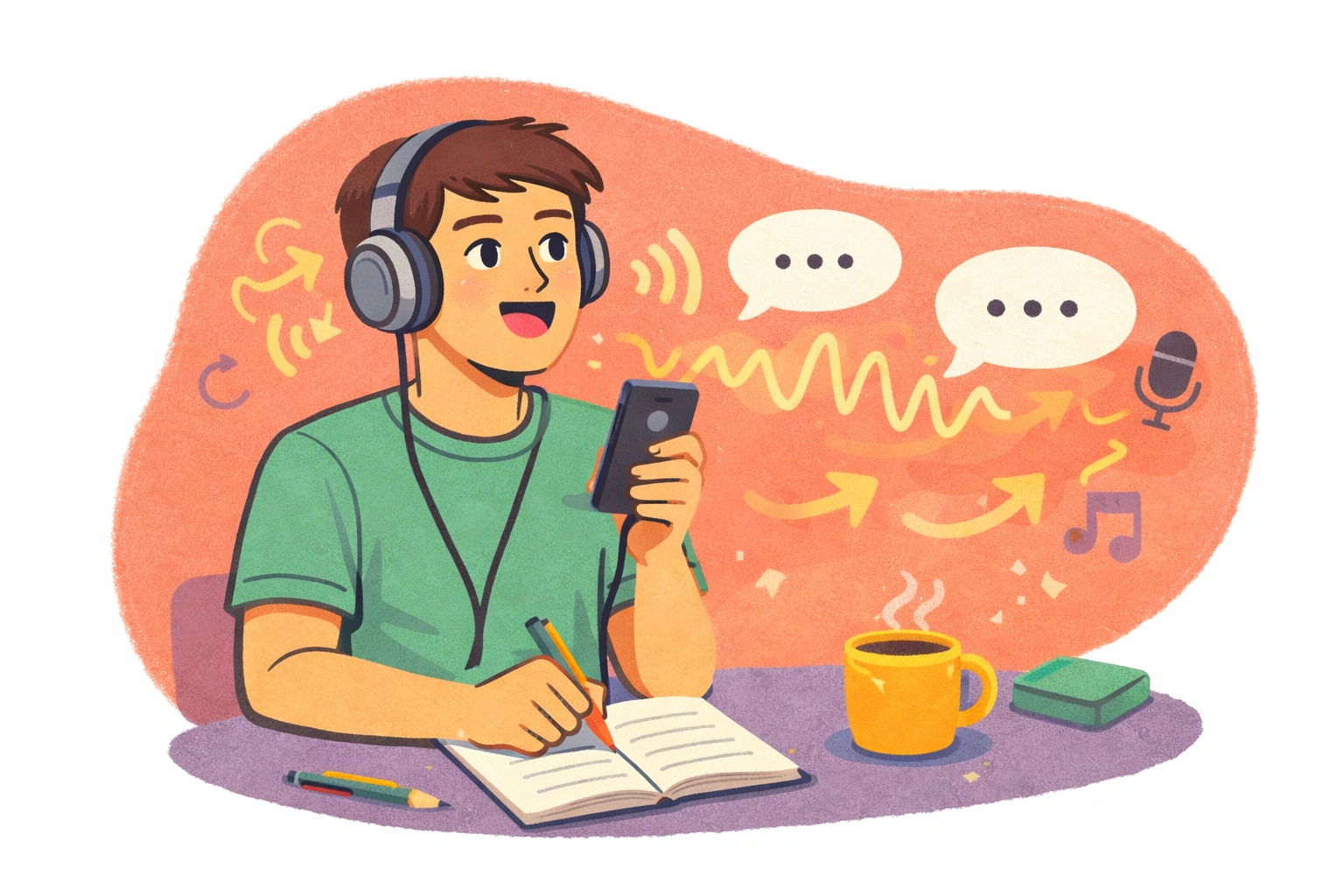
Here is how to do it:
- Pick a short audio clip with clear pronunciation.
- Listen once without speaking.
- Play it again and repeat right after the speaker.
- Focus on matching the flow, not on perfect translation.
- Repeat until the line feels natural.
At first, shadowing may feel awkward. That is fine. Everyone sounds a little chaotic in the beginning. The point is not to sound elegant on day one. The point is to build sound awareness.
For beginners, short learner dialogues work well. For advanced learners, short clips from interviews, dramas, or podcasts can be excellent. However, do not jump into fast native content too early. That often leads to frustration, not progress.
If your reading side also needs work, learn kanji the smart way so you can connect spoken words with written forms more efficiently.
Transcription practice: hard, helpful, and slightly humbling
Transcription is exactly what it sounds like. You listen to a short audio clip and write down what you hear.
Yes, it is hard. Yes, it can be annoying. Also yes, it works.
Transcription forces you to notice tiny details. You start catching long vowels, small pauses, dropped particles, and sound changes that usually slip past you. Because of that, it is one of the fastest ways to diagnose weak spots.

Try this process:
- Choose a clip that is under 30 seconds.
- Write down everything you hear.
- Replay the clip several times.
- Compare your answer with the transcript.
- Mark the sounds or words you missed.
Do not do this for an hour straight unless you enjoy suffering recreationally. Ten to fifteen focused minutes is enough.
Japanese listening practice for JLPT learners
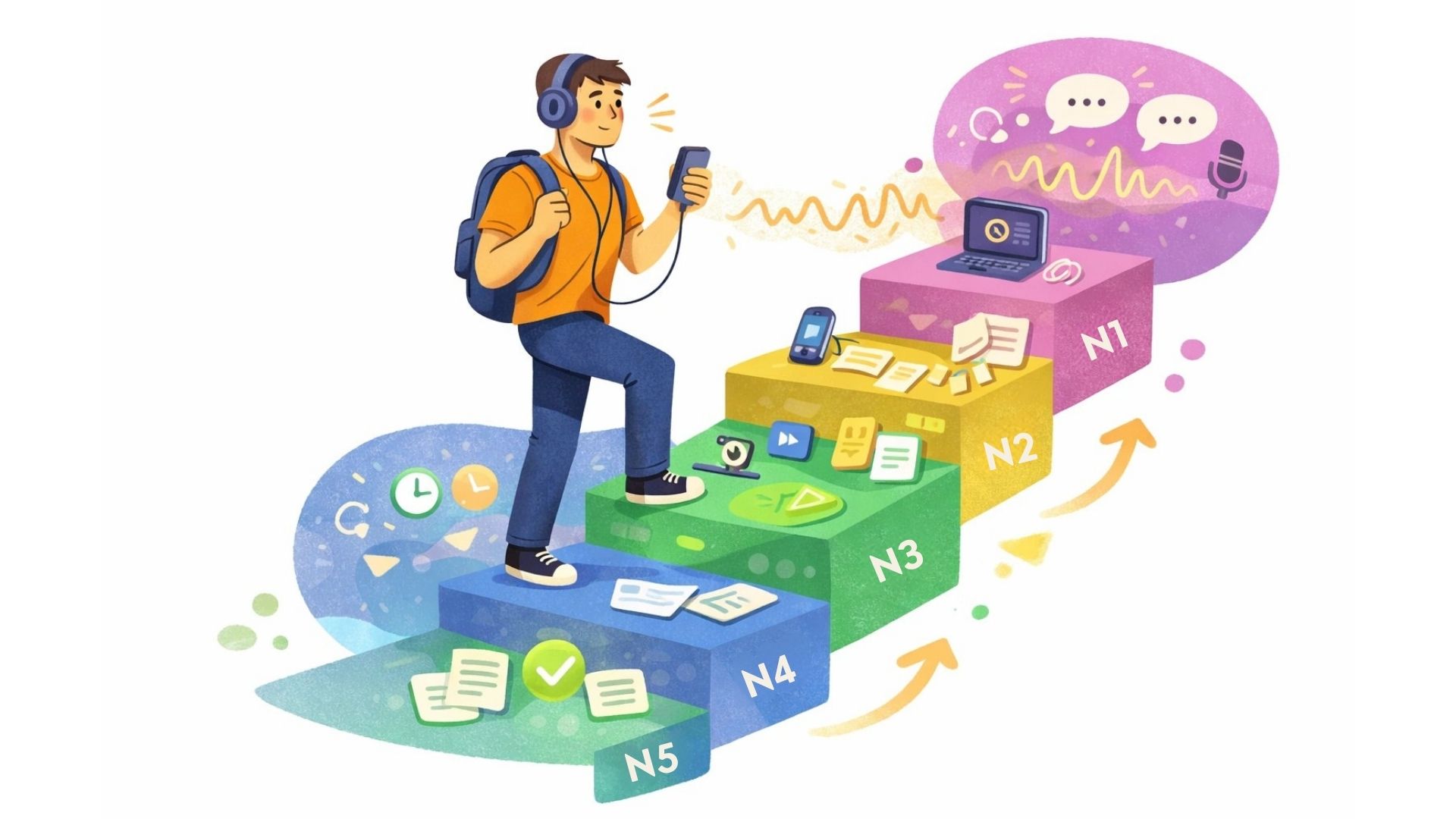
If you are studying for the JLPT, your listening practice should include test-style training. The exam is not just about understanding Japanese. It is also about handling speed, pressure, and predictable question types.
First, practice with timed audio. That helps you get used to making quick decisions. Second, train with slightly faster playback, around 1.25x. When you return to normal speed, the original audio often feels more manageable.
Just do not overdo it. Speed training helps when used carefully. However, if the material becomes incomprehensible, the benefit disappears.
For a stronger foundation, review this Japanese grammar friendly guide for beginners. Grammar knowledge helps listening far more than many learners realize, especially in JLPT-style conversations.
You can also support your test prep with the Kanji123, since stronger kanji recognition often improves your vocabulary recall during listening.
Real conversation is where everything gets real
Recorded audio is useful, but real conversation is the final boss. People interrupt each other. They hesitate. They mumble. They change direction mid-sentence. Very rude, honestly.
Still, this kind of practice matters because real listening is messy. If you only train with polished textbook audio, natural speech will keep shocking you.
You do not need daily language exchanges to benefit. Even 15 minutes a week can help. Short conversations with a tutor, study partner, or language exchange friend can reveal gaps that recordings never show.
Because live interaction is unpredictable, it teaches flexible listening. That is exactly the skill many learners need most.
Use video for Japanese listening practice, not just audio
Video gives you context. You can see facial expressions, gestures, settings, and actions. Therefore, video often feels easier than audio-only content at the same language level.
That extra context is not cheating. It is support. In fact, it helps your brain link language to meaning more naturally.
A simple three-pass method works well:
- Watch with English subtitles for context.
- Watch again with Japanese subtitles.
- Watch a third time without subtitles.
This approach helps you move from understanding the situation to noticing the language itself.
Is anime good for listening practice?
Anime can help, but it is not always ideal. Some shows use exaggerated speech, unusual character voices, or dramatic phrasing that you will not hear in everyday life.
That does not mean anime is useless. It just means you should choose carefully. Slice-of-life shows are usually better than fantasy battles where everyone sounds like they are announcing the end of civilization.
Japanese dramas, interviews, vlogs, and learner-focused YouTube channels often provide more natural speech. As a result, they can be better for practical listening improvement.
Podcasts and audio resources you can actually use
Podcasts are excellent because they fit into real life. You can listen while walking, commuting, or pretending to enjoy cleaning.
For beginners, choose slow podcasts with transcripts. These help you build confidence and connect sound with meaning. For intermediate learners, story-based podcasts and simplified news are strong choices. For advanced learners, native podcasts about daily life, culture, or hobbies work very well.
Try matching the content to your level and interests. That matters because interest keeps you consistent. Consistency beats intensity almost every time.
If you are still learning the writing system, Japanese alphabet for beginner is a useful refresher. Better kana fluency makes transcript-supported listening much smoother.
You can also strengthen vocabulary alongside listening with Learn Kanji & Japanese Vocabulary and reinforce your kana with MochiKana – Learn Japanese Alphabet.
Build a daily routine that does not collapse after three days
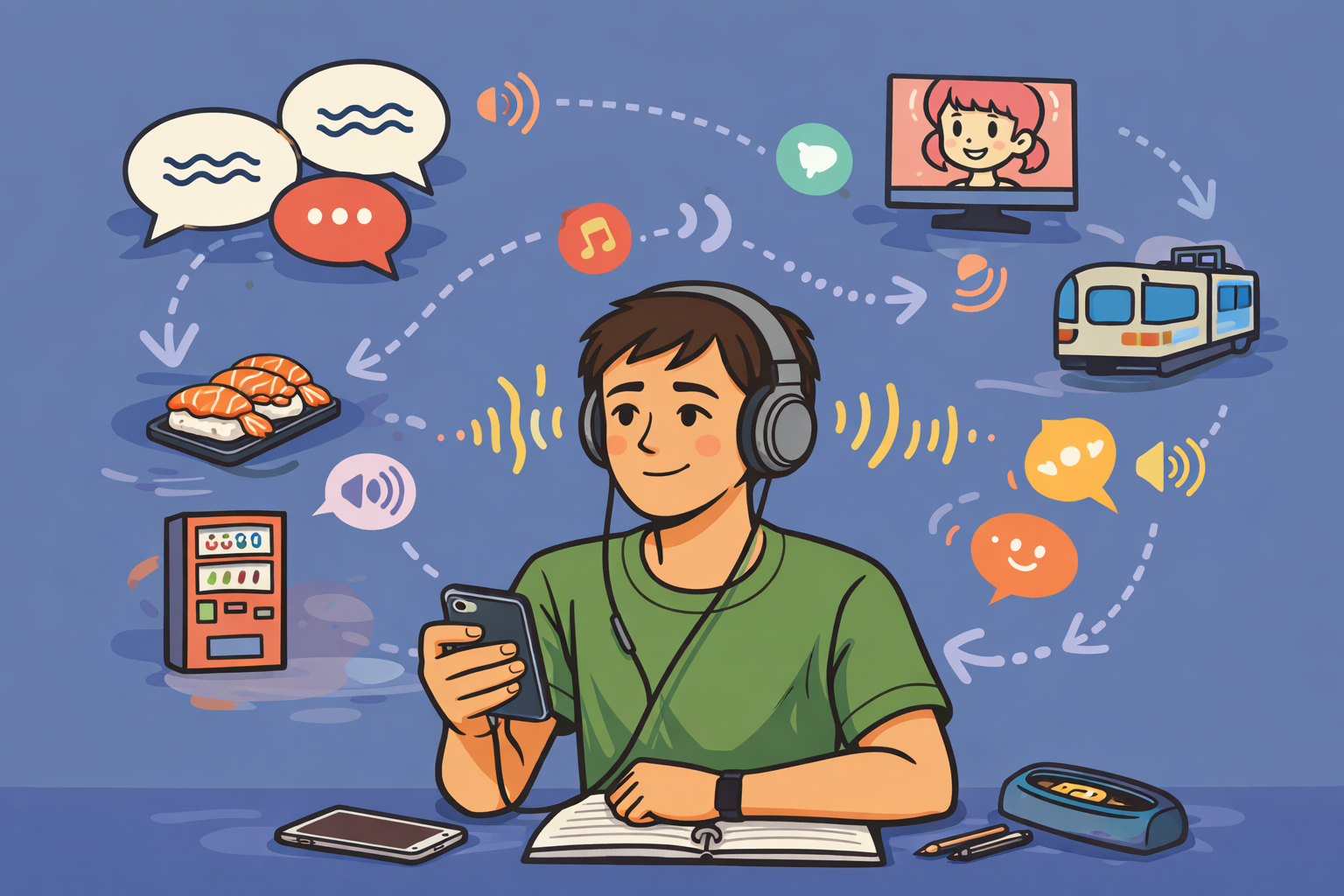
The best Japanese listening practice routine is not the most ambitious one. It is the one you actually follow next week.
A simple daily routine might look like this:
- 10 minutes of shadowing in the morning
- 10 to 15 minutes of active listening later in the day
- 10 minutes of light passive listening in the evening
That is enough to create momentum. In addition, the variety keeps practice from getting stale.
If 30 minutes feels too heavy, start with 10. Seriously. Ten focused minutes every day will beat one dramatic two-hour session followed by four days of avoidance.
Vocabulary matters more than people want to admit
Listening is not only about hearing sounds correctly. It is also about knowing enough words to understand what you heard.
For basic everyday conversation, a few thousand words can take you surprisingly far. However, more complex shows, podcasts, and real conversations demand a much larger vocabulary.
Here is the catch: reading vocabulary and listening vocabulary are not identical. You may know a word on the page but miss it in speech. Therefore, every new word should be learned with audio when possible.
This is why combining listening with reading is so effective. When you connect spoken forms, kana, and kanji, the word becomes easier to recognize in real time.
If you want a better base, revisit how to learn Japanese and keep expanding your vocabulary through reading, review, and repeated exposure.
Common mistakes that slow down listening progress
Many learners make the same mistakes, so let’s save you some pain.
Using material that is far too hard
Harder is not always better. If you understand almost nothing, you are not training efficiently. You are mostly absorbing confusion.
Treating listening like passive background noise
Passive listening has value, but it cannot do all the work. You still need focused practice where you actively notice sounds, words, and patterns.
Ignoring grammar
Grammar is not just for tests. It helps you predict sentence structure and understand relationships between words. Because of that, stronger grammar usually leads to stronger listening.
Studying inconsistently
A huge session once a week feels productive. Daily exposure works better. Japanese listening improves through repetition, not heroics.
Put it all together
If you want better results, keep your approach simple.
Use active listening to train comprehension. Add shadowing to improve rhythm and sound awareness. Use transcription to find weak spots. Practice with video for context. Add podcasts for daily exposure. Then bring everything into real conversation whenever you can.
That combination works because each method trains a different part of listening. Together, they build real comprehension instead of fake confidence.
And that is the goal. Not just recognizing a few words here and there, but actually understanding Japanese as it happens.
Final thoughts on Japanese listening practice
Japanese listening practice can feel brutal in the beginning. Then one day, you catch a phrase without effort. Later, you follow a full sentence. After that, a short conversation starts to feel normal.
Progress often sneaks up on you.
So keep going. Choose material that fits your level. Practice a little every day. Use tools and resources that make the process easier, not heavier. Most importantly, do not confuse “this is hard” with “this is not working.”
It is working.
You are just building the skill in real time.
For your next step, explore Japanese learning resources, review core Japanese grammar, and keep growing your reading base with kanji study for beginners. The more connected your skills become, the easier listening gets.
FAQ
How can beginners start Japanese listening practice?
Beginners should start with slow audio, short clips, and transcript-supported content. Active listening and shadowing are great starting methods because they build comprehension without overwhelming you.
How long does it take to improve Japanese listening?
It depends on your consistency, level, and materials. However, many learners notice small improvements within a few weeks when they practice regularly with level-appropriate audio.
Does grammar really help with listening?
Yes. Grammar helps you understand sentence structure, predict meaning, and catch how words connect. That is why grammar study often improves listening faster than learners expect.
Is watching anime enough for Japanese listening practice?
Anime can help, but it should not be your only resource. Some anime uses exaggerated or unnatural speech. For balanced progress, mix anime with podcasts, dramas, conversations, and learner-friendly audio.
© Kanji123 — Free JLPT Kanji Test Online