
So you’re wondering how long it takes to learn Japanese.
That’s actually a smart question to ask before you dive in — not because the answer should scare you off, but because knowing the real timeline helps you plan properly and avoid the frustration that kills most learners’ motivation somewhere around month four.
Here’s the honest truth: there’s no single number. However, there are reliable patterns. And once you understand what drives those patterns, you can make smarter choices that shave months — sometimes years — off your journey.
This guide breaks it all down: hour estimates by goal, JLPT level benchmarks, what actually speeds things up, and a concrete first-week plan so you can stop researching and start moving.
What Does “Learning Japanese” Actually Mean?
Before we talk hours, we need to agree on what the finish line looks like. Because “learning Japanese” means completely different things to different people — and therefore takes completely different amounts of time.
Consider the range:
- Ordering confidently at a ramen shop in Tokyo
- Watching your favorite anime without subtitles
- Passing the JLPT N2 for a job requirement
- Reading Haruki Murakami in the original Japanese
- Holding business meetings entirely in Japanese
These goals are not on the same planet, timeline-wise. Therefore, the first thing you need to do — before you open a single app or textbook — is define what your version of “learned Japanese” actually looks like.
For most people reading this, the realistic goal falls somewhere in the middle: comfortable conversation, the ability to navigate daily life in Japan, and reading enough to enjoy some media in Japanese. That’s a meaningful, achievable goal. Furthermore, it’s the benchmark we’ll use throughout this guide.If you’re starting from absolute zero, a good first step is understanding how the Japanese writing systems fit together. That context alone will change how you approach everything else.
The Official Numbers: What FSI Research Says
The U.S. Foreign Service Institute trains diplomats to use foreign languages in high-stakes, professional environments. Their research on Japanese is the most-cited data point in language learning — and it’s both useful and widely misunderstood.
Their estimate: 2,200 classroom hours to reach professional working proficiency.
Here’s what most articles leave out, though. That estimate applies to experienced language learners — people who already speak two or three other languages — in intensive, structured classroom environments with expert instructors. When you factor in self-study time on top of those classroom hours, the total climbs closer to 4,000–4,500 hours.
That sounds frightening. However, you almost certainly don’t need professional working proficiency. Most people want conversational fluency — and that’s a very different target.
So What Does “Good Enough” Actually Require?
For solid conversational ability — the kind where you can handle real-life situations in Japan, enjoy Japanese media, and hold meaningful conversations — most learners need somewhere between 1,000 and 2,000 hours of quality study time.
That’s still a lot. However, those hours go much faster when you study consistently and use the right methods. In addition, “quality” matters here more than raw quantity — 500 focused hours outperforms 1,000 scattered ones every single time.
How Long Does It Take to Learn Japanese by JLPT Level?
The Japanese Language Proficiency Test gives us the clearest benchmarks available. Because each level has defined vocabulary, kanji, and grammar targets, you can actually plan your timeline around them rather than chasing a vague idea of “fluency.”
Here’s a realistic breakdown for an English-speaking adult studying from zero.

JLPT N5 — Absolute Beginner
- Study hours needed: 250–600 hours
- Calendar estimate: 3–6 months at 1–2 hours/day
N5 is the entry point. At this level, you can introduce yourself, read basic hiragana and katakana, and handle simple everyday phrases. You’ll know roughly 100 kanji and 800 vocabulary words.
It sounds modest. But getting here cleanly — with solid reading skills and a real understanding of basic grammar — sets up everything that follows. Therefore, don’t rush this stage.
JLPT N4 — Basic Proficiency
- Study hours needed: 400–900 hours total
- Calendar estimate: 6–12 months at 1–2 hours/day
N4 is where Japanese starts to feel real. You can hold simple conversations, read basic texts, and understand slow, clear speech. Your kanji count climbs to around 300, and your vocabulary reaches roughly 1,500 words.
In addition, N4 is usually the level where most self-taught learners start to feel genuinely excited — because things are starting to click.
JLPT N3 — Intermediate
- Study hours needed: 700–1,700 hours total
- Calendar estimate: 1–2 years at 1–2 hours/day
N3 is the milestone that separates casual learners from committed ones. At this level, you can navigate most everyday situations in Japan, understand the gist of TV shows and conversations, and read standard text with some dictionary help.
N3 also requires about 650 kanji and 3,750 vocabulary words. That’s where a systematic approach to kanji — rather than trying to memorize characters one by one — becomes genuinely essential. Our kanji for beginners guide explains how to build that foundation without burning out.
JLPT N2 — Advanced
- Study hours needed: 1,600–2,800 hours total
- Calendar estimate: 2–4 years at 1–2 hours/day
N2 is the level that opens professional doors. Many Japanese companies and universities accept N2 as proof of working-level proficiency. At this point, you can read news articles, understand most TV content without subtitles, and handle most workplace communication.
N2 requires roughly 1,000 kanji and around 6,000 vocabulary words. However, the bigger challenge at this stage isn’t memorization — it’s getting enough exposure to how Japanese is actually used in real life.
JLPT N1 — Near-Native
- Study hours needed: 3,000–4,800 hours total
- Calendar estimate: 3–6 years at 1–2 hours/day
N1 is the summit. Even native Japanese speakers sometimes struggle with N1’s literary and technical vocabulary. At this level, you can handle academic writing, legal documents, complex literature, and anything else the language throws at you.
N1 also demands around 2,000 kanji. Therefore, your kanji strategy from day one has an enormous impact on how long this level actually takes you.
| Quick reference: Try the free JLPT kanji tests on Kanji123 to see which level you’re currently at — no account needed. |
The Kanji Factor: Why Your Starting Point Changes Everything
Here’s the single biggest variable in how long it takes to learn Japanese: how much kanji knowledge you bring to the table before you even start.
Research consistently shows that prior kanji knowledge cuts advanced-level study time by 30–50%. A Chinese speaker who already recognizes hundreds of characters might reach N1 in 1,700–2,600 hours. An English speaker starting from zero? That same goal takes 3,000–4,800 hours.
That’s nearly double. Because of this, how you approach kanji in your first few months will have a larger impact on your total timeline than almost any other decision you make.
The Wrong Way to Learn Kanji
Most beginners treat kanji like random symbols to memorize through repetition. They write the same character fifty times, forget it a week later, and write it fifty more times. This method works — eventually. However, it’s painfully slow and deeply frustrating.
The Smarter Approach: Radicals and Mnemonics
Kanji are not random. Each character is built from smaller visual components called radicals, and each radical carries a meaning. Once you learn to see those components, you can create memorable stories that make new kanji stick immediately.
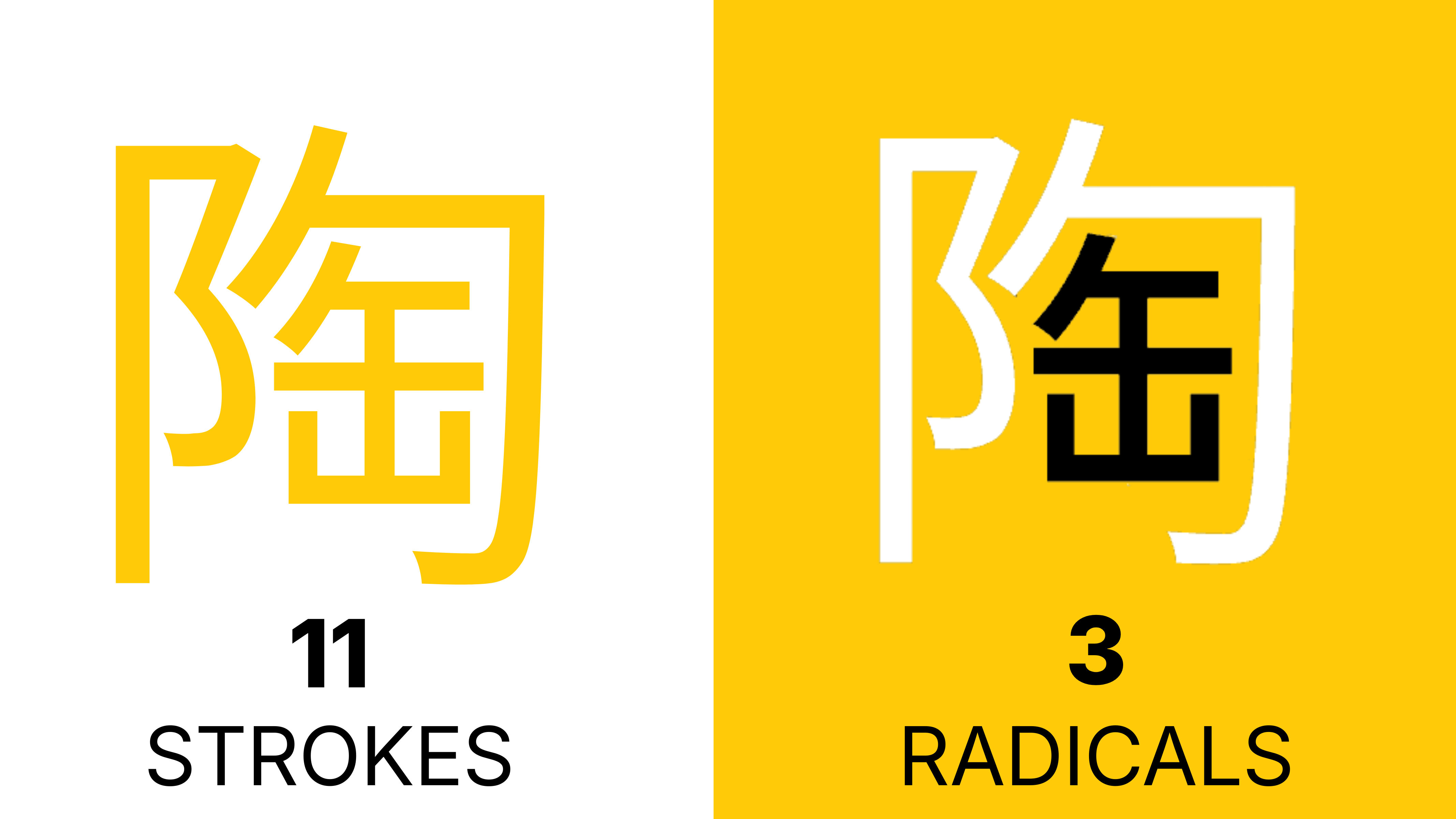
For example: the kanji 陶 (pottery) combines 阝 (hill/clay), 勹 (embrace/hands), and 缶 (jar). Hands shaping clay from the earth into a jar — pottery. You see it once and remember it forever. Our guide to kanji radicals walks you through this entire system so you can apply it from your very first character.
In addition, understanding on’yomi and kun’yomi — the two types of kanji readings — removes another major source of confusion early on. Most learners discover this concept three months in and wish they’d understood it on day one.
For a complete system that combines radicals, mnemonics, and spaced repetition into one efficient routine, see our smart kanji learning guide. It’s the closest thing to a shortcut that actually works.
What Actually Speeds Up Japanese Learning
After looking at what successful learners do differently from those who plateau or quit, a few patterns show up consistently. These aren’t hacks. They’re just smart decisions made early.
Consistency Beats Intensity Every Time
Thirty minutes every single day produces better results than three hours crammed into a Saturday. This is not motivational advice — it’s how memory consolidation actually works.
Your brain builds language pathways through repeated, spaced exposure. Therefore, daily contact with Japanese — even in small amounts — is more effective than occasional marathon sessions. Aim for a daily minimum you can actually maintain. Twenty minutes counts. So does thirty. Just don’t skip days.
Active Use Matters More Than Passive Exposure
Watching anime with English subtitles is entertainment. It’s valuable, enjoyable entertainment — but it’s not studying. Real progress comes from active engagement: speaking, writing, actively reading, and retrieving vocabulary from memory rather than just recognizing it.
In addition, producing the language — even badly — accelerates learning faster than any amount of passive listening. Start speaking Japanese earlier than feels comfortable. Mistakes are not setbacks. They’re the mechanism.
Your Goal Determines Your Method
Someone studying Japanese for a Tokyo vacation needs different things than someone preparing for JLPT N2. However, most learning resources treat all students the same. Choosing tools and content that match your specific goal saves enormous amounts of time and energy.
For a curated list of free tools organized by goal and level, our Japanese learning resources guide covers every stage from absolute beginner to advanced.
Vocabulary Before Grammar Pays Off Later
Grammar feels urgent, and most beginners rush straight to it. However, learners who build a strong vocabulary base first find grammar far easier to absorb. When you know 80% of the words in a sentence before studying it, you can focus entirely on the grammar pattern instead of juggling multiple unknowns at once.
That’s the “plus one” approach: every new thing you learn should have only one unknown element. It feels slower early on. But it accelerates dramatically once the foundation is in place.
Why Traditional Study Methods Take Longer Than They Should
The FSI’s 2,200-hour estimate is based on traditional classroom instruction: grammar drills, vocabulary lists, and carefully controlled textbook dialogues. The method works. However, it’s not optimized for efficiency — it’s optimized for consistency across large groups of learners with very different needs.
The Textbook-Real Life Gap
Here’s the core problem with starting in a textbook: textbook Japanese and real Japanese are genuinely different languages. You can memorize “This is a pen” until you dream in Japanese grammar and still freeze completely when someone says 「ちょっと待って」or 「マジで?」 in a natural conversation.
Real Japanese is faster, messier, and full of contractions and casual speech that textbooks treat as optional advanced material. Most learners encounter this gap somewhere around the N3 level — and it’s jarring enough to stall progress for months.
The Efficient Alternative
The most effective modern approach flips the traditional model. Start with the writing systems first — hiragana and katakana can each be learned in a few days with the right method. Then build a kanji and vocabulary base using spaced repetition. After that, tackle grammar with real sentences rather than constructed examples.
This sequence feels counterintuitive at first. However, learners who follow it consistently reach conversational ability significantly faster than those who start with grammar and use vocabulary as an afterthought.
If you want the full roadmap in one place, our learn Japanese guide walks through every step in order, with time estimates and tool recommendations for each stage.
Your First Week: A Practical Action Plan
Most “how long does it take” articles end with timelines and leave you wondering where to actually begin. So here’s a concrete first week — seven days that set you up for everything that follows.
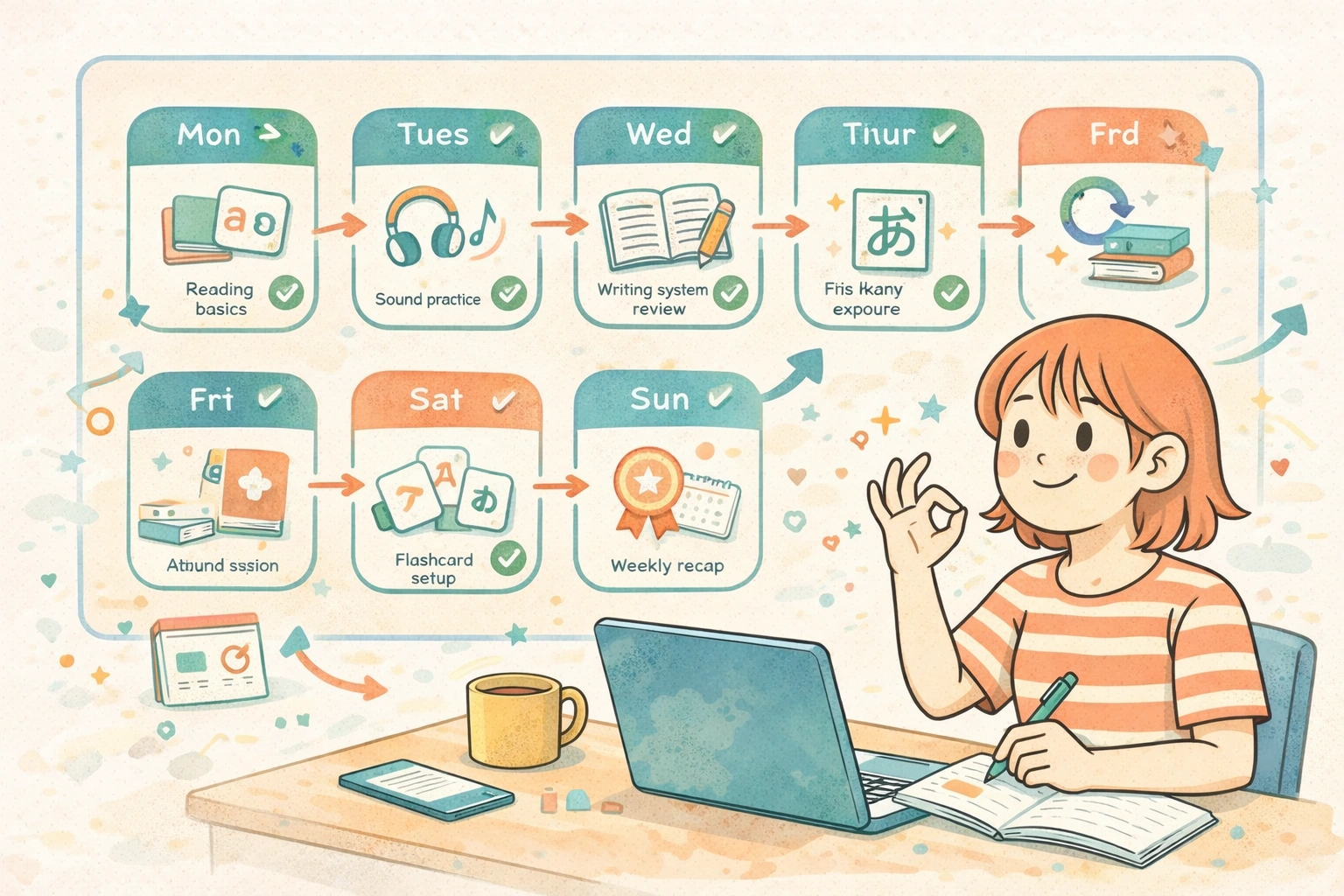
Day 1–2: Learn Hiragana
Hiragana is the phonetic foundation of Japanese. Every other skill builds on it. Use mnemonics rather than rote repetition, and you can read all 46 core characters within 48 hours. Therefore, do not skip or rush this step. Furthermore, do not spend a month on it the way traditional classrooms do.
The goal by the end of Day 2: read every hiragana character, even slowly.
Day 3–4: Learn Katakana
Katakana uses the same sounds as hiragana but different shapes. Because you already know the sounds, this is mostly a shape-matching exercise. Two days is plenty. Don’t stress if it feels slower than hiragana — that’s normal, and it gets easier with exposure.
Day 5: Understand Kanji Basics
Before you memorize a single kanji, spend one study session understanding how kanji works — what radicals are, what on’yomi and kun’yomi mean, and why learning kanji early (rather than avoiding it) dramatically shortens your overall timeline. This one session pays off for years.
Day 6: Set Up a Spaced Repetition System
MochiKana is a great free tool for locking in your kana with SRS before moving to kanji and vocabulary. Mochidemy’s Kanji & Vocabulary tool extends the same system to kanji and JLPT vocab across all levels.
Set up your tool, add your first batch of characters, and do your first review session. Ten to fifteen minutes is enough.
Day 7: Review and Set Your JLPT Target
Review everything from the week. Then pick a specific JLPT level as your first milestone — most beginners should aim for N5, which is achievable in three to six months. Having a concrete target makes the daily habit much easier to maintain.
Realistic Timelines Based on Your Daily Schedule
The calendar estimates below assume consistent, quality study using modern methods — not grammar drills from a 1980s textbook. They also assume you’re starting from zero.
| Daily Study Time | N5 | N4 | N3 | N2 | N1 |
| 30 min/day | 8–12 months | 1.5–2 years | 3–4 years | 5–7 years | 8–12 years |
| 1 hour/day | 4–6 months | 9–14 months | 1.5–2.5 years | 3–4 years | 5–7 years |
| 2 hours/day | 2–3 months | 5–8 months | 10–18 months | 2–3 years | 3–5 years |
| 3+ hours/day | 6–8 weeks | 3–5 months | 7–12 months | 1.5–2.5 years | 2–4 years |
A few honest notes on this table:
First, these are ranges, not guarantees. Your actual timeline depends heavily on the quality of your study, not just the quantity. In addition, life gets in the way — inconsistent months slow things down, and that’s completely normal.
Second, these estimates improve significantly if you use kanji-first methods rather than grammar-first ones. Therefore, don’t skip the kanji foundation even when grammar feels more immediately useful.
Finally, most learners dramatically underestimate how enjoyable Japanese gets somewhere around the N4 level. Because that’s when you start understanding real things — and that motivational boost tends to accelerate everything.
Frequently Asked Questions
How long does it take to learn Japanese for a trip to Japan?
For a functional trip — ordering food, asking directions, reading basic signs — plan on two to three months of daily study focused on practical phrases, hiragana, katakana, and survival vocabulary. You won’t be fluent. But you’ll have a much richer experience than someone with a translation app.
Can you learn Japanese in a year?
Yes — to a meaningful level. One year of consistent, daily study (one to two hours per day) typically gets you to N4 or early N3. That’s comfortable everyday conversation, the ability to get around Japan independently, and a solid foundation for continued growth.
Is Japanese really one of the hardest languages for English speakers?
In terms of raw structural differences, yes. Japanese has different sentence structure, three writing systems, no shared vocabulary with English, and a complex honorific system. However, “hard” is relative. Furthermore, Japanese pronunciation is very consistent and phonetically simple compared to Mandarin or Arabic. Many learners find it more accessible than its reputation suggests once they get past the initial writing-system hurdle.
How many kanji do you actually need?
The Japanese government designates 2,136 kanji as the standard for daily life literacy — these are called the Jōyō kanji. However, you don’t need all of them to be useful. N5 requires about 100. N4 requires around 300. N3 requires 650. Reaching conversational fluency requires roughly 1,000–1,200. Therefore, you reach practical literacy well before you hit the full 2,136.
Does living in Japan speed things up?
Yes — significantly, but only if you’re actively engaging with the language rather than sheltering in an English-speaking expat bubble. Immersion accelerates progress because you get constant, contextualized exposure. However, passive immersion without structured study rarely produces fluency on its own. The most effective approach combines structured learning with genuine daily exposure.
The Bottom Line on Learning Japanese
So — how long does it take to learn Japanese? The real answer is somewhere between six months (basic conversational ability with focused effort) and several years (true advanced fluency). However, where you land in that range has less to do with talent and more to do with three things: how consistently you study, how systematically you approach kanji, and how early you start engaging with real Japanese.
The learners who reach fluency fastest aren’t the ones who study the most hours in a single week. They’re the ones who build a daily habit, follow a logical sequence, and don’t skip the boring-but-essential foundations.
You already know more than most beginners — because you asked the right question before you started.
Now go learn some hiragana.
Ready to find your current JLPT level? Take a free kanji test on Kanji123 — no account required, results in minutes.
© Kanji123 — Free JLPT Kanji Test Online