If you have ever opened a kanji dictionary, stared at a character, and immediately felt like the entire writing system was making eye contact with you on purpose, welcome. You are having a normal kanji moment.
At some point, every learner runs into the phrase “kanji radical” and assumes one of two things. Either radicals are magical building blocks that explain everything, or they are obscure dictionary trivia invented purely to make life harder. The annoying part is that both of those ideas are wrong in interesting ways.
So this guide is here to clean that up. We are going to talk about what a kanji radical actually is, how to find it, why it matters, when it helps, and when it mostly just sits there doing classification work like a tiny bureaucrat inside the character.
Featured snippet version:
A kanji radical is the official classification part of a kanji used for dictionary lookup. Every kanji has one official radical, but many kanji also contain other visible components that learners use for memory and pattern recognition. To find the kanji radical, look first on the left side, the top, or the outside frame of the character, then confirm it with a dictionary or radical chart.
The short answer:
A kanji radical is usually the one official part used to classify the kanji in dictionaries. It is often on the left, across the top, or wrapped around the outside. It can sometimes hint at meaning, but its main job is classification and lookup.
What is a kanji radical, exactly?
A kanji radical is the official classification part of a kanji. In Japanese, this is called 部首(ぶしゅ / bushu). If you are using a paper dictionary—or any dictionary that still respects the old logic behind character lookup—the radical is the piece that tells you where the kanji belongs.
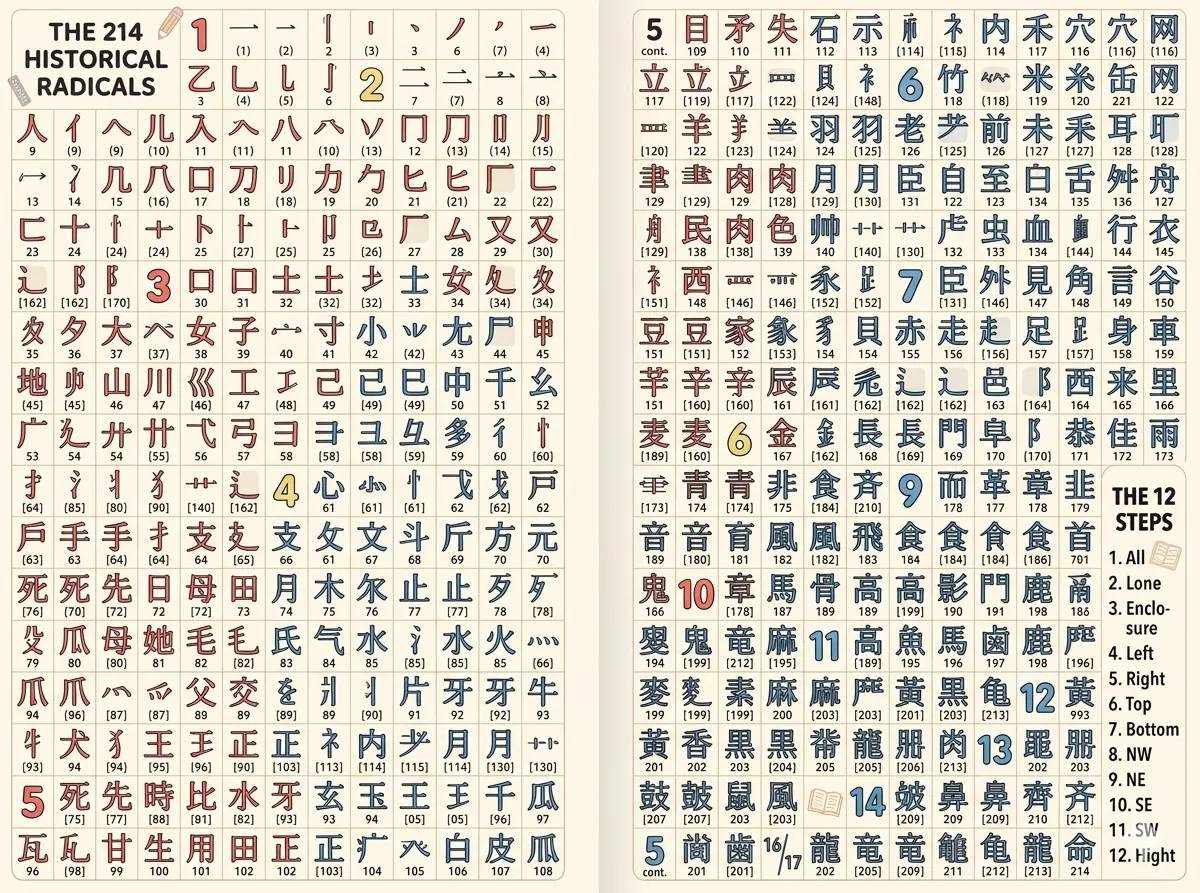
That means a radical is not just “any part you can see.” This is where beginners often get tripped up. A kanji can contain several visible pieces, but only one of them counts as the official radical.
So yes, you can absolutely use multiple parts of a kanji for memory. That is useful. But if you are asking what the kanji radical is in the strict dictionary sense, you are asking for the single official classification part.
Why learners get confused about radicals
Because two ideas get mixed together all the time.
Confusion often arises because two separate ideas get mixed together. While one side focuses on the official radical for dictionary classification, the other involves all the visible parts learners use for mnemonics
For example, a learner may look at a kanji and say, “I can see water, person, and mouth in here.” That can be a perfectly good memory strategy. However, the official radical might be only one of those pieces.
If you want a beginner-safe explanation of that difference, Kanji Radicals Explained is the best companion article to read after this one. It helps separate dictionary logic from memory logic, which is a huge quality-of-life upgrade.
Why radicals matter at all
If all you ever do is use modern handwriting input and copy-paste text from a screen, you can survive for a while without caring much about radicals. However, the moment you meet an unfamiliar kanji in the wild, radicals start earning their keep.
A kanji radical helps with three main things:
· dictionary lookup
· structural awareness
· meaning clues in some cases
That third point needs an asterisk. Sometimes a radical hints at the meaning. Other times, it mainly helps with organization. And in many kanji, another component is doing more of the work on the sound side.
So no, radicals are not magical meaning machines. They are still useful. They just do not explain everything, and that is okay.
Useful mindset shift:
The radical is the official lookup part. The other visible pieces are still valuable. They help with memory, comparison, and pattern recognition, even when they are not the official radical.
How to find the kanji radical
Alright. Here is the practical part.
If you are trying to find the kanji radical, start by checking the most common locations first. In many kanji, the radical is:
· on the left side
· across the top
· wrapped around the outside
That is not a perfect rule, but it is a very good first pass. It narrows the search quickly, which is what you want when your brain is already busy trying not to be annoyed.
1. Look on the left side first
This is one of the most common radical positions. If a kanji has a clearly separate left-side component, there is a good chance you are looking at the radical.
For example, 氵, the water radical, shows up on the left side in characters like 海, 洋, and 泳. Once you start seeing that pattern, a lot of water-related kanji stop feeling like unrelated line piles.
2. Then check the top
If the kanji has a component that stretches across the top, that part is another strong radical candidate.
Think of characters like 花 or 草. The top piece carries the classification role there. Again, that does not mean the radical explains everything about the kanji. It just means the dictionary puts the character under that heading.
3. Then look for an outside frame
Some radicals wrap around the kanji rather than sitting neatly on one side. These are especially useful once you start noticing them, because they tend to stand out visually.
This is where enclosure-style radicals come in. A character may have an outside part that surrounds or partially surrounds the rest of the kanji. In those cases, that frame is often the radical you want to check first.
What if none of those seem obvious?
That happens. In some cases, the radical is not where a beginner expects it to be. In others, there are several plausible candidates. Occasionally, the kanji just looks like it was built to make classification mildly inconvenient.
When that happens, do not turn it into a spiritual crisis. Use a radical chart, a digital dictionary, or a kanji search tool that lists radicals and their variants.
This is also where stroke count can help. If you have two plausible radicals, counting strokes can narrow the right branch quickly.
If the whole lookup process still feels slippery, How to Use a Kanji Dictionary—or, more realistically in your ecosystem, use articles like Kanji for Beginners and Learn Kanji the Smart Way to keep the structure clear while you build the habit.
The most common radical shapes beginners should recognize
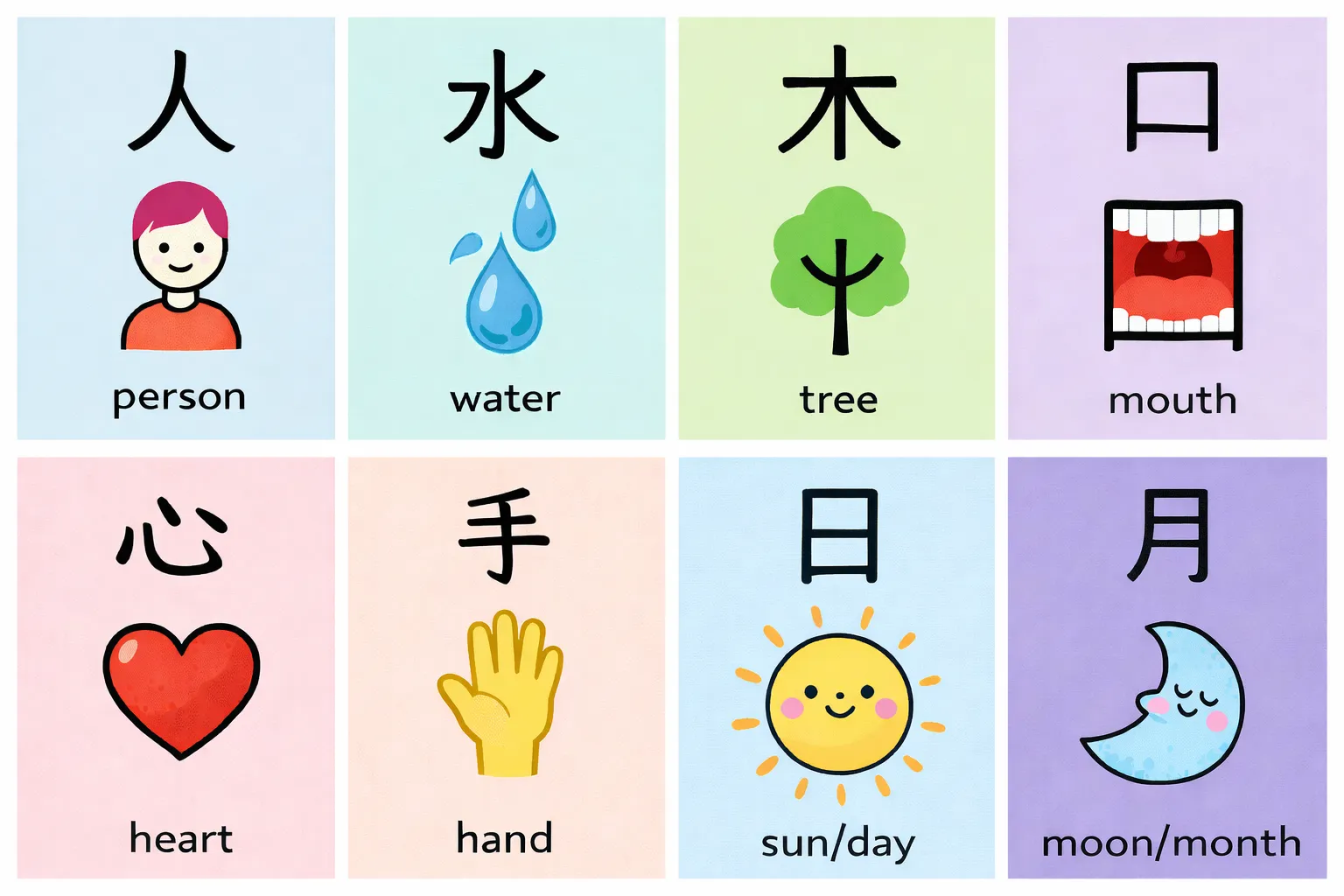
You do not need to memorize all 214 traditional radicals before breakfast. However, there are a handful that show up often enough to pay you back very quickly.
| Radical | Nickname / meaning | Common position | Example kanji |
| 氵 | water | left | 海, 洋, 泳 |
| 亻 | person | left | 休, 体, 住 |
| 扌 | hand | left | 持, 打, 指 |
| 艹 | grass / plant | top | 花, 草, 茶 |
| 口 | mouth | varies | 味, 右, 国 |
| 心 / 忄 | heart | bottom or left | 思, 急, 情 |
| 辶 | movement | bottom-left sweep | 道, 近, 進 |
| 門 | gate | frame | 聞, 間, 開 |
The moment you start recognizing these, unfamiliar kanji stop feeling fully unfamiliar. That is a huge upgrade from trying to brute-force each character as a completely separate drawing.
Modified Radicals
One of the first reasons radicals feel more confusing than they should is that they do not always keep the same visual shape. A radical can shrink, stretch, simplify, or tilt depending on where it appears in the character. That means a learner may technically know the radical already and still fail to recognize it in the wild.
This is not your fault. It is just how kanji behaves. A radical often has a dictionary form and one or more common position-based forms. Once you understand that, radical lookup gets much less irritating because you stop waiting for every character part to appear in its neat textbook version.
Useful mindset shift:
When you are trying to find the kanji radical, do not assume the dictionary form will always appear unchanged. Sometimes the radical is wearing a compressed version of itself because the rest of the kanji needed room too.
Some modified radicals are so common that beginners should learn them almost like alternate spellings. For example, the person radical often appears as 亻 on the left side, the water radical appears as 氵, the hand radical becomes 扌, and the speech radical turns into 訁. Once these become familiar, a huge number of kanji starts feeling less random.
Common modified radicals to know first
| Dictionary form | Modified form(s) | What it usually means | Example kanji |
| 人 | 亻 / 𠆢 | person | 休, 体, 今 |
| 刀 | 刂 | knife / cutting | 別, 利, 則 |
| 心 | 忄 / ⺗ | heart / emotion | 情, 忘, 思 |
| 手 | 扌 / 龵 | hand / action | 持, 指, 探 |
| 水 | 氵 / 氺 | water | 海, 洋, 泳 |
| 犬 | 犭 | dog / animal | 猫, 犯, 独 |
| 示 | 礻 | altar / spirit | 神, 社, 福 |
| 竹 | ⺮ | bamboo | 答, 算, 笑 |
| 糸 | 糹 | thread / fiber | 紙, 終, 経 |
| 艸 | 艹 | grass / plant | 花, 草, 茶 |
| 衣 | 衤 | clothing | 初, 補, 被 |
| 言 | 訁 | speech / words | 記, 話, 語 |
| 辵 | 辶 / ⻌ / ⻍ | movement | 近, 進, 週 |
| 金 | 釒 | metal / money | 銀, 鉄, 録 |
| 食 | 飠 | eat / food | 飯, 館, 飲 |
The practical takeaway is simple: if you cannot find the radical because the shape looks slightly different from the one you memorized, that does not mean you are wrong. It often means you have found the right radical wearing its compressed working clothes.
The Seven Radical Locations
When beginners ask how to find a radical, what they often need first is not a complete historical explanation. They need a map. More specifically, they need to know where radicals usually live inside a kanji.
Traditional character study recognizes seven major positions or location patterns. Learning these positions does two helpful things at once: it gives you a faster way to scan a kanji, and it stops you from checking every visible part with the same level of suspicion.
Why this matters:
If you know the seven radical locations, you stop treating a kanji like one giant mystery block. Instead, you start scanning it in a predictable order.
| Location | Japanese label | How it sits in the kanji | Example kanji |
 | Hen (へん) | Radical appears clearly on the left | 海, 指, 話 |
 | Tsukuri (つくり) | Radical sits on the right side | 別, 助, 欧 |
 | Kanmuri (かんむり) | Radical spreads like a roof or crown | 花, 空, 雪 |
 | Ashi (あし) | Radical sits underneath the rest | 思, 点, 恋 |
 | Tare (たれ) | Radical hangs down from upper-left | 原, 店, 局 |
 | Nyō (にょう) | Radical sweeps from lower-left | 近, 建, 起 |
 | Kamae (かまえ) | Radical surrounds from multiple sides | 国, 間, 開 |
Hen (left side)
This is one of the most common radical positions, which is why it is usually the first place learners should check. Water, person, hand, and speech radicals often live here. Once you recognize common left-side radicals, a lot of kanji stops looking unrelated.
Tsukuri (right side)
Right-side radicals are less famous in beginner explanations, but they matter. They often appear in characters where the left side does most of the visual setup and the right side completes the official classification.
Kanmuri (top)
Top radicals are often visually easy to spot because they sit like a crown. Plant, rain, bamboo, and roof-like radicals frequently appear here.
Ashi (bottom)
Bottom radicals are easy to overlook because the eye often focuses on the top and left first. However, many official radicals live beneath the rest of the kanji, especially in characters where the lower part acts like a foundation.
Tare (top-left hang)
A tare radical starts high and leans downward from the upper-left side. This makes the kanji feel partially covered rather than neatly split into left and right.
Nyō (bottom-left wrap)
Nyō radicals tend to begin low and sweep or wrap under the main body of the character. Movement and path-related radicals show up here often enough that beginners should get used to this pattern early.
Kamae (frame)
Frame radicals are some of the easiest to see once you know to look for them. They surround the inside content from several sides, which makes them visually distinctive and very useful for lookup.
There are also a few kamae variants:


The Twelve Steps to Finding the Radical
Now we get to the part that feels the most like a real method instead of a loose tip. If a kanji has multiple visible parts and you are not sure which one is the official radical, the safest move is to use a step-by-step order instead of guessing randomly.
The traditional approach works almost like a decision tree. You check the most likely possibilities first, then move outward into the less obvious ones. That does not make every kanji easy, but it does stop the process from feeling completely arbitrary.
Before you start:
You are not trying to prove your genius in one shot. You are trying to narrow the search efficiently. That is the whole job.
| Step | What to check | Why this comes here | Example |
| 1 | Is the whole kanji itself a radical? | Some characters are already radical forms by themselves. | 人, 文, 長 |
| 2 | Does it clearly contain only one traditional radical shape? | Some kanji make the choice surprisingly obvious. | 木 inside 本 |
| 3 | Check for an enclosure first | Frames are visually strong and often official radicals. | 国, 医, 図 |
| 4 | Check the left side | This is one of the most common radical positions. | 海, 持, 記 |
| 5 | Check the right side | If the left side fails, the right side is the next practical stop. | 別, 助, 欧 |
| 6 | Check the top | Top radicals are common and often easy to spot. | 花, 空, 雪 |
| 7 | Check the bottom | Bottom radicals are easy to miss but very common. | 思, 点, 恋 |
| 8 | Check the upper-left corner | Some radicals hide in one corner instead of owning the whole side. | 報 |
| 9 | Check the upper-right corner | Less common, but still a standard fallback position. | 呉 |
| 10 | Check the lower-right corner | Some kanji place the official radical here. | 君 |
| 11 | Check the lower-left corner | Another fallback when the obvious locations fail. | 糶 |
| 12 | If all else fails, look inside and confirm with a dictionary | At this point you need confirmation, not pride. | Complex multi-part kanji |
Step 1: Is the whole character the radical?
Some kanji are already radicals in their complete form. If the character is a traditional radical on its own, the search ends immediately. This is the easiest case, and it is worth checking first because it saves time.
Step 2: Is there only one obvious radical candidate?
Sometimes a kanji contains one clearly recognizable radical shape and everything else looks like supporting structure. In those cases, do not overcomplicate the problem.
Step 3: Check for an enclosure
Enclosing radicals stand out because they wrap around the rest of the kanji. If a character has a frame, bowl, or enclosing shell, that is often the best candidate to test first.
Step 4: Check the left side
Left-side radicals are incredibly common. That is why experienced learners almost always glance here early in the process.
Step 5: Check the right side
If the left side is not the answer, move across. Right-side radicals are less common than left-side ones, but they are far from rare.
Step 6: Check the top
Top radicals often look like crowns, roofs, or banners stretching across the character. This makes them visually easy to inspect once you know the pattern.
Step 7: Check the bottom
Bottom radicals can be deceptive because the upper part often looks more dramatic. Still, many characters are officially classified by the piece underneath.
Step 8 to 11: Work through the corners
At this stage, you are in fallback territory. That does not mean the method failed. It means you are moving from common placements to less obvious ones in a disciplined order.
Step 12: Confirm the answer with a lookup tool
Once you are down to unusual placements or multiple plausible candidates, a dictionary or search tool becomes the smart move. At that point, suffering beautifully is not the objective. Finding the radical is. For most beginners, the full twelve-step method is still useful, but a shorter version is easier to remember.
A beginner-friendly shortcut version
The full twelve-step method is useful, but most beginners do better with a shorter version they will actually remember. Here is the simplified practical order:
1. Start by identifying whether the whole kanji is already a radical in its own right.
2. Look at the left side, as this is the most common position for a radical.
3. Scan across the top for any “crown” or “roof” components.
4. Investigate any enclosure or frame that might wrap around the character.
5. Shift your focus to the right side if the previous spots didn’t yield a result.
6. Examine the bottom for “foot” radicals.
7. Then move through the corners as a final manual search.
8. Finally, confirm your findings with a reliable dictionary or kanji search tool.
This version is less elegant, but honestly, it is the one most learners will actually use. And a method you use imperfectly is still much more valuable than a perfect method you forget after lunch.
When the radical helps with meaning—and when it doesn’t
Here is the part that needs a little emotional honesty.
Yes, radicals sometimes help with meaning. Water-related radicals often appear in water-related kanji. Heart-related radicals show up in emotion-heavy or mind-related kanji surprisingly often. Hand-related radicals appear in action-heavy characters.
However, if you expect the radical to hand you the full meaning every time, you are going to have an unnecessarily dramatic relationship with kanji.
Sometimes the radical gives you a clue. Other times, it is mostly useful for classification. And in some cases, another component is doing more of the work on the sound side.
In other words, radicals are useful hints, not complete explanations. That is still a very good deal.
Radical vs. component: same neighborhood, different job
This distinction saves a lot of beginner confusion.
A radical is the official classification part. A component is any visible piece inside the kanji that you notice and use.
In real study life, you will use both. The radical helps with lookup and organization. The components help with memory stories, comparison, and pattern recognition.
Some parts are both a radical and a useful mnemonic chunk. Some are only one or the other. Either way, your brain does not lose points for using every clue available.
Useful rule:
When you are studying, use all the visible parts you can. When you are doing formal lookup, remember that only one of them is the official radical.
How radicals help you look up unknown kanji
This is where radicals stop being theory and start being practical.
If you meet an unknown kanji in the wild and cannot type it easily, being able to identify the radical gives you a way in. You can search by radical, narrow by stroke count, and usually find the character much faster than guessing from vibes alone.
Modern tools make this easier than old paper dictionaries ever did, but the logic is still the same. Once you can find the likely radical, the kanji stops being an impenetrable wall and starts being a lookup problem.
That is one reason articles like Learn Kanji the Smart Way and Kanji for Beginners keep circling back to structure. Structure is what makes retrieval possible.
What beginners usually get wrong about radicals
A few mistakes show up over and over again.
· Treating every visible part as the official radical
· Expecting the radical to explain the full meaning every time
· Ignoring radicals completely because modern apps can do handwriting search
· Trying to memorize all radicals before learning any real kanji
The best beginner approach is much calmer than that. Learn common radicals gradually. Use them when they help. Let them support memory and lookup. Do not turn them into a new source of unnecessary drama.
A smarter beginner way to study radicals
The healthiest way to learn radicals is not as an isolated side quest. It is as part of real kanji study.
That means:
1. notice radicals inside common kanji
2. attach them to useful example words
3. use them for lookup when you meet something new
4. let pattern recognition build naturally over time
If you want a structured environment for that, Learn Kanji & Japanese Vocabulary is a good next step because radicals become much easier to understand when they keep showing up inside words you actually study.
And if you want a quick way to see whether those patterns are sticking, Kanji123 – Free JLPT Kanji Test Online is useful because it turns “I have definitely seen this before” into something testable.
Final thoughts
A kanji radical is not a magic key that unlocks every character. It is something more practical than that.
It is a classification tool, a lookup clue, and, very often, the first structural handle your brain can grab when a kanji still feels new.
So if you have been trying to find the kanji radical and feeling mildly attacked by the whole process, good news: you do not need mystical intuition. You need a few reliable patterns, a little patience, and enough practice that the common shapes stop feeling strange.
Start with the common radicals. Pair them with real kanji. Keep MochiKanji nearby for structured study, and use Kanji123 when you want a fast reality check. Progress is much more useful than panic, and thankfully it also stacks better.
FAQ
What is a kanji radical?
A kanji radical is the official classification part of a kanji used for dictionary lookup.
How do I find the kanji radical?
Start by checking the left side, the top, or the outside frame of the kanji. Then confirm it with a dictionary or radical chart.
Does every kanji have only one radical?
Yes. A kanji can contain many visible parts, but only one of them is the official radical in the dictionary sense.
Do radicals always tell you the meaning?
No. Sometimes they give a clue, but many times they mainly help with classification and lookup.
Should beginners memorize all 214 radicals?
No. Beginners usually do better learning common radicals gradually while studying real kanji and vocabulary.