You have memorized hiragana, drilled verb conjugations, and studied kanji every morning. But something still sounds flat when you speak Japanese. Native speakers smile politely yet something feels off. The missing piece is Japanese onomatopoeia.
Japanese onomatopoeia are expressive sound-based words that native speakers use every single day in conversation, manga, anime, medical offices, business emails, and weather forecasts. They are not just fun sound effects. They are the layer of nuance that separates textbook Japanese from real Japanese. The Japanese onomatopoeia dictionary contains over 4,500 entries, compared to roughly 1,000–1,500 in English. Once you start using them, your Japanese will instantly feel more alive, more specific, and more natural.
In this complete guide, you will learn everything you need to know about Japanese onomatopoeia: the five types, the formation rules that let you decode new words on your own, the grammar patterns for using them in real sentences, and a comprehensive reference dictionary organized by topic. By the end, you will have both the knowledge and the tools to use these words with confidence.
Before you dive in: Japanese onomatopoeia are written in both hiragana and katakana. If you want to read every example in this guide fluently, make sure your kana is solid first.
What Are Japanese Onomatopoeia?
In English, onomatopoeia are words that sound like what they describe — buzz, crash, tick-tock, meow. They represent real, audible sounds. Japanese works the same way for sounds — but it goes dramatically further.
Japanese onomatopoeia do not just describe sounds. They describe textures, movements, emotional states, physical sensations, and atmospheric conditions. A word like fuwa fuwa (ふわふわ) describes something soft and fluffy — like a fresh pillow or a cloud-like pancake. There is no sound involved at all. Yet it is still classified as onomatopoeia.
This expansiveness is what makes Japanese onomatopoeia so unique — and so essential to learn. In Japanese, verbs are less specific than in English. English speakers can glance, stare, gaze, peer, or gawk — all distinct verbs for different types of looking. In Japanese, most of these translate simply as 見る (miru). Therefore, onomatopoeia carry the nuance that the verb cannot. Add jiro jiro (じろじろ) before 見る and you get a rude stare. Add chira chira (ちらちら) and you get a sneaky sideways glance. The verb stays the same — the onomatopoeia does all the expressive work.
This is also why Japanese is sometimes called “vague” by learners. In reality, it is not vague at all. Japanese onomatopoeia provide extraordinary precision — you just have to know them.
The 5 Types of Japanese Onomatopoeia
Japanese linguists classify onomatopoeia into five categories. Each one serves a different purpose, so understanding them separately makes the whole system much easier to navigate.
1. Giseigo (擬声語) — Sounds from Living Things
Giseigo are the most familiar type for English speakers. They represent sounds that people and animals actually make. Some sound similar to English equivalents — others are surprisingly different.
Animal Sounds:
| Japanese | Romaji | Animal | English Sound |
| わんわん | wan wan | Dog | Woof |
| にゃーにゃー | nyaa nyaa | Cat | Meow |
| もーもー | moo moo | Cow | Moo |
| こけこっこ | koke kokkō | Rooster | Cock-a-doodle-doo |
| げろげろ | gero gero | Frog | Ribbit |
| ぶーぶー | buu buu | Pig | Oink |
| ちゅんちゅん | chun chun | Sparrow | Tweet |
| がおー | gaoo | Bear / Godzilla | Roar |
| ひひいん | hihiin | Horse | Neigh |
| ちゅーちゅー | chuu chuu | Mouse | Squeak |
Human Sounds:
| Japanese | Romaji | Meaning |
| くすくす | kusu kusu | Giggling quietly, unable to hold it in |
| げらげら | gera gera | Laughing out loud, boisterously |
| おいおい | oi oi | Crying loudly (adult crying) |
| うわーん | uwaan | A child crying loudly |
| ごにょごにょ | gonyo gonyo | Muttering so others cannot hear |
| ぺちゃくちゃ | pecha kucha | Chatting about small, frivolous things |
| ぺらぺら | pera pera | Speaking a foreign language fluently |
| おほん | ohon | Clearing your throat for attention |
| がみがみ | gami gami | Being nagged or scolded by someone above you |
| うふふ | ufufu | Chuckling like you have a secret |
2. Giongo (擬音語) — Sounds from Objects and Nature
Giongo represent real sounds in the environment — rain, wind, fire, machines, footsteps. These appear constantly in manga, where sound effects are drawn directly into the artwork as part of the visual storytelling.
| Japanese | Romaji | Meaning |
| ざーざー | zaa zaa | Heavy, continuous rain |
| ぽつぽつ | potsu potsu | Rain just beginning to fall |
| しとしと | shito shito | Light, quiet rain falling gently |
| ごろごろ | goro goro | Thunder rumbling |
| ぴかっ | pikkat | A sudden flash of lightning |
| めらめら | mera mera | Flames suddenly bursting up |
| ぱちぱち | pachi pachi | Popping of a fire or clapping hands |
| ぴゅーぴゅー | pyuu pyuu | Cold, whistling winter wind |
| さーさー | saa saa | Wind blowing through tree leaves |
| ばしゃっ | bashat | Water splashing forcefully |
| こぽこぽ | kopo kopo | Water bubbling gently |
| さくさく | saku saku | Footsteps on soft dirt or snow |
| たたたた | ta ta ta ta | Running at full speed |
| かちかち | kachi kachi | A ticking clock or clicking sound |
| ぐるぐる | guru guru | Something spinning round and round |
| がたがた | gata gata | A rattling, shaking object |
3. Gitaigo (擬態語) — Conditions and Physical States
Gitaigo are what make Japanese onomatopoeia truly remarkable. These words describe physical states and textures — things that produce no sound at all. There is no English equivalent for most of them, which makes them both harder to learn and more impressive when you use them correctly.
| Japanese | Romaji | Meaning |
| ふわふわ | fuwa fuwa | Light, soft, fluffy (like a pillow or fresh bread) |
| べとべと | beto beto | Sticky with sweat or something unpleasant |
| びしょびしょ | bisho bisho | Completely soaked through with water |
| さらさら | sara sara | Silky smooth (hair, sand, a shallow stream) |
| ざらざら | zara zara | Rough and scratchy to the touch |
| ぬるぬる | nuru nuru | Slippery and slimy |
| ほかほか | hoka hoka | Warm and cozy, like freshly cooked rice |
| むしむし | mushi mushi | Hot and humid, unpleasantly muggy |
| ひんやり | hinyari | Pleasantly cool to the touch |
| ぐちゃぐちゃ | gucha gucha | Messy, all mixed up, sloppy |
| ぎらぎら | gira gira | A harsh glare, like strong midsummer sun |
| さんさん | sansan | Lots of beautiful, shining sunlight |
| でこぼこ | deko boko | Uneven, bumpy ground or surface |
| じんわり | jinwari | Slowly soaking through, like sweat or tears |
| ぽかぽか | poka poka | A comfortable, gentle warmth all over |
4. Giyougo (擬容語) — Movements and Motions
Giyougo describe the manner of movement. Therefore, you will almost always find these paired with a movement verb. The onomatopoeia tells you how the action is done — the verb tells you what the action is.
| Japanese | Romaji | Meaning |
| うろうろ | uro uro | Wandering around aimlessly with no destination |
| のろのろ | noro noro | Moving at a snail’s pace, sluggish |
| ぶるぶる | buru buru | Trembling from cold, fear, or anger |
| きょろきょろ | kyoro kyoro | Looking around restlessly, eyes darting |
| ぐったり | guttari | Slumping down from complete exhaustion |
| すたこら | sutakora | Walking quickly with eager, purposeful steps |
| ちょこちょこ | choko choko | Scurrying with small, quick steps |
| のそのそ | noso noso | Moving heavily and sluggishly, like a bear |
| よたよた | yota yota | Staggering unsteadily, about to fall |
| ふらふら | fura fura | Wandering without any direction or purpose |
| せかせか | seka seka | Moving busily, as if always in a hurry |
| とぼとぼ | tobo tobo | Trudging wearily, head down |
| よちよち | yochi yochi | Toddling, like an infant learning to walk |
| がくがく | gaku gaku | Knees or joints shaking uncontrollably |
| ぴょんぴょん | pyon pyon | Hopping or bouncing lightly |
5. Gijougo (擬情語) — Feelings and Emotions
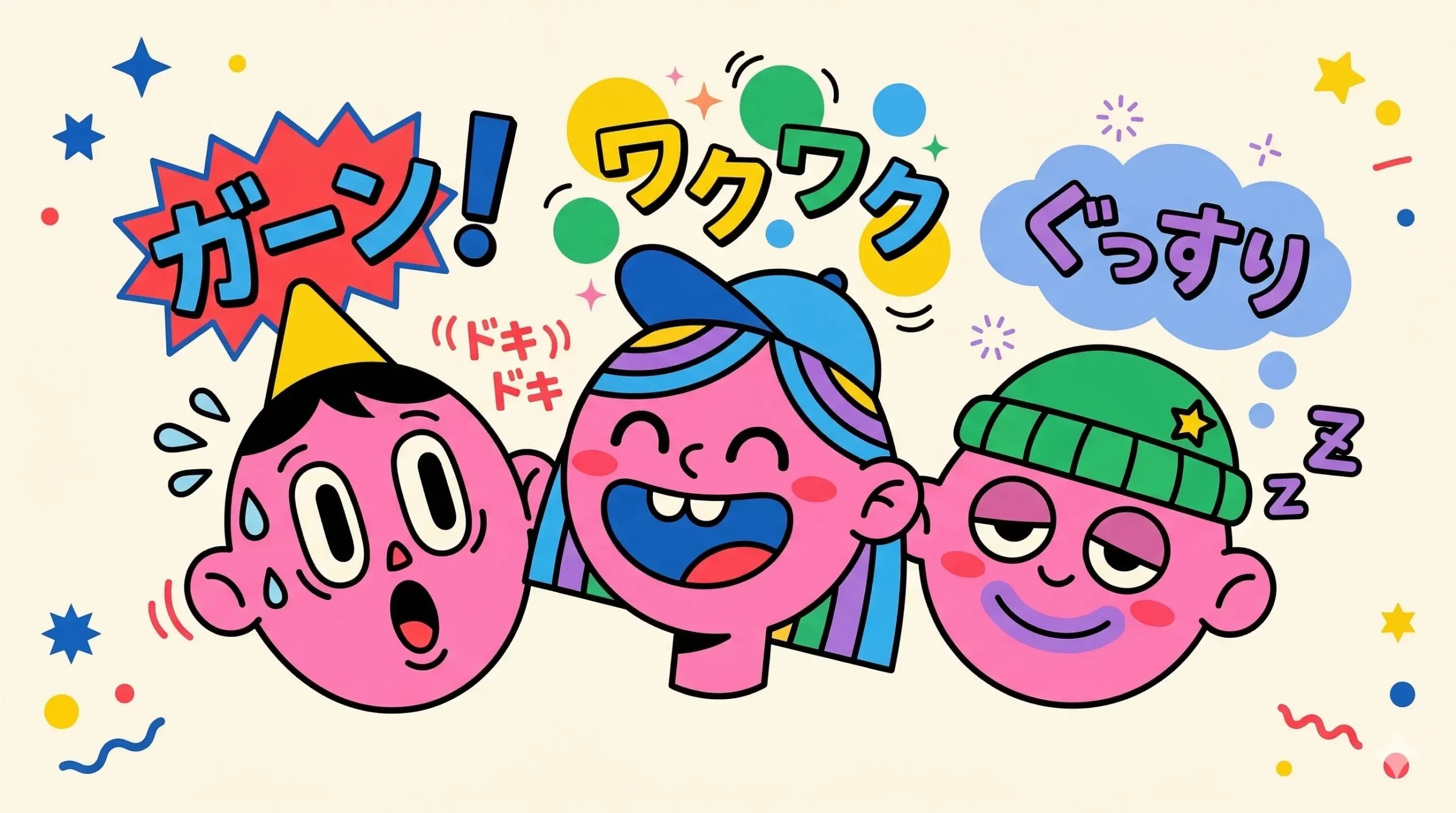
Finally, gijougo describe inner emotional and psychological states. As a result, you will hear these constantly in casual conversation. They are also deeply embedded in Japanese pop culture — doki doki and waku waku appear in song titles, anime names, game menus, and everyday speech.
| Japanese | Romaji | Meaning |
| わくわく | waku waku | Excited, buzzing with anticipation |
| どきどき | doki doki | Heart pounding from nerves or excitement |
| もやもや | moya moya | A foggy, unsettled, unresolved feeling |
| くよくよ | kuyo kuyo | Dwelling on past worries or mistakes |
| うっとり | uttori | Completely spellbound by something beautiful |
| いらいら | ira ira | Irritated, on edge, easily annoyed |
| ぞくぞく | zoku zoku | A spine-tingling thrill or chill |
| しんみり | shinmiri | Quiet and solemn, a little lonely |
| そわそわ | sowa sowa | Restless, fidgety, unable to settle down |
| うきうき | uki uki | Light-hearted, cheerful, floating with happiness |
| くたくた | kuta kuta | Completely and utterly exhausted |
| しょんぼり | shonbori | Dejected, drooping with sadness |
| にこにこ | niko niko | Smiling warmly and continuously |
| はらはら | hara hara | Feeling tense and anxious watching something risky |
| もじもじ | moji moji | Shy and hesitant, too embarrassed to act |
Why Does Japanese Have So Many Onomatopoeia?
Most languages have onomatopoeia for actual sounds. Japanese took the concept much further — and there are two main reasons why.
First, Japanese verbs are less specific than English verbs. In English, looking can be broken into glance, stare, gaze, peer, squint, gawk, and more. In Japanese, most of these collapse into 見る (miru). Therefore, onomatopoeia carry the nuance the verb itself cannot express. The same applies to eating, walking, sleeping, crying, and almost every other physical action.
Second, manga culture accelerated the language. Japanese comic artists use onomatopoeia as visual sound effects drawn directly into panels. Over decades, this reinforced and expanded the vocabulary enormously. Today, onomatopoeia appear not just in manga and anime but in medical consultations, weather forecasts, product descriptions, and business writing. A doctor in Japan routinely asks patients whether their pain is zuki zuki (ずきずき, throbbing) or gangan (がんがん, pounding) to get an accurate description.
The Science of Sound Symbolism
One of the most fascinating things about Japanese onomatopoeia is that they are not arbitrary — the sounds themselves carry meaning. Linguist Gwilym Lockwood studied this phenomenon and demonstrated that even people with no Japanese background can guess the meanings of these words at above-chance rates. Try it yourself:
- nuru nuru — dry or slimy?
- pika pika — bright or dark?
- waku waku — excited or bored?
- ira ira — happy or angry?
- guzu guzu — moving quickly or slowly?
Most people get these right. The sounds are expressive by design — not by coincidence. This is what linguists call sound symbolism, and it makes Japanese onomatopoeia both logical and intuitive once you understand the patterns.
According to Wikipedia’s entry on Japanese sound symbolism, voiced consonants consistently represent heavier, harsher, and more intense qualities, while unvoiced consonants suggest lighter, softer, and gentler ones. High front vowels like i suggest small, sharp, and quick qualities, while back vowels like o and u suggest larger, slower, and deeper ones.
How Japanese Onomatopoeia Are Formed
Most Japanese onomatopoeia follow predictable patterns. Because of this, you can often decode an unfamiliar word just by analyzing its sounds and structure. Here are the seven core formation rules.
Rule 1: Reduplication — The Most Common Pattern
The most common pattern is repeating a syllable or pair of syllables. This repetition signals something happening continuously, repeatedly, or over and over.
- ごろごろ (goro goro) — rolling or rumbling, again and again
- きらきら (kira kira) — sparkling continuously
- わさわさ (wasa wasa) — rustling constantly
In formal Japanese, repeated words sometimes use the iteration mark 々, as in 時々 (tokidoki, sometimes) or 人々 (hitobito, people). However, onomatopoeia almost always write the full repetition.
Rule 2: Voiced vs. Unvoiced Consonants
This is the single most powerful rule for decoding new onomatopoeia. Japanese uses dakuten (゛) — two small marks — to convert an unvoiced consonant into a voiced one. The voiced version is always heavier, louder, and more intense than its unvoiced pair.
| Unvoiced | Meaning | Voiced | Meaning |
| さらさら | silky smooth | ざらざら | rough and scratchy |
| とんとん | light tapping | どんどん | heavy drumming |
| こんこん | soft, gentle knocking | ごんごん | loud, heavy banging |
| はらはら | gently fluttering | ばらばら | scattering, falling apart |
| ぱらぱら | light rain drops | ばらばら | heavy scattered drops |
Therefore, whenever you encounter a new onomatopoeia, you already know its voiced version will be more intense. That one rule unlocks dozens of word pairs instantly.
Rule 3: Vowels Shape the Quality of Sound
Changing the vowel changes the quality of the sensation described. This pattern holds across hundreds of words:
- あ (a) — open, broad, resonant
- い (i) — small, sharp, high-pitched, quick
- う (u) — dull, low, restrained
- え (e) — often negative or unpleasant
- お (o) — deep, heavy, full
Compare these three “clanging” sounds:
- かんかん (kan kan) — clear, metallic ringing
- きんきん (kin kin) — high-pitched, piercing
- こんこん (kon kon) — low, hollow, echoey
Say them out loud. You can hear how the vowel completely reshapes the same basic consonant pattern.
Rule 4: Ending in っ (Glottal Stop)
Words ending in っ represent something sudden and abrupt. The sound cuts off sharply, matching the abrupt action described.
- がばっ (gabat) — bolting upright in bed suddenly
- ごくっ (gokut) — a single hard gulp
- ぎゅっ (gyut) — squeezing tightly all at once
- ばしゃっ (bashat) — a sudden forceful splash
Rule 5: Ending in り
Words ending in り feel soft, gradual, and deliberate — the opposite energy of the glottal stop. They describe something gentle or slow.
- のそり (nosori) — moving slowly and ponderously
- ほっかり (hokkari) — warm steam or breath rising gently
- ぽっちゃり (pochari) — pleasantly chubby
- のらりのらり (norari norari) — wandering aimlessly and unhurried
Rule 6: Ending in ん
Words ending in ん carry a nasal resonance — a sense of something that lingers, echoes, or continues. For sounds, they usually involve ringing or reverberating. For states, they suggest something ongoing.
- しん (shin) — deep, penetrating cold silence
- ごほん (gohon) — a strong, deliberate cough
- こんこん (kon kon) — something knocking repeatedly
- じゃぶん (jabun) — something plunging into water with resonance
Rule 7: Long Vowels (ー) Signal Duration
Words containing a long vowel sound (ー) describe something prolonged, continuous, or drawn out. The stretched vowel mirrors the stretched action.
- ざーざー (zaa zaa) — rain pouring continuously without stopping
- ぐーぐー (guu guu) — deep, loud snoring
- ふわー (fuwaa) — a long, slow, lazy yawn
- のーのー (noo noo) — going along without a care in the world
How to Use Japanese Onomatopoeia in Sentences
Japanese onomatopoeia are grammatically versatile. However, each word tends to attach to sentences in specific ways. Understanding these patterns means you can use any onomatopoeia correctly — not just the ones you have memorized.
Pattern 1: Onomatopoeia + と (Adverb)
This is the most common pattern. Add と after the onomatopoeia to modify a verb as an adverb. It tells you how the verb’s action is happening.
- 雷がごろごろと鳴り始めた。— Thunder started rumbling.
- 彼女はにこにこと笑った。— She smiled warmly.
- 雨がぽつぽつと降り始めた。— The rain started falling lightly.
- 波がざざっと岩に打ち寄せた。— The waves crashed into the rocks.
- 朝の太陽がおっとりと雪原を照らしていた。— The morning sun gently lit up the snowy field.
Pattern 2: Onomatopoeia + する (Verb)
Add する to turn any onomatopoeia into a standalone verb. As a result, you can conjugate it in any tense or form, just like a normal verb.
- 汗で服がじめじめしていた。— My clothes were damp and clammy with sweat.
- 知らないうちにうとうとしていた。— Before I knew it, I had been nodding off.
- 発表の前にどきどきする。— My heart always pounds before presentations.
- 旅行の前からわくわくしている。— I have been excited ever since I planned the trip.
- お腹がぺこぺこする。— I’m starving.
Pattern 3: Onomatopoeia + に (Result State)
Add に to describe a resulting condition. This pattern works especially well for describing how something ends up looking or feeling.
- シャツがびしょびしょに濡れた。— My shirt got completely soaked.
- この道はがたがたになっている。— This road has become really bumpy.
- レッドブルを飲んでぎんぎんに目が冴えた。— Red Bull made me wide awake.
- お気に入りのシャツがぼろぼろになった。— My favorite shirt got worn out.
Pattern 4: Onomatopoeia + の (Noun Modifier)
Add の to use the onomatopoeia directly before a noun. This works just like an adjective modifying a noun.
- ふわふわのパンケーキが食べたい。— I want to eat fluffy pancakes.
- さらさらの髪が羨ましい。— I’m jealous of her silky hair.
- ほかほかのご飯を食べた。— I ate warm, freshly cooked rice.
- 彼女はばりばりのキャリアウーマンだ。— She is a hard-charging career woman.
Pattern 5: Onomatopoeia + やる (Casual Verb)
In casual or colloquial speech, やる replaces する for a more energetic or rough tone.
- がんがんやっていこうぜ! — Let’s go at it full force!
- ちゃきちゃきやってくれよ。— Get it done quickly, will you?
- さくさくやれちゃった。— I got through it quickly and easily.
Pattern 6: Onomatopoeia + だ (Copula)
Use だ to let the onomatopoeia stand alone as a complete sentence or predicate. This is very natural in casual speech and highly effective.
- 徹夜続きでくたくただ。— I’m absolutely exhausted from all-nighters.
- 今日の気分はわくわくだ!— I’m feeling so excited today!
- このまくらぐにゃぐにゃだね。— This pillow is really squishy, isn’t it?
- 赤ちゃんの手はぷくぷくだ。— The baby’s hands are adorably chubby.
Japanese Onomatopoeia with Everyday Verbs
The fastest way to start using Japanese onomatopoeia naturally is to pair them with the basic verbs you already know. Here are eight core verbs with the onomatopoeia that transform them.
起きる (おきる) — To Wake Up
| Onomatopoeia + Verb | Meaning |
| むくむくと起きる | To lazily roll and squirm out of bed |
| がばっと起きる | To suddenly bolt upright |
| のっそり起きる | To slowly and heavily drag yourself up |
| むっくり起きる | To spring up from sleep |
寝る (ねる) — To Sleep
| Onomatopoeia + Verb | Meaning |
| ぐっすり寝る | To sleep deeply and soundly |
| すやすや寝る | To sleep peacefully with even breathing |
| うとうと寝る | To nod off, half in and half out of sleep |
| ぐーぐー寝る | To snore loudly while fast asleep |
| すーすー寝る | To breathe quietly and steadily while sleeping |
食べる (たべる) — To Eat
| Onomatopoeia + Verb | Meaning |
| がつがつ食べる | To eat greedily, with urgency |
| ぱくぱく食べる | To eat with your mouth opening and closing |
| もぐもぐ食べる | To chew steadily and quietly |
| むしゃむしゃ食べる | To munch and crunch noisily |
| ぺろぺろ食べる | To lick (an ice cream or something sweet) |
飲む (のむ) — To Drink
| Onomatopoeia + Verb | Meaning |
| がぶがぶ飲む | To guzzle something down fast |
| ちびちび飲む | To take small, careful sips to make it last |
| ごくごく飲む | To gulp steadily and continuously |
| ぐびぐび飲む | To gulp alcohol down repeatedly |
歩く (あるく) — To Walk
| Onomatopoeia + Verb | Meaning |
| とぼとぼ歩く | To trudge wearily, head down |
| のろのろ歩く | To shuffle along extremely slowly |
| すたこら歩く | To walk fast and purposefully |
| ちょこちょこ歩く | To scurry with small, quick steps |
| てくてく歩く | To walk a long way steadily |
見る (みる) — To See / Look
| Onomatopoeia + Verb | Meaning |
| じろじろ見る | To rudely stare at someone |
| まじまじ見る | To stare directly and intently at a face |
| ちらちら見る | To glance repeatedly from the corner of your eye |
| しばしば見る | To blink repeatedly while looking |
泣く (なく) — To Cry
| Onomatopoeia + Verb | Meaning |
| めそめそ泣く | To cry weakly and miserably |
| しくしく泣く | To cry softly, sniffling quietly |
| おいおい泣く | To wail loudly (an adult) |
| ぐすぐす泣く | To cry and sniffle wetly |
笑う (わらう) — To Laugh
| Onomatopoeia + Verb | Meaning |
| にこにこ笑う | To smile warmly and continuously |
| げらげら笑う | To laugh out loud, guffawing |
| くすくす笑う | To giggle quietly, trying not to show it |
| にんまり笑う | To smile with quiet, private satisfaction |
Hiragana vs. Katakana: Which Script Do You Use?
Japanese onomatopoeia can be written in either hiragana or katakana, and both are correct. However, the choice of script subtly changes the feeling of the word.
Hiragana feels soft, gentle, and natural. It tends to appear in prose writing, casual speech, and situations that call for warmth or delicacy.
Katakana feels sharp, emphatic, and intense. It tends to appear in manga sound effects, advertising copy, and any situation where you want the word to feel louder or more striking.
For example, fuwa fuwa written as ふわふわ feels soft, dreamy, and gentle — like a quiet description of a pillow. Written as フワフワ, the same word feels crisper and more vivid — like a product ad or a manga panel reaction. Both are correct. However, the emotional weight is subtly different.
Because of this, both hiragana and katakana mastery matters for reading and feeling onomatopoeia correctly. If you want to strengthen your reading fluency across both scripts, MochiKana’s kana flashcard system is built specifically for this kind of targeted practice.
A Note on Onomatopoeia with Kanji
Some Japanese onomatopoeia have kanji representations. You will almost never see these in modern usage — however, they do exist, and encountering them occasionally in classical texts or formal writing is possible.
| Kanji Form | Hiragana | Meaning |
| 燦燦 | さんさん | Brilliant, shining sunlight |
| 昏昏 | こんこん | A long, deep sleep |
| 煌煌 | こうこう | Bright and luminously shining |
| 潺潺 | せんせん | The sound of a clear, shallow mountain stream |
| 齷齪 | あくせく | Anxious, feeling like you never have enough time |
These are rare but fascinating. They demonstrate that onomatopoeia are not just informal or playful — they are a deeply embedded feature of the written language at every level.
Japanese Onomatopoeia Reference Dictionary
This is your quick-reference dictionary, organized by topic. Bookmark this section and return to it whenever you encounter a new word in the wild.
Weather
Rain
| Japanese | Romaji | Meaning |
| ざーざー | zaa zaa | Heavy, continuous rain pouring down |
| ぽつぽつ | potsu potsu | Rain just starting to fall, a few drops |
| しとしと | shito shito | Light, quiet, persistent drizzle |
| ぱらぱら | para para | A light scattering of rain or hail |
| ばらばら | bara bara | Large, heavy drops suddenly coming down |
| じとじと | jito jito | Rain continuously falling and making things damp |
| ざっ | zat | A brief, sharp shower |
Thunder and Lightning
| Japanese | Romaji | Meaning |
| ごろごろ | goro goro | Thunder rumbling and reverberating |
| ぴかっ | pikkat | A sudden, brief flash of lightning |
| どーん | doon | A deep, explosive thunderclap |
Wind
| Japanese | Romaji | Meaning |
| そよそよ | soyo soyo | A gentle, quiet breeze |
| さーさー | saa saa | Wind blowing softly through tree leaves |
| ぴゅーぴゅー | pyuu pyuu | Cold, continuous, wintry wind |
| ごーっ | goo | A strong wind raging violently |
| びゅーびゅー | byuu byuu | Strong, continuous typhoon-level winds |
Sunshine and Temperature
| Japanese | Romaji | Meaning |
| さんさん | sansan | Beautiful, abundant shining sunlight |
| ぎらぎら | gira gira | The harsh glare of strong midsummer sun |
| かんかん | kankan | Blazing, intense summer heat beating down |
| ぽかぽか | poka poka | A warm, comfortable, gentle heat |
| ひんやり | hinyari | Pleasantly cool |
| むしむし | mushi mushi | Unpleasantly hot and humid |
Water and Liquids
Dripping and Splashing
| Japanese | Romaji | Meaning |
| ぽたぽた | pota pota | Small water drops dripping steadily |
| ぼたぼた | bota bota | Larger drops falling heavily |
| ばしゃっ | bashat | Water splashing forcefully |
| ぱしゃっ | pashat | Water splashing gently |
| ぽろぽろ | poro poro | Tears spilling out over and over |
Flowing and Pouring
| Japanese | Romaji | Meaning |
| さらさら | sara sara | A quiet, shallow stream flowing smoothly |
| ちょろちょろ | choro choro | A thin trickle of water flowing |
| どーっ | doo | A large volume of water rushing violently |
| とくとく | toku toku | Glugging from a narrow opening |
Dampness and Wetness
| Japanese | Romaji | Meaning |
| びしょびしょ | bisho bisho | Horribly soaked by a large amount of water |
| しっとり | shittori | Soaked in just the right amount of moisture |
| じめじめ | jime jime | Sodden and clammy from humidity |
| べとべと | beto beto | Sticky, unpleasant dampness |
Bubbling and Rippling
| Japanese | Romaji | Meaning |
| こぽこぽ | kopo kopo | Water bubbling gently |
| ごぼごぼ | gobo gobo | Loud, vigorous bubbling |
| ちゃぷちゃぷ | chapu chapu | Water sloshing gently |
| ぶくぶく | buku buku | Steady bubbling |
Fire
| Japanese | Romaji | Meaning |
| めらめら | mera mera | Flames suddenly bursting up |
| ぼーぼー | boo boo | Fire burning strongly |
| ちろちろ | chiro chiro | A small flame flickering |
| ぱちぱち | pachi pachi | The strong popping of a fire |
| じりじり | jiri jiri | The sun or fire burning intensely |
Movements and Actions
Walking and Running
| Japanese | Romaji | Meaning |
| とぼとぼ | tobo tobo | Trudging wearily with drooping steps |
| のろのろ | noro noro | Moving at an extremely slow pace |
| すたすた | suta suta | Walking briskly without looking around |
| せかせか | seka seka | Moving busily, always seeming in a hurry |
| ちょこちょこ | choko choko | Scurrying with small, quick steps |
| よたよた | yota yota | Staggering, about to fall |
| よちよち | yochi yochi | Toddling like a baby learning to walk |
| たたたた | ta ta ta ta | Running at full, flat-out speed |
Waking Up and Standing
| Japanese | Romaji | Meaning |
| がばっ | gabat | Suddenly bolting upright |
| むくむく | muku muku | Slowly squirming and getting up |
| のっそり | nossori | Slowly, ponderously rising |
| すっ | sut | Standing up casually and lightly |
Sleeping
| Japanese | Romaji | Meaning |
| ぐっすり | gussuri | Completely and deeply asleep |
| すやすや | suya suya | Sleeping peacefully with gentle breathing |
| うとうと | uto uto | Half asleep, nodding off |
| ぐーぐー | guu guu | Snoring loudly while fast asleep |
| こっくりこっくり | kokkuri kokkuri | Head drooping repeatedly while falling asleep |
Shaking and Trembling
| Japanese | Romaji | Meaning |
| ぶるぶる | buru buru | Trembling from cold, fear, or anger |
| がくがく | gaku gaku | Knees shaking from weakness or fear |
| がたがた | gata gata | Shivering violently from cold or fear |
| ぞくぞく | zoku zoku | Shivers running up the spine |
| びくっ | bikut | Suddenly flinching in reflex |
Looking and Seeing
| Japanese | Romaji | Meaning |
| じろじろ | jiro jiro | Staring rudely and openly |
| まじまじ | maji maji | Staring directly and intently at a face |
| ちらちら | chira chira | Glancing repeatedly from the corner of your eye |
| きょろきょろ | kyoro kyoro | Eyes darting around restlessly |
| ぼんやり | bonyari | Only seeing dim, unclear outlines |
| ぎろっ | girot | Giving someone a sharp, threatening glare |
| しばしば | shiba shiba | Blinking repeatedly |
Eating and Drinking
Eating
| Japanese | Romaji | Meaning |
| がつがつ | gatsu gatsu | Eating greedily, driven by strong desire |
| ぱくぱく | paku paku | Eating with mouth repeatedly opening and closing |
| もぐもぐ | mogu mogu | Chewing steadily and continuously |
| むしゃむしゃ | musha musha | Munching and crunching noisily |
| ぺろぺろ | pero pero | Licking something over and over |
| かりかり | kari kari | Lightly crunching on something hard |
| さくっ | sakut | A light, crisp bite into something |
Drinking
| Japanese | Romaji | Meaning |
| がぶがぶ | gabu gabu | Guzzling something down quickly |
| ごくごく | goku goku | Gulping steadily and continuously |
| ちびちび | chibi chibi | Taking small, careful sips |
| ぐびぐび | gubi gubi | Gulping alcohol down repeatedly |
Emotions and Feelings
| Japanese | Romaji | Meaning |
| わくわく | waku waku | Excited, buzzing with anticipation |
| どきどき | doki doki | Heart pounding with nerves or excitement |
| いらいら | ira ira | Irritated, on edge |
| もやもや | moya moya | Unsettled, foggy, unresolved |
| ぞくぞく | zoku zoku | Spine-tingling thrill or eerie chill |
| うっとり | uttori | Spellbound by something beautiful |
| しょんぼり | shonbori | Dejected, drooping |
| くたくた | kuta kuta | Utterly exhausted |
| はらはら | hara hara | Tense anxiety watching something risky |
| うきうき | uki uki | Light-hearted, floating with joy |
| にこにこ | niko niko | Beaming, smiling warmly |
| もじもじ | moji moji | Shy and hesitant from embarrassment |
| そわそわ | sowa sowa | Restless, unable to sit still |
| くよくよ | kuyo kuyo | Dwelling on past regrets |
| ぺこぺこ | peko peko | Starving hungry |
Pain and Physical Sensation
This category is especially practical. In Japan, doctors routinely ask patients to describe pain using onomatopoeia — so knowing these words is genuinely useful.
| Japanese | Romaji | Type of Pain or Sensation |
| ずきずき | zuki zuki | Throbbing, pulsing pain |
| がんがん | gangan | Pounding, intense headache |
| ひりひり | hiri hiri | Stinging, burning pain on the skin |
| きりきり | kiri kiri | Sharp, twisting pain |
| じんじん | jin jin | Tingling, numbing sensation |
| むかむか | muka muka | Nausea, feeling sick to the stomach |
| ずーん | zuun | A heavy, dull, deep ache |
Textures and Physical States
| Japanese | Romaji | Meaning |
| ふわふわ | fuwa fuwa | Soft, light, fluffy |
| さらさら | sara sara | Silky, smooth, flowing |
| ざらざら | zara zara | Rough, scratchy |
| ぬるぬる | nuru nuru | Slimy, slippery |
| べとべと | beto beto | Sticky and unpleasant |
| ぐにゃぐにゃ | gunyagunyaa | Soft and floppy, lacking firmness |
| ぷにぷに | puni puni | Soft and squashy, like a stress ball |
| かちかち | kachi kachi | Rock hard, completely rigid |
| ごつごつ | gotsu gotsu | Jagged, rough, like bare rock |
| もちもち | mochi mochi | Soft, chewy, and pleasantly elastic |
How to Practice Japanese Onomatopoeia Effectively
Understanding these words in a guide is an excellent start. However, using them naturally in conversation requires active, consistent exposure and practice. Here are the most effective methods.
Read Manga in Japanese
Manga uses giongo and giseigo as visual sound effects on every page. Because the context is immediately visual — you see the action and the word together — your brain forms strong associations fast. As a result, manga is one of the most efficient ways to absorb onomatopoeia vocabulary.
Watch Anime Without Subtitles
As you listen actively, your brain starts picking up recurring sound patterns. You will hear waku waku, doki doki, and goro goro so consistently that they become instinctive. In addition, hearing native intonation for these words helps you reproduce them correctly.
Notice Them in Real Life Japanese
Look for onomatopoeia in product packaging, food labels, app interfaces, and weather forecasts. Japanese product descriptions use fuwa fuwa, mochi mochi, and saku saku constantly to describe textures. Noticing them in context accelerates retention.
Practice with Spaced Repetition Flashcards
On MochiKana, you can create custom vocabulary decks for exactly the onomatopoeia categories most relevant to your level and interests. Spaced repetition surfaces the right word at the right moment — so you review it just before you would forget it.
Write Sentences Using Your New Words
Before using onomatopoeia in speaking, practice writing. Each morning, describe your night’s sleep using different 寝る combinations. Describe your breakfast using different 食べる onomatopoeia. This low-pressure writing habit builds fluency faster than passive study alone.
Final Thoughts
Japanese onomatopoeia are not just expressive extras you can add once your Japanese is “good enough.” They are central to how Japanese people communicate every single day — in casual conversations, in creative writing, in professional settings, and in medical contexts. Therefore, learning them is not optional for anyone who wants to sound genuinely natural.
The good news is that the system is learnable. Voiced vs. unvoiced consonants, vowel quality, word endings, formation patterns — once these rules click, you can decode new words on your own rather than memorizing each one individually. Start with the emotions and basic verb combinations from this guide. Then expand into the dictionary sections as your confidence grows.
Your Japanese will not just improve — it will come alive.