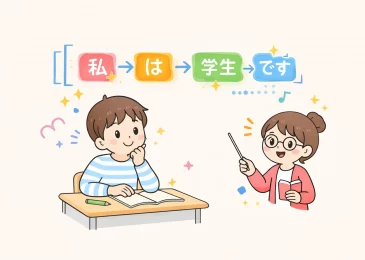
Japanese sentence structure is one of the first big surprises for English speakers learning Japanese. You sit down expecting something familiar, and instead you find the verb hiding at the end, the subject missing entirely, and small particles doing jobs that word order handles in English.
But here’s the thing — Japanese sentence structure is not random. It follows a clean, consistent logic. And once that logic clicks, building and reading sentences starts to feel natural.
Before you continue, if you are completely new to Japanese, it’s best to learn how to read the basics first. We recommend going through our hiragana guide and katakana guide before diving into sentence structure. These two writing systems are quick to pick up, and they will make everything in this guide much easier to understand.
In this guide, we are going to walk through Japanese language sentence structure from the ground up. We will use one running example — a simple scene about making ramen — and add grammar pieces to it one by one. By the end, you will have a clear map of how sentence structure Japanese works, from a single-word sentence all the way to complex multi-clause constructions.
The Basics
Start Here: Japanese Sentence Structure vs English
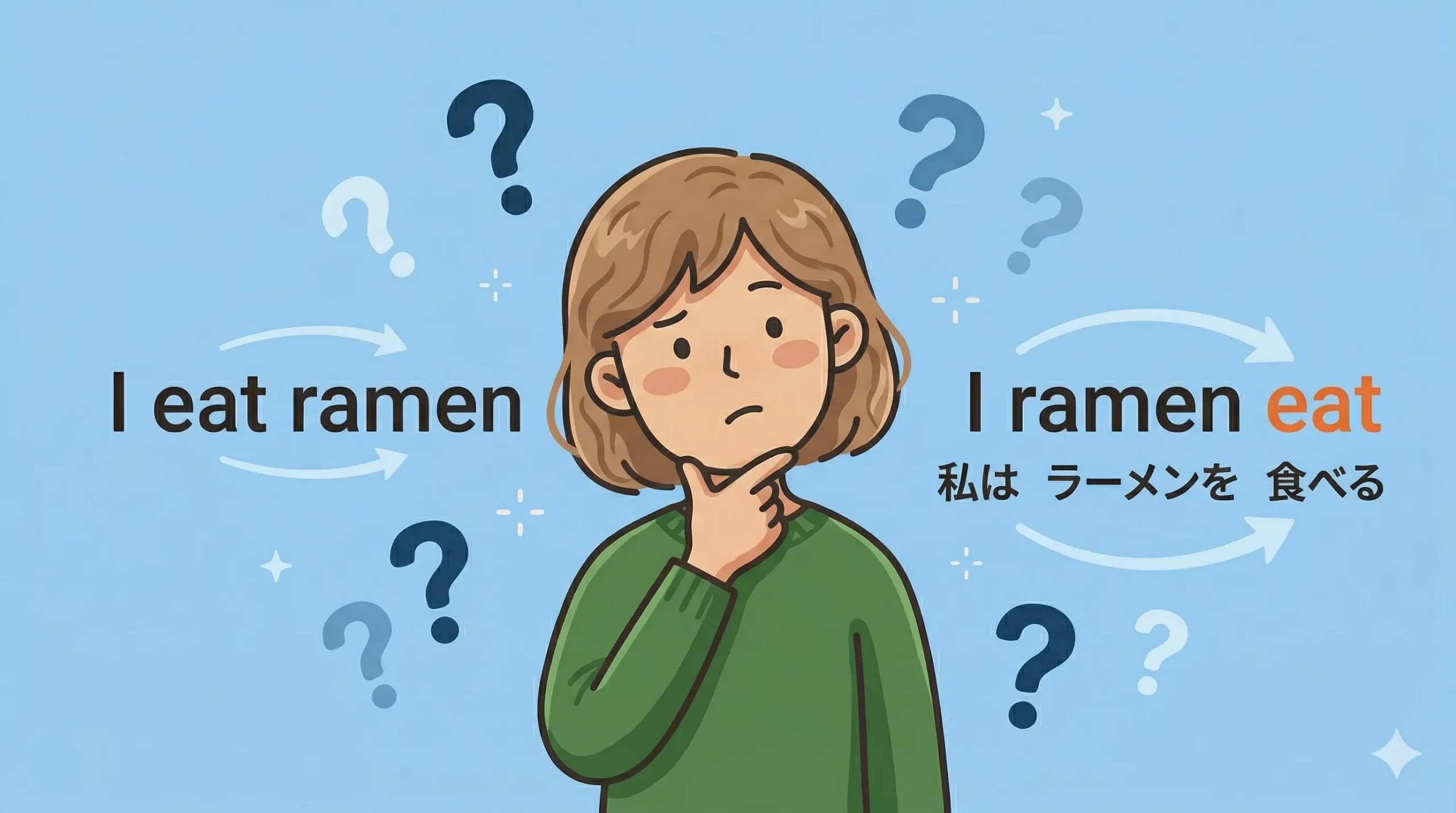
Before we jump in, let’s get the biggest difference out of the way. English sentence structure follows a Subject–Verb–Object (SVO) order. Japanese, however, follows Subject–Object–Verb (SOV).
In English you say: “I eat ramen.” In Japanese, you say: 私はラーメンを食べる — which, word for word, is “I ramen eat.” The verb goes last. Always.
Here is a side-by-side look at the two:
| English | Japanese | |
| Word order | Subject → Verb → Object | Subject → Object → Verb |
| Verb position | Middle of the sentence | End of the sentence |
| Subject | Required every time | Optional — often dropped |
| Role markers | Word order shows role | Particles show role |
| Flexibility | Fixed — change order, lose meaning | Flexible — particles preserve meaning |
That last row is important. Because Japanese uses particles (small grammar markers like が, を, は) to label what each word is doing, you can rearrange words without losing meaning. We will see exactly how this works as we build our example sentence.
The Only Thing a Japanese Sentence Actually Needs
Here is something that surprises most learners: a complete Japanese sentence needs just one thing — a predicate.
The predicate is the part that gives information. It can be a verb, an adjective, or even a noun. Everything else — the subject, the object, the time and place — is optional. You add those elements to give more context, but you do not need them to form a valid sentence.
Let’s start with our running example. Our scene: a father is in the kitchen, making ramen on Sunday afternoon. His daughter calls to ask what’s going on at home. The father picks up the phone and says:
| 作る。 |
| Tsukuru. |
| “Making (it).” |
That’s it. One word, one complete sentence. From context, everyone already knows who is making what. So the predicate alone does the job.
The predicate can take several forms. For example:
| Predicate type | Japanese | English |
| Verb | 食べる。 | (I’ll) eat. |
| い-adjective | 暑い。 | It’s hot. |
| な-adjective | きれい。 | It’s pretty. |
| Noun | 犬。 | It’s a dog. |
Each of these is a grammatically complete sentence in Japanese. Therefore, understanding the predicate is the single most important step in understanding Japanese sentence structure.
Building the Sentence: Adding Elements One by One
Now let’s build our example sentence step by step. We will keep adding elements to show how Japanese language sentence structure expands naturally around the predicate.
Step 1 — Add an Object (を)
An object is the thing being acted on. In Japanese, we mark the object with the particle を (wo). So our father adds what he is making:
| ラーメンを作る。 |
| Ramen wo tsukuru. |
| “Making ramen.” |
The particle を after ラーメン tells us clearly: ramen is the thing being made. Because the particle carries that information, the word order has some flexibility — but changing it to を作るラーメン would not mean “make ramen”; it would instead create a relative clause meaning “ramen that (someone) makes.” The particle does the grammatical heavy lifting, but the word order must still align with the intended structure.
Step 2 — Add a Subject (が)
Next, let’s say the daughter is confused — she thought her mom was cooking today. The father wants to make it clear that it is him making the ramen, not anyone else. So he adds a subject, marked by the particle が (ga):
| お父さんがラーメンを作る。 |
| Otōsan ga ramen wo tsukuru. |
| “Dad (specifically) is making ramen.” |
The particle が emphasizes who is doing the action — it highlights お父さん as the answer to an unspoken “who?” question. This is a key difference between が and は, which we will see next.
Step 3 — Add a Topic (は)
Topics frame the whole conversation. The particle は (wa) marks what the sentence — or even the whole discussion — is about. Let’s say the daughter asks about Sundays specifically. The father replies:
| 毎週日曜日は、お父さんがラーメンを作る。 |
| Maishū nichiyōbi wa, otōsan ga ramen wo tsukuru. |
| “Every Sunday, Dad makes ramen.” |
Here, 毎週日曜日 (every Sunday) is the topic. It does not describe who does the action — it sets the time frame for everything that follows. The topic tends to stay stable across multiple sentences, while the subject can change freely. To learn more about the difference, see our guide on
Step 4 — Add an Adverbial (で / に)
Adverbials tell us when, where, or how something happens. They use several different particles, most commonly で (de) for location of an action and に (ni) for direction or time. Let’s add where:
| 毎週日曜日は、お父さんが台所でラーメンを作る。 |
| Maishū nichiyōbi wa, otōsan ga daidokoro de ramen wo tsukuru. |
| “Every Sunday, Dad makes ramen in the kitchen.” |
台所で (in the kitchen) gives us the location of the action. Notice that it slides naturally into the sentence before the object and verb — because, in Japanese, adverbials generally come before the thing they relate to.
Step 5 — Add a Sentence-Final Particle
Sentence-final particles go at the very end and shape the feeling of the sentence. They are one of the most expressive parts of Japanese sentence structure. Common ones include:
| Particle | Feel | Example nuance |
| よ (yo) | Emphasis / new info | Like saying “I’m telling you!” |
| ね (ne) | Shared feeling / “right?” | “It’s hot, isn’t it?” |
| の (no) | Explanation | Softens a statement into an explanation |
| か (ka) | Question marker | Turns any sentence into a question |
The father, explaining things to his daughter, might use の to make his answer feel warm and explanatory:
| 毎週日曜日は、お父さんが台所でラーメンを作るの。 |
| Maishū nichiyōbi wa, otōsan ga daidokoro de ramen wo tsukuru no. |
| “Every Sunday, Dad makes ramen in the kitchen — that’s just how it is.” |
That の adds a gentle “and that’s the story” feeling that is very hard to translate directly into English. However, it illustrates how sentence-final particles add real communicative color to Japanese.
So here is our sentence at full build — from a single word all the way to a complete picture:
| Running example — fully built:作る。→ ラーメンを作る。→ お父さんがラーメンを作る。→ 毎週日曜日は、お父さんがラーメンを作る。→ 毎週日曜日は、お父さんが台所でラーメンを作る。→ 毎週日曜日は、お父さんが台所でラーメンを作るの。 |
Japanese Sentence Structure Examples: Word Order in the Wild
The standard sentence structure Japanese follows is SOV — Subject, Object, Verb. However, because particles do the labeling, speakers can move elements around for emphasis or naturalness. This is one of the biggest differences in Japanese sentence structure vs English.
Let’s say the daughter calls back later and asks what’s happening. The mother answers — but she does it in a very Japanese way:
| ラーメンを作ってるの、お父さんがね。 |
| Ramen wo tsukutteru no, otōsan ga ne. |
| “Ramen is what’s being made — by Dad, that is.” |
Notice the order: Object → Verb → Subject. In English this would be unnatural. In Japanese, however, it works — and it carries a specific meaning. By putting ラーメン first, the mother emphasizes the ramen. By placing お父さんが at the end, she treats “who is doing it” almost as an afterthought.
In contrast, English word order is fixed. Move things around and the sentence either breaks or sounds like Yoda. In Japanese, flexibility is a feature, not a bug.
Beyond the Basics: Complex Japanese Sentence Structure
Simple sentences are great, but real conversation quickly moves into complex territory. Complex sentences contain more than one clause. In Japanese, there are two main ways to build them: linking clauses and embedding clauses.
Linking Clauses Together
Linked clauses connect two independent thoughts into one sentence. The daughter, calling home, learns two things at once. Her mother says:
| 今日は日曜日だから、お父さんがラーメンを作ってるよ。 |
| Kyō wa nichiyōbi dakara, otōsan ga ramen wo tsukutteru yo. |
| “Because today is Sunday, Dad is making ramen.” |
The particle から (kara) links the first clause (today is Sunday) to the second (Dad is making ramen) as a cause-and-effect. It works similarly to “because” in English. Other common linking particles include:
| Particle | Meaning | Nuance |
| から (kara) | because / so | Direct, assertive reason |
| ので (node) | because / since | Softer, more polite reason |
| けど (kedo) | but / although | Contrast or softening |
| て-form | (and) / so | Sequential or light reason |
You can also link clauses through conjugation instead of a particle. For example, the て-form connects verbs and adjectives directly to the next clause:
| 今日は日曜日で、お父さんがラーメンを作ってるよ。 |
| Kyō wa nichiyōbi de, otōsan ga ramen wo tsukutteru yo. |
| “Today is Sunday, and Dad is making ramen.” |
This version is slightly softer — it links the two ideas without stating a direct causal relationship. Therefore, the choice between particles and conjugation shapes the exact meaning and tone of your sentence. For a deeper look at て-form, visit our guide on
Embedding Clauses: Quotation
The second way to build complex sentences is embedding — placing one clause inside another. Quotation is the clearest example. The daughter calls her friend to tell her what’s going on:
| お父さんが「ラーメンを作ってる」と言ってた。 |
| Otōsan ga “ramen wo tsukutteru” to itteta. |
| “Dad said, “I’m making ramen.”” |
The particle と (to) acts like a spoken quotation mark. The embedded clause — ラーメンを作ってる — sits before と, and the main clause — お父さんが言ってた — wraps around it.
Importantly, と is also used for indirect quotation, where you are paraphrasing rather than quoting exact words:
| お父さんがラーメンを作ってると聞いた。 |
| Otōsan ga ramen wo tsukutteru to kiita. |
| “I heard (that) Dad is making ramen.” |
In this indirect version, there are no quotation marks 「」 — and the embedded clause uses plain form. Additionally, because this is a paraphrase, you would not add politeness markers like です or ます inside the embedded clause. That would sound unnatural.
Embedding Clauses: Noun Modification
Clauses can also modify nouns — just like adjectives. This is where Japanese sentence structure gets really interesting. In English, relative clauses come after the noun they describe: “the ramen that Dad made.” In Japanese, the modifier always comes before the noun.
Start simple — an adjective modifying a noun:
| おいしいラーメン |
| Oishii ramen |
| “delicious ramen” |
Now replace the adjective with an entire clause:
| お父さんが作ったラーメン |
| Otōsan ga tsukutta ramen |
| “the ramen that Dad made” |
The whole clause お父さんが作った sits in front of ラーメン and modifies it. Now let’s use this as part of a full sentence:
| お父さんが作ったラーメンはとてもおいしかった。 |
| Otōsan ga tsukutta ramen wa totemo oishikatta. |
| “The ramen that Dad made was really delicious.” |
To parse this kind of sentence, try a useful trick: find the main verb at the very end first (おいしかった — was delicious). Then look left to find the topic or subject (ラーメン). Then, everything in front of ラーメン is the modifier. You have just decoded a relative clause.
You can stack multiple relative clauses in one sentence:
| お父さんが日曜日に作ったラーメンをお母さんが全部食べた。 |
| Otōsan ga nichiyōbi ni tsukutta ramen wo okāsan ga zenbu tabeta. |
| “Mom ate all the ramen that Dad made on Sunday.” |
Remove the embedded clause and you get: お母さんがラーメンを食べた — “Mom ate ramen.” The relative clause just tells us which ramen. For more on reading complex sentences, see our
Politeness in Japanese Sentence Structure: です and ます
Japanese has two key politeness markers: です (desu) and ます (masu). Where you place them inside a sentence matters — and it is closely tied to clause structure.
The End of the Sentence Decides the Tone
In Japanese sentence structure, the final element sets the overall politeness level. Therefore, as long as your sentence ends with です or ます, the overall tone stays polite — even if earlier clauses use plain form.
The father explains to a neighbor why he is cooking:
| 今日は日曜日だから、ラーメンを作ります。 |
| Kyō wa nichiyōbi dakara, ramen wo tsukurimasu. |
| “Because today is Sunday, I’m making ramen.” |
The first clause uses plain form (だ), but the sentence ends with ます. As a result, it sounds polite. However, a politeness marker in the middle without one at the end would sound unnatural — so always close with です or ます if you want a polite register.
Politeness Markers in Quoted Clauses
When quoting someone’s exact words, it is fine to include です and ます inside the quote, because those are the words actually said:
| お父さんは「ラーメンを作ります」と言った。 |
| Otōsan wa “ramen wo tsukurimasu” to itta. |
| “Dad said, “I’m making ramen.”” |
However, for indirect quotations, use plain form instead. Because an indirect quote is a summary, not exact words, adding politeness markers would feel out of place. Use だ rather than です inside indirect embedded clauses.
Japanese Sentence Structure Examples: The Full Picture
Here is every stage of our running example in one place — a complete reference for the japanese sentence structure examples we have built throughout this guide:
| Stage | Japanese | What was added |
| Predicate only | 作る。 | Just the verb |
| + Object | ラーメンを作る。 | を marks the object |
| + Subject | お父さんがラーメンを作る。 | が marks the subject |
| + Topic | 毎週日曜日はお父さんがラーメンを作る。 | は marks the topic |
| + Adverbial | 台所でお父さんがラーメンを作る。 | で marks location |
| + Sentence-final particle | 〜作るの。 | の adds explanatory feel |
| Linked clause | 日曜日だから、〜作る。 | から links reason → result |
| Quotation clause | 〜「作ってる」と言った。 | と embeds a quote |
| Noun modification | お父さんが作ったラーメン | clause modifies a noun |
Putting It All Together
Japanese sentence structure follows clear logic. The predicate comes last and is the only required part. Particles label every other element, so word order becomes flexible. Simple sentences need just one word. Complex sentences stack and embed clauses using a small set of consistent patterns.
In other words, everything you learned above builds on the same foundation — a predicate with optional elements layered around it. So instead of memorizing rules in isolation, focus on recognizing those layers as you read and listen.
The best way to internalize sentence structure Japanese is to encounter it constantly in real material. Therefore, start with simple sentences, add one element at a time, and expose yourself to natural Japanese as much as possible.
For next steps, explore our guides on
がんばって!(Ganbatte!) — You’ve got this.