Most people learn Japanese vocabulary the same way. They stare at a flashcard, repeat it ten times, and then forget it by morning.
That’s rote memorization — and almost nobody enjoys it. More importantly, it doesn’t work well. Your brain isn’t built to retain random strings of sounds through repetition alone. However, it is built to remember vivid stories, strange images, and sensory experiences.
That’s exactly what the keyword mnemonic method exploits.
If you’re trying to figure out how to learn Japanese vocabulary efficiently — without grinding through the same cards over and over — this method is the most effective tool I’ve found.
✦ In terms of time, pain, and efficiency, mnemonics are simply the way to go.
By the end of this post, you’ll have learned 10 Japanese vocabulary words. I’ll quiz you at the end. Expect to score 70–80% — even on your first attempt.
Why Most Learners Struggle to Learn Japanese Vocabulary
If you want to learn Japanese vocabulary, you have probably tried writing words out over and over again. Most learners do this. However, rote repetition alone is slow, frustrating, and easy to forget within days.
There is a smarter approach. The keyword mnemonic method turns new Japanese words into vivid mental stories, so your brain holds on to them far longer. In addition, this technique works on any vocabulary list — from everyday nouns to JLPT terms.
In this guide, you will learn exactly how the keyword mnemonic method works, see it applied to ten real Japanese words, and discover how to combine it with spaced repetition for long-term retention. Because understanding the method is one thing, but seeing it in action makes all the difference.
✦ Kanji123 tip: This guide pairs perfectly with free hiragana chart — excellent starting points for beginners.
What Is the Keyword Mnemonic Method?
The keyword mnemonic method is a two-step memory technique. First, you connect the sound of a Japanese word to a familiar word in your native language. Second, you link that “keyword” to the English meaning through a short, vivid mental image.
Therefore, instead of trying to memorize a word through repetition, you build a tiny mental story. Your brain loves stories. As a result, it remembers them far better than bare word pairs.
Step 1 — Find Your Keyword
Start with the Japanese word and find an English word that sounds similar. For example, take 食べる (taberu), which means “to eat.” The word sounds like “table.” So, “table” becomes your keyword.
You do not need a perfect phonetic match. Because the goal is recall, even a rough similarity works. Use the first half of the word at minimum.
Step 2 — Build a Mental Image
Now, connect your keyword to the English meaning through a short scene. For taberu, imagine a table opening a huge mouth and trying to eat you — complete with crunching sounds and a rancid smell. That bizarre image sticks because your brain pays extra attention to unusual events.
Neuroscientists call this a “flashbulb memory.” In other words, high-intensity or strange images burn themselves into memory more deeply than neutral ones. Therefore, the weirder your scene, the better it works.
✦ Kanji123 tip: Always try to involve two or more senses in your mental scene — sight, sound, smell, or touch. This multi-sensory approach strengthens the memory trace significantly.
Seven Rules for Creating Powerful Keyword Mnemonics
Before you practice, here are seven guidelines that will improve your keyword mnemonics right away.
Use nouns as keywords whenever you can
Nouns are easy to picture. “Table,” “crow,” and “owner” all create instant mental images. Verbs and adjectives are harder to visualize, so prefer concrete objects as your keyword anchor.
Make the keyword and meaning interact
A keyword alone is not enough. The keyword must do something with the English meaning — or vice versa. For instance, the table is not just sitting there; it is actively trying to eat you. That active interaction is the memory hook.
Keep the scene simple but bizarre
One interaction, one image. However, make it strange. The more unusual your mental scene, the harder your brain works to process it. In turn, that extra processing creates a stronger memory.
Engage multiple senses
Add a smell, a sound, or a texture to your scene. Because multi-sensory memories are more durable, even one extra sense can double retention. For example, hear the table’s crunching bite and smell its rotten breath.
Use only part of the Japanese word if needed
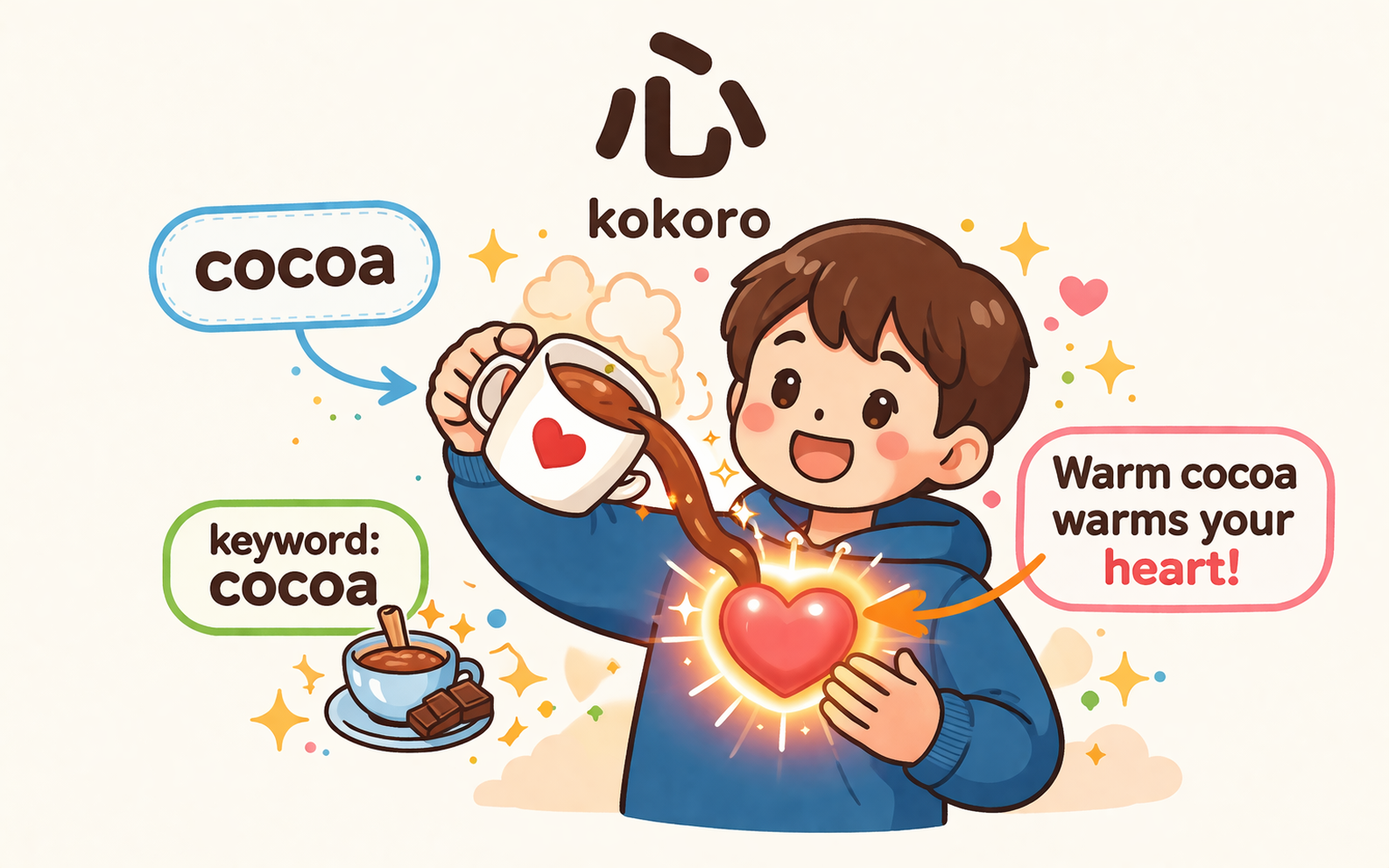
You do not have to match every syllable. For こころ (kokoro/heart), just use the ここ (koko) part and connect it to “cocoa.” That is enough for your brain to reconstruct the full word at recall time.
Accept imperfect connections
Mnemonics are bridges, not definitions. Even a weak connection between the keyword and the meaning is enough to trigger recall. Therefore, do not spend minutes searching for a perfect keyword — a good-enough one beats nothing.
Skip mnemonics for easy words
Some words are simple enough to learn through brief exposure. As a result, you should focus mnemonic energy on the words that keep slipping away. Pick your battles wisely.
10 Japanese Vocabulary Words with Keyword Mnemonics
Below, you will see the keyword mnemonic method applied to ten common Japanese vocabulary words. Read each entry slowly, close your eyes, and spend a few seconds inside each mental scene. Because active imagination is key, try not to rush.
女 (onna) — woman
Keyword: owner. You walk into three different shops and ask to speak with the owner. Each time, a different woman steps out. You realize: in this world, only women own businesses.
心 (kokoro) — heart
Keyword: cocoa. Imagine pouring a warm mug of cocoa directly into your chest cavity. Your heart instantly glows with happiness. Cocoa powers your heart.
肉 (niku) — meat
Keyword: Nick. Imagine your friend Nick — but with no skin, only meat. He cheerfully cuts off a slice and hands it to you saying, “Nice to meat you!” It’s gross, but memorable.
本 (hon) — book
Keyword: hone. You pick up a book and feel your skills sharpening as you read. You think: “This book helps me hone my knowledge.” Each page makes you sharper.
頭 (atama) — head
Keyword: “at AMA.” Picture yourself hosting a Reddit AMA (Ask Me Anything) about your head. The audience fires questions: “What’s inside your head?” “How heavy is your head?” You answer them all.
持つ (motsu) — to hold
Keyword: moats. You are a giant trying to hold several castle moats in your hands. Water and mud drip through your fingers. You desperately try to hold the moats together, but they keep falling.
死ぬ (shinu) — to die
Keyword: “she knew.” A mysterious woman stares at you and says, “She knew what you did last summer — and now you must die.” Feel the sudden fear of being caught.
聞く (kiku) — to hear
Keyword: kick. You are completely deaf. Then someone kicks you in the head. Suddenly, sound floods back in. The kick restored your hearing. Feel the overwhelming mix of pain and joy.
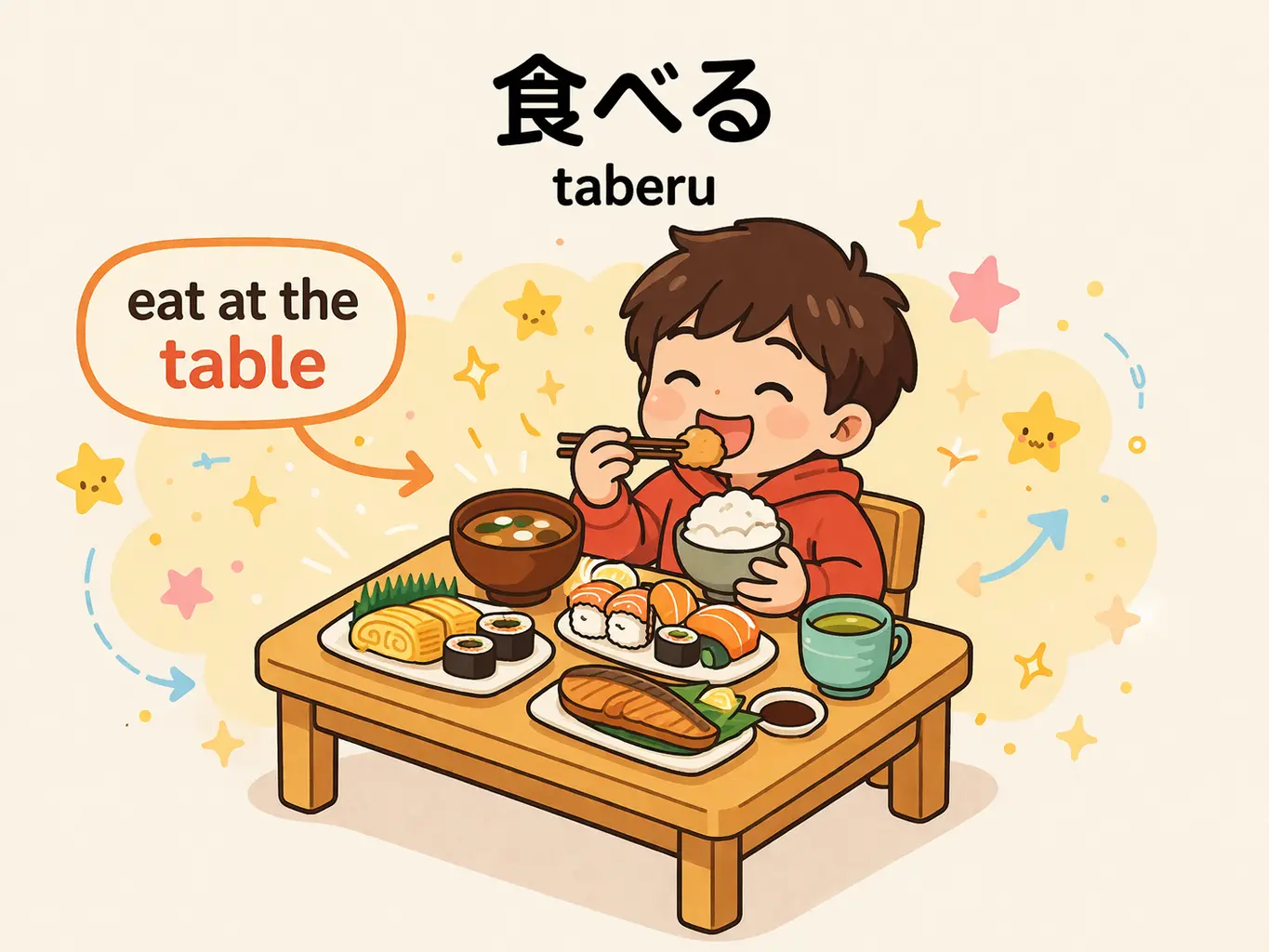
食べる (taberu) — to eat
Keyword: table. Picture yourself happily eating at a wooden table covered with sushi, rice, and soup. You think, “I eat at the table.” Table helps you remember taberu (食べる), which means “to eat.”
黒い (kuroi) — black
Keyword: crow. Picture a large, glossy crow landing in front of you. Its feathers are so perfectly black they almost look purple. Black is the crow’s defining feature.
✦ Kanji123 tip: After working through all ten words, close this guide and try to recall each one from the Japanese alone. Aim for seven or eight correct answers — that’s a strong result for a first pass.
How to Combine Keyword Mnemonics with Spaced Repetition
Keyword mnemonics work best when you combine them with spaced repetition. Because memory fades over time, you need to review each word at increasing intervals — before you forget it completely.
Therefore, use a spaced repetition system (SRS) as your review engine. Each card review reactivates the mnemonic story in your mind. Over time, the story fades and the word becomes automatic — exactly the goal.
A simple workflow
- Day 1: Learn the word using its keyword mnemonic.
- Day 2: Review the word and replay the mental scene.
- Day 4: Review again. Notice whether the story feels vivid or blurry.
- Day 8 and beyond: Review at spaced intervals until the word feels automatic.
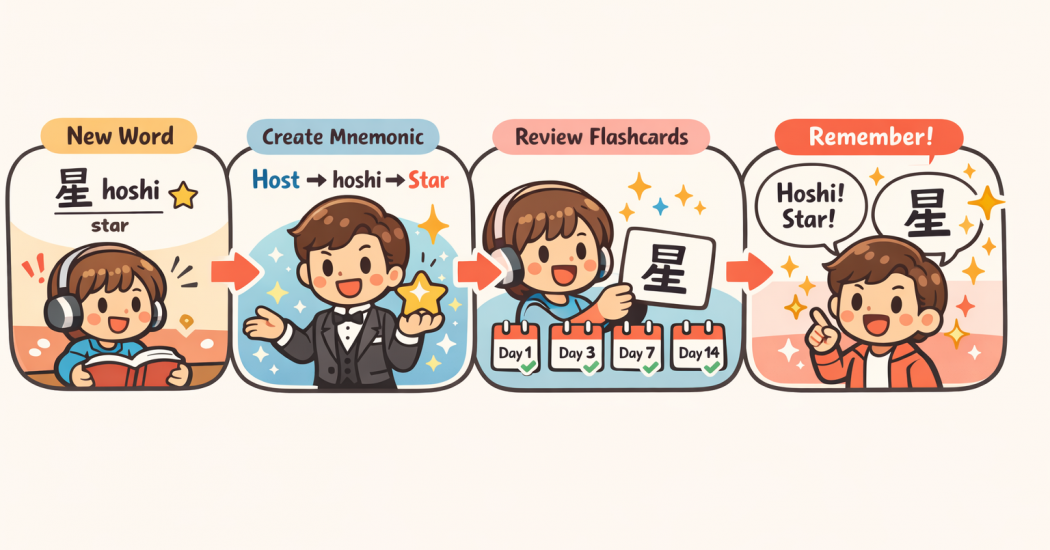
In addition, MochiKana’s vocabulary practice tool builds this spacing automatically. As a result, you spend more time on hard words and less time on the ones you already know.
See also: our guide on building a daily Japanese study habit and our article on JLPT N5 vocabulary — both will help you get more mileage from this technique.
Keyword Mnemonic vs. Rote Memorization: A Quick Comparison
Many learners wonder whether the time spent building mental stories is worth it. The research says yes — and the numbers are significant.
- Keyword mnemonics produce retention rates of 60–80% after a week, compared to roughly 20–30% for rote repetition alone.
- Because the method activates imagination and emotion, it engages more regions of the brain simultaneously.
- In addition, mnemonics scale well: the more you practice building them, the faster you create new ones — often in five to ten seconds.
- However, not every word benefits from a mnemonic. Short, highly frequent words (like は or の) often stick through exposure alone.
Therefore, treat the keyword mnemonic method as a targeted tool — not a replacement for reading, listening, and using the language. It works best on vocabulary that keeps slipping away despite repeated exposure.
When Keyword Mnemonics Work Best
This method is especially powerful in three situations.
Learning vocabulary for the JLPT
JLPT vocabulary lists are long and highly specific. Because many of these words rarely appear in everyday conversation, you do not get natural reinforcement. Keyword mnemonics fill that gap effectively.
Breaking through a vocabulary plateau
If you feel stuck at a certain vocabulary level, chances are you keep forgetting the same words. As a result, a targeted mnemonic for each stubborn word can break that cycle quickly.
Learning abstract or similar-sounding words
Words like 始める (hajimeru/to begin) and 初める (hajimeru/same reading, different meaning) can be confusing. However, building distinct mental scenes for each one separates them cleanly in memory.
The Honest Limitations of This Method
The keyword mnemonic method is powerful, but it has limits worth knowing.
- It teaches meaning, not kanji. To read Japanese text, you also need to learn the written characters separately.
- Memory fades without review. Therefore, a mnemonic alone is not enough — you need a review system alongside it.
- Some words resist good mnemonics. When that happens, a short sentence example or raw repetition may be more efficient.
- In addition, other people’s mnemonics are less effective than ones you create yourself. Because personal associations are stronger, adapt any examples you read into your own imagery.
Start Using Keyword Mnemonics Today
Learning Japanese vocabulary does not have to feel like grinding through a word list. Because your brain is wired for stories and images, the keyword mnemonic method works with your memory — not against it.
Start with the ten example words in this guide. Then, build mnemonics for the words you keep forgetting. In addition, combine each mnemonic with spaced repetition so that new words move steadily into long-term memory.
MochiKana is here to support every step of that journey. Explore our hiragana and katakana chart, and our spaced repetition practice sets to put this method into action right away.
© Kanji123 — Free JLPT Kanji Test Online