Let’s be real: staring at a wall of complex kanji can feel like trying to read a bowl of spaghetti. Most people give up because they think they need a photographic memory, but the secret isn’t working harder—it’s working weirder. By using Kanji Radicals and Mnemonics, you stop seeing random sticks and start seeing stories. It’s the ultimate ‘cheat code’ for your brain, turning those scary characters into something that actually sticks (without the mental breakdown).
This is where many beginners start treating kanji like a giant wall of symbols to brute-force through with enough repetition, caffeine, and mild emotional damage. That approach technically works in the same way that carrying all your groceries home in your arms technically works. It’s possible, but it’s also a ridiculous way to do it.
A better way is to stop looking at kanji as indivisible blocks and start seeing them as parts—specifically, radicals. Once you can recognize these recurring pieces and pair them with mnemonics (simple, memorable stories), those intimidating characters stop feeling random and start feeling familiar.
That is where the kanji radicals and mnemonics method comes in. It will not magically make kanji easy. However, it will make kanji much more learnable, which is the upgrade most beginners actually need.
If your script foundation still feels shaky, build that first with MochiKana, Japanese Alphabet for Beginner, Learn Hiragana Online Free, and Learn Katakana lessons. Kanji gets much less dramatic once the writing system itself stops moving around in your head.
Featured snippet version:
To learn kanji with radicals and mnemonics, break each kanji into smaller recurring parts, attach simple meanings or nicknames to those parts, then build a short memory story that links the parts to the kanji’s meaning. This works because radicals make kanji more recognizable, and mnemonics make those patterns easier to remember.
What are kanji radicals, really?
At the simplest level, radicals are the recurring parts inside kanji. Some are official dictionary radicals. Some are just useful structural pieces learners notice and reuse. For beginner study, the practical idea matters more than the taxonomy fight: radicals are the chunks that help you stop seeing each kanji as a completely new shape.
That matters because your brain is much better at remembering meaningful patterns than it is at memorizing a thousand unrelated line clusters. If you can look at a character and say, “Oh, that is the water piece plus the temple piece,” you are already in a stronger position than if your brain only says, “Well, that sure is a lot of strokes.”
If you want the stricter dictionary version of radicals, read Kanji Radicals Explained. For this article, we are focusing on radicals as learning tools, which is what most beginners actually need.
Why radicals help so much
Radicals help because they reduce chaos. Instead of memorizing one giant visual object, you learn to recognize smaller pieces that repeat across many kanji.
That gives you three major advantages:
· You notice structure instead of visual noise.
· You get reusable building blocks that appear again and again.
· You have something concrete to attach memory stories to.
That third point is the bridge to mnemonics. Radicals make kanji easier to see. Mnemonics make them easier to keep.
Important reality check:
Radicals are not magic. They will not teach you every reading or every nuance of every kanji. What they do is give your memory somewhere to stand, which is already a huge improvement over brute-force memorization.
1) Radicals: The Building Blocks of Kanji
Before radicals help you memorize anything, they have to do one simple job: make kanji stop looking like indivisible blocks. That is the real beginner unlock. Once your brain starts seeing recurring pieces instead of a single tangle of strokes, kanji gets much less hostile.
For the purposes of learning, radicals are the reusable pieces inside kanji. Some are official dictionary radicals, some are just learner-friendly components, but the practical value is the same: they turn one giant shape into smaller visual chunks your memory can actually work with.
Think of radicals as building blocks. You do not need to memorize every line in a kanji one by one if you can recognize the larger pieces that keep showing up. That shift alone makes new characters feel more familiar, because every radical you learn keeps reappearing in later kanji.
Why this matters:
When you learn radicals first, you stop treating every kanji like a new emergency. You start seeing patterns, and patterns are dramatically easier to remember than disconnected lines.
Two quick examples

Take the kanji 町, which means “town.” It is built from two parts: 田 and 丁. When you label those parts as rice paddy and street, the kanji stops being a random seven-stroke object and becomes a small visual recipe.
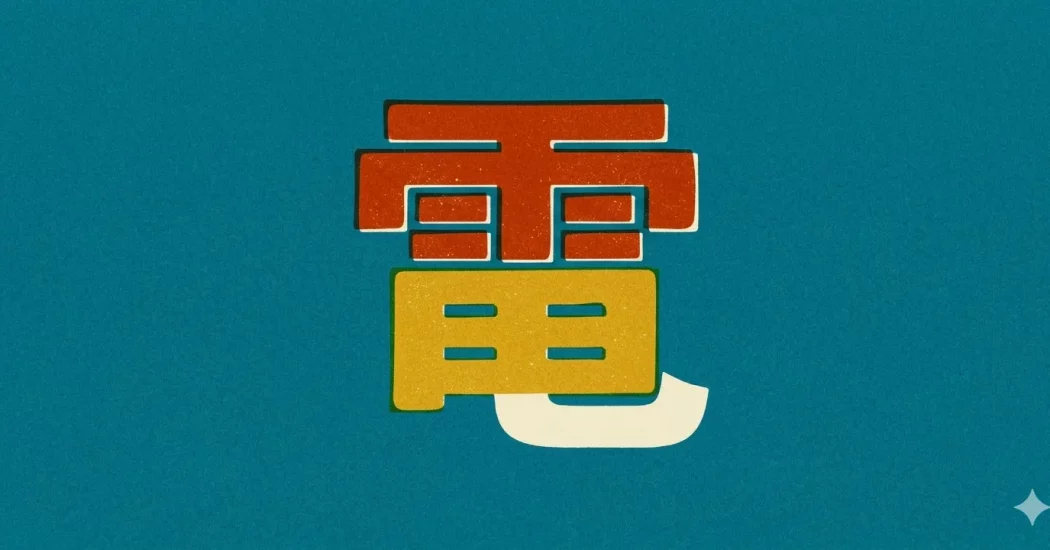
Now look at 電, which means “electricity.” This one uses three parts: 雨, 田, and 乚. Even if the full kanji feels complicated at first, breaking it into rain, rice paddy, and umbrella gives you something concrete to work with.
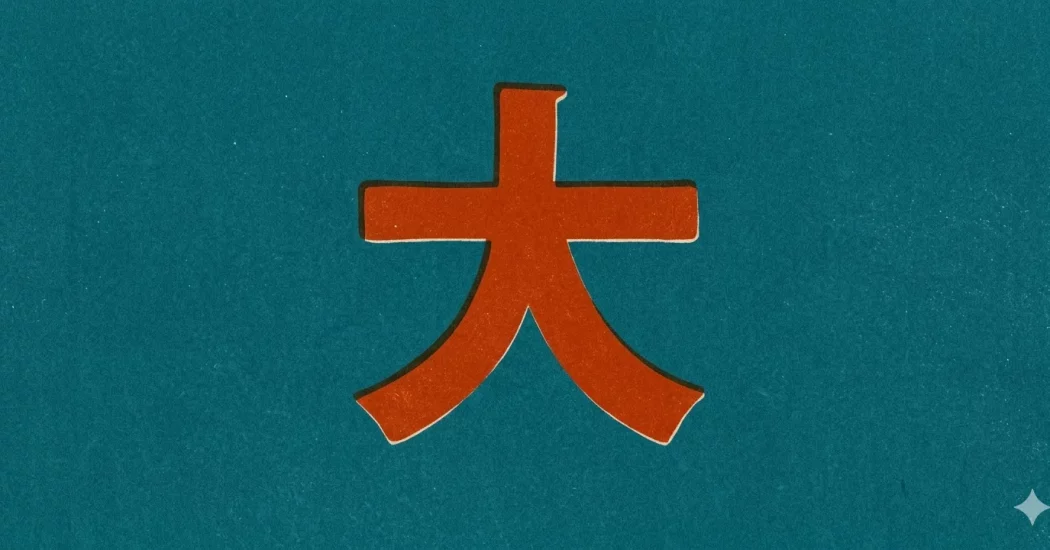
And sometimes the kanji and the radical are simply the same thing, like 大. That is the easiest version of all: one kanji, one part, one meaning. Nice when Japanese decides to be helpful for once
| Kanji | Meaning | Radicals / parts | What the breakdown gives you |
| 町 | town | 田 (rice paddy) + 丁 (street) | Two reusable pieces instead of one full shape |
| 電 | electricity | 雨 (rain) + 田 (rice paddy) + 乚 (umbrella) | Three memorable chunks instead of thirteen isolated strokes |
| 大 | big | 大 (big) | The kanji itself is the radical-like unit |
2) Strokes vs. Radicals
This is where the radical method starts feeling unfairly useful. Traditional rote learning often treats a kanji as a chain of individual strokes. That can work, but it asks your short-term memory to hold a lot of tiny visual details at once.
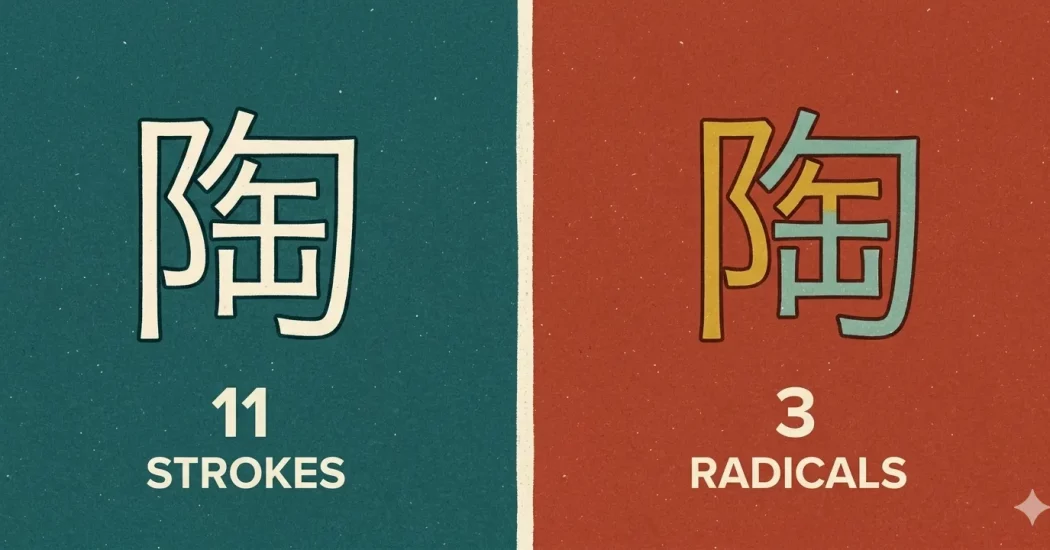
Radicals reduce that load immediately. Instead of remembering every stroke separately, you remember a smaller number of meaningful chunks. That makes the kanji easier to picture, easier to describe, and much easier to call back later.
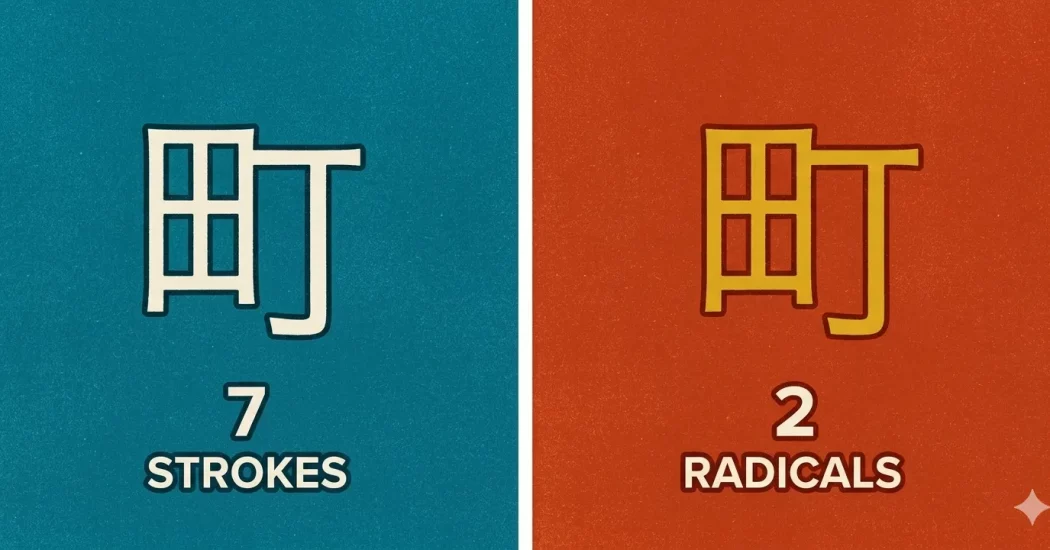
A simple way to see the difference is to compare stroke count versus radical count. The more complicated the kanji gets, the more obvious the advantage becomes.
| Kanji | Meaning | Stroke count | Radical / component count | Why radicals help |
| 大 | big | 3 | 1 | Three strokes are manageable, but one chunk is still easier than three loose lines. |
| 町 | town | 7 | 2 | Seven strokes is already pushing memory harder than two stable parts. |
| 電 | electricity | 13 | 3 | Thirteen strokes is a lot to hold at once; three parts is far more realistic. |
The practical takeaway:
Even before mnemonics enter the picture, radicals usually reduce the amount of visual material you need to remember by a huge margin. Less chaos in, less chaos out.
3) Radicals + Mnemonics = Easy Kanji Memorization
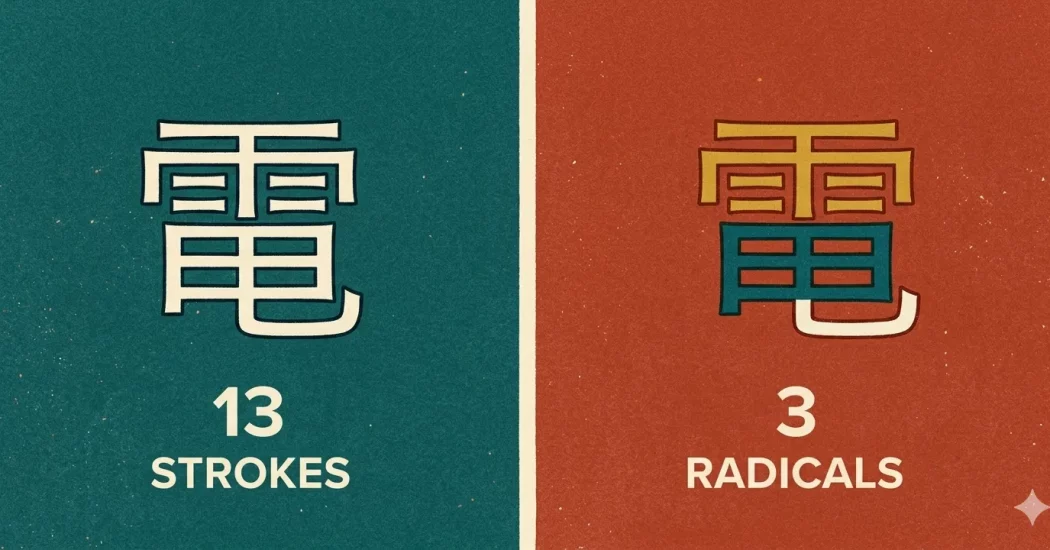
Radicals make kanji easier to see. Mnemonics make those radicals easier to keep. Put them together and you get one of the most beginner-friendly ways to memorize kanji meanings without turning study into blind repetition.
The formula is simple. First, identify the parts. Next, keep those parts in a consistent order—usually from the upper-left toward the lower-right. Then build a short story or image that links those parts to the kanji’s meaning.
Good mnemonic stories are not elegant. They are memorable. They should be short, visual, and weird enough that your brain actually notices them.
Good mnemonic rule:
Do not write a full fantasy novel for every kanji. One compact image or one absurd little scene is usually much stronger than a long, overexplained story.
Core examples

| Radical breakdown | Kanji meaning | How to use it |
| 電 = 雨 (rain) + 田 (rice paddy) + 乚 (umbrella) | electricity | Picture someone standing in a rice paddy during rain, holding an umbrella, when a bolt of electricity suddenly strikes. |
| 大 = 大 (big) | big | No story needed. The radical and the kanji are effectively the same anchor. |
More mnemonic practice examples
| Breakdown | Kanji meaning | Mnemonic direction |
| 日 (sun) + 月 (moon) = 明 | bright | If both the sun and the moon are out together, the world gets absurdly bright. |
| ネ (spirit) + 乚 (umbrella) = 礼 | thanks | You hold an umbrella over a spirit statue as a gesture of thanks. |
| ネ (spirit) + 単 (simple) = 禅 | zen | A simple spirit is a very zen spirit. |
| 火 (fire) + 丁 (street) = 灯 | lamp | You carry fire down a dark street, so it becomes a lamp. |
| 禾 (grain) + 口 (mouth) = 和 | peace / Japanese style | If every mouth has grain to eat, things feel peaceful. |
| 日 (sun) + 寺 (temple) = 時 | time / o’clock | A temple uses the sun to mark the time. |
| 目 (eye) + 亡 (death) = 盲 | blind | When sight in the eye is gone, blindness remains. |
| 女 (woman) + 辰 (landslide) = 娠 | pregnant | A woman carrying a tiny landslide inside her is pregnant. |
| 火 (fire) + 喿 (syrup) = 燥 | dry up | Put syrup near fire and it dries up. |
| 敝 (penguin) + 廾 (twenty) = 弊 | evil | A group of twenty suspicious penguins is definitely evil. |
4) Identifying the Radical
Before you can build a mnemonic, you need to know what parts you are actually looking at. That sounds obvious, but this is where a lot of learners get stuck. If the kanji has several visible pieces, which one counts as the official radical, and which ones are just useful learner-facing components?
For memory work, the practical answer is simple: use the parts that help you build a stable story. For dictionary lookup, you still care about the official radical. For mnemonics, though, the bigger priority is consistent, repeatable chunking.
A helpful first pass is to check the most common positions: left side, top, outer frame, right side, then bottom. That will not solve every kanji in existence, but it solves a surprising number of them.
| Kanji | Likely radical / key component | Where it appears | Why it stands out |
| 海 | 氵 | left | The water radical is a very common left-side clue. |
| 花 | 艹 | top | The grass / plant radical often sits like a crown. |
| 国 | 囗 | enclosure | The outer frame is the most obvious structural clue. |
| 別 | 刂 | right | Some radicals appear on the right even when learners miss them at first. |
| 思 | 心 | bottom | Bottom components can function as the key radical-like anchor. |
| 進 | 辶 | bottom-left sweep | Movement-style radicals often wrap or sweep around the base. |
Beginner-friendly rule:
If the dictionary radical and the memory-friendly pieces are not perfectly the same, do not panic. For lookup, use the official radical. For remembering the kanji, use the pieces that make the strongest story.
5) Memorizing a Kanji’s “Reading” with Mnemonics
A kanji’s meaning is only one part of knowing it. If you want to read actual Japanese, you also need a way to remember a useful reading.
The practical beginner move is not to memorize every possible reading up front. That turns one learning problem into three. A much more efficient first step is to choose one high-value reading—the one you will meet most often—and attach that to the kanji first.
The mnemonic method for readings works by continuing the meaning story into a sound cue. Once you already have the parts and the meaning in place, you add one extra image, person, sound, or word fragment that points you toward the reading.
Why one reading first is smart:
For many kanji, one reading does most of the heavy lifting in vocabulary. Learning one strong reading first keeps your memory cleaner and your progress faster.
| Kanji | Meaning | Chosen reading | Mnemonic direction for the reading |
| 町 | town | ちょう | Imagine the whole town being run by someone named Chou, so the town always reminds you of ちょう. |
| 電 | electricity | でん | The electricity leaves a giant dent in the ground, and that dent pushes you toward でん. |
| 明 | bright | めい | The world gets bright in May, which can cue めい. |
| 礼 | thanks | You say thanks and a ray of light appears, pushing you toward れい. | |
| 灯 | lamp | The lamp glows so brightly it feels like Tokyo tower lights, which can cue とう. | |
| 和 | peace / Japanese style | Everyone eats peacefully and somehow turns into walruses, cueing わ. |
These reading cues do not have to be beautiful. They just have to be stable enough that when you remember the meaning story, the sound cue follows behind it.
6) Jukugo Vocabulary
Once you move from kanji to vocabulary, the mnemonic logic still works. Jukugo—compound words made of two or more kanji—are often the easiest place to start because the meanings of the individual kanji usually contribute directly to the word as a whole.
That means if you already know the pieces, the compound word stops feeling random. You can use the known kanji meanings to build a compact story for the full vocabulary item.
| Word | Kanji breakdown | Meaning | Mnemonic direction |
| 人口 | 人 (person) + 口 (mouth) | population | The total number of people with mouths to feed is the population. |
| 目玉 | 目 (eye) + 玉 (ball) | eyeball | An eye that is also a ball is an eyeball. |
| 子犬 | 子 (child) + 犬 (dog) | puppy | The child of a dog is a puppy. |
| 戦場 | 戦 (war) + 場 (location) | battlefield | The location where war happens is the battlefield. |
| 野球 | 野 (field) + 球 (sphere) | baseball | The sport played in a field with a sphere is baseball. |
| 旅行者 | 旅 (trip) + 行 (go) + 者 (someone) | traveler / tourist | Someone who goes on a trip is a traveler. |
7) Verbs
Verbs are different from jukugo because they often pair one kanji with kana. That kana ending is your clue. If you see a kanji plus kana ending in an う-row sound, there is a good chance you are looking at a verb.
The useful beginner shortcut is this: start from the kanji meaning, then treat the kana ending as the signal that the word is behaving like a verb version of that meaning.
| Verb | Kanji idea | How to think about it | Meaning |
| 食べる | 食 = eat | Kanji meaning + verb ending | to eat |
| 言う | 言 = say | Kanji meaning + verb ending | to say |
| 聞く | 聞 = hear / ask | Kanji meaning + verb ending | to hear / to ask |
| 学ぶ | 学 = study | Kanji meaning + verb ending | to study / to learn |
| 目覚める | 目 (eye) + 覚 (awake) | Eyes becoming awake | to wake up |
| 心得る | 心 (heart) + 得 (obtain) | A heart that has obtained understanding | to know / to understand well |
8) Adjectives
Adjectives give you another pattern that beginners can use immediately. A lot of common adjectives are い-adjectives. So if you see a kanji followed by い, that is often your cue that the word is behaving like an adjective version of the kanji meaning.
| Adjective | Kanji idea | Pattern | Meaning |
| 大きい | 大 = big | kanji + い | big |
| 忙しい | 忙 = busy | kanji + い | busy |
| 丸い | 丸 = circle / round | kanji + い | round |
| 白い | 白 = white | kanji + い | white |
| 若々しい | 若 + 々 = young, repeated | kanji + repeater + い | youthful |
9) Single Kanji Vocabulary
Sometimes the vocabulary word is just one kanji standing on its own. In those cases, the vocabulary meaning is often the same as the kanji meaning, or very close to it. That makes these words some of the nicest beginner wins in the language.
They are also a good reminder that not every mnemonic needs to be elaborate. Sometimes the right answer really is just: it is a mountain because it is 山.
| Word | Meaning | Why it is straightforward |
| 山 | mountain | The kanji and the word meaning align directly. |
| 力 | power | Single-kanji noun with a direct core meaning. |
| 外 | outside | The vocabulary meaning stays close to the kanji meaning. |
| 今 | now | Short, common, and semantically direct. |
| 瓶 | bottle | Single kanji, single noun meaning. |
| 蟹 | crab | A very memorable noun even without extra complexity. |
How to learn kanji with radicals and mnemonics

Here is the practical workflow.
1. Break the kanji into recognizable parts.
2. Give each part a stable meaning or nickname.
3. Build a short image or story from those parts.
4. Attach the story to the kanji’s core meaning.
5. Review the kanji before the story fades.
That is the method in one clean loop. The details below are what make it actually work.
Step 1: Learn a small set of useful radicals first
You do not need all 214 traditional radicals before breakfast. What you need is a useful starter set: high-frequency pieces that appear again and again.
| Radical | Meaning / nickname | Common position | Example kanji |
| 氵 | water | left | 海, 洋, 泳 |
| 亻 | person | left | 休, 住, 体 |
| 扌 | hand | left | 持, 打, 指 |
| 艹 | grass / plant | top | 花, 茶, 草 |
| 口 | mouth | varies | 味, 問, 告 |
| 心 / 忄 | heart | bottom / left | 思, 情, 急 |
| 辶 | movement | bottom-left sweep | 近, 週, 進 |
| 木 | tree / wood | full part | 林, 森, 校 |
These are useful because they repeat constantly. Once your eyes start spotting them automatically, kanji stops feeling like a parade of strangers.
Step 2: Give radicals memorable names
This sounds small, but it matters. If one day you call a radical “heart,” the next day “emotion,” and the day after that “mind vibes,” your mnemonics get weaker. Stable labels make stable memory.
The label does not have to be academically perfect. It just has to be consistent and useful. That is why learners often use simple English nicknames for radicals instead of formal dictionary terminology.
Step 3: Build the story fast
A good mnemonic is short, concrete, and slightly ridiculous. Slightly ridiculous is not a bug. It is usually what makes the memory stick.
For example, if a kanji has the radicals for ‘water’ and ‘temple,’ you might imagine a temple floating on water. That image is simple enough to remember, and strange enough not to slide out of your head immediately.
What you do not want is a paragraph-long story with multiple plot twists, emotional development, and side characters. That is not a mnemonic anymore. That is unpaid screenwriting.
Step 4: Attach the story to the meaning, not just the pieces
This is where many learners quietly sabotage themselves. They make a funny radical story and forget to tie it back to the kanji’s actual meaning.
The radical story should lead you to the meaning. If the parts are memorable but the meaning is still floating separately, the method is doing half its job.
Step 5: Review before your brain throws it out
Mnemonics are not a replacement for review. They are a support system for review. The story gives you the recall hook. Review keeps the hook from rusting.
That is where a spaced-review system helps. If you want a structured next step, Learn Kanji & Japanese Vocabulary gives you a much cleaner environment for keeping those memory hooks alive over time.
Good mnemonic rule:
If the story makes you smile, cringe slightly, or immediately picture something specific, it is probably doing its job.
Why this method works especially well for beginners
Beginners usually do not have enough kanji exposure yet for pure pattern repetition to work smoothly. They need stronger support at the point of first contact. Radicals and mnemonics provide exactly that.
Later, when you have seen more kanji and read more vocabulary, your memory needs less theatrical help. But early on, the more concrete and structured the first encounter is, the better your retention tends to be.
That is why this method feels almost unfairly effective at the beginning. It gives your brain leverage right when leverage matters most.
What radicals are good at—and what they are not
Radicals are excellent for structure. They are often helpful for meaning. They are less reliable for teaching full readings on their own.
That means radicals can absolutely help you remember that a kanji feels water-related, hand-related, person-related, or plant-related. However, they will not automatically hand you all the onyomi and kunyomi you need.
That is why a fuller study system still matters. Once you understand the memory side, follow it with reading and vocabulary support through resources like Onyomi vs Kunyomi and Kanji for Beginners so the method grows into actual reading ability.
How to make better mnemonics
Not all mnemonics are equally useful. Some are sticky. Some are instantly forgettable. The difference is usually in how concrete they are.
- Use vivid objects, not abstract ideas.
- Keep the scene short.
- Make the image unusual enough to stand out.
- Use the same radical names every time.
- Tie the story clearly to the kanji meaning.
The goal is not to impress anybody. The goal is to remember the kanji tomorrow.
What learners usually get wrong about radical mnemonics
- Trying to memorize every radical before learning any actual kanji
- Making stories so long they become harder to remember than the kanji
- Changing radical nicknames too often
- Using the mnemonic but skipping review
- Learning meaning only and forgetting to connect the kanji to real vocabulary
The calmer version is much better: learn a useful set of radicals, build short stories, connect those stories to meaning, then reinforce everything through vocabulary and review.
Do not build a second problem:
The mnemonic is supposed to simplify kanji, not become a more complicated thing you now also have to study.
A beginner-friendly study plan for radicals and mnemonics
6. Learn 8 to 15 high-frequency radicals first.
7. Practice spotting those radicals inside real kanji.
8. Create quick mnemonic stories for new kanji meanings.
9. Review before the story fades.
10. Attach each kanji to one or two real vocabulary words.
11. Use quizzes or recall checks to find weak spots early.
If you want a practical next step after this article, use Learn Kanji the Smart Way to turn this method into a broader kanji routine, then keep Kanji123 – Free JLPT Kanji Test Online nearby for quick reality checks once the characters start to feel familiar.
Why this matters for long-term kanji learning
The radical mnemonic method is not just a memory trick. It is a way of teaching yourself to see kanji structurally. And that structural awareness keeps paying you back.
Once your brain gets used to spotting recurring parts, every new kanji enters a less chaotic system. That does not mean every future character is easy. It means fewer of them feel totally alien.
That is one of the biggest wins beginners can get: not instant mastery, but a steadily shrinking sense of panic.
Final thoughts
If kanji has been feeling like a giant wall, radicals and mnemonics are one of the best ways to turn that wall into smaller climbable pieces.
You do not need mystical talent. You do not need to memorize all 214 radicals immediately. You just need a better first encounter with each character: see the parts, name the parts, build the story, review the result, and keep moving.
So yes, learn kanji radicals. And if you want the method to actually stick, learn to pair them with mnemonics, vocabulary, and review. Start with a small radical set, build outward with MochiKanji, and use Kanji123 when you want to see whether your “I definitely know this” feeling is actually true.
That is when kanji starts feeling less like punishment and more like a system.
FAQ
What are kanji radicals?
Kanji radicals are recurring parts or components inside kanji. Some are official dictionary radicals, and others are useful learner-facing building blocks for memory and pattern recognition.
How do mnemonics help with kanji?
Mnemonics turn the radical parts of a kanji into a short, memorable story that helps you recall the kanji’s meaning more easily.
Should I learn all radicals before kanji?
No. Most beginners do better learning a useful set of common radicals while studying real kanji instead of trying to memorize everything first.
Do radicals teach kanji readings too?
Not reliably on their own. Radicals are much better for structure and memory than for teaching full readings without vocabulary support.
What is the best way to learn kanji with radicals?
Start with a small set of high-frequency radicals, build short mnemonic stories for new kanji, then reinforce them with spaced review and real vocabulary.