What Is Katakana Alphabet?
The katakana alphabet is one of the three main Japanese writing systems, along with hiragana and kanji. It is mainly used for loanwords, foreign names, sound effects, and emphasis. Because katakana appears often in menus, apps, signs, and brand names, it helps beginners start reading real Japanese quickly.
What Is the Difference Between Hiragana and Katakana?
Hiragana and katakana represent the same sounds, but they are used differently. Hiragana is used for native Japanese words and grammar, while katakana is mainly used for loanwords, foreign names, and emphasis.
They also look different. Hiragana has softer, more curved shapes, while katakana looks sharper and more angular. Because of this, katakana often stands out in text.
- Hiragana: grammar, particles, and native Japanese words
- Katakana: loanwords, foreign names, sound effects, and emphasis
- Kanji: meaning-based characters used for core vocabulary
Which Should I Learn First?
Most learners start with hiragana first because it is used more often in basic Japanese. If you have not learned it yet, start with our Learn Hiragana guide first. After that, learning katakana is much easier since both systems share the same sounds.
Katakana chart
Now let’s take a look at the katakana chart.
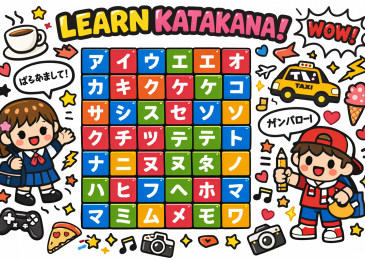
Katakana has 46 basic characters, and each one represents a sound used in Japanese. Like hiragana, katakana also uses dakuten, handakuten, and combination sounds to cover a wider range of pronunciation.
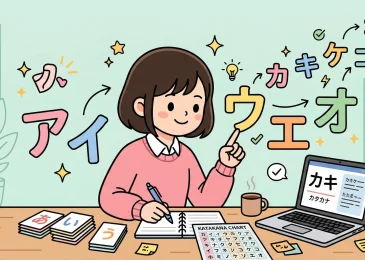
Start with the five vowels: ア, イ, ウ, エ, オ. After that, each row follows the same pattern by pairing one consonant with those vowels in order. For example, you get カ, キ, ク, ケ, コ, then サ, シ, ス, セ, ソ, and so on. A few sounds are irregular, but the overall system is very consistent, which makes katakana easier to learn than it first seems.
Take a look at the Katakana alphabet below.
| Row | A | I | U | E | O |
| Vowels | ア | イ | ウ | エ | オ |
| K | カ | キ | ク | ケ | コ |
| S | サ | シ | ス | セ | ソ |
| T | タ | チ | ツ | テ | ト |
| N | ナ | ニ | ヌ | ネ | ノ |
| H | ハ | ヒ | フ | ヘ | ホ |
| M | マ | ミ | ム | メ | モ |
| Y | ヤ | — | ユ | — | ヨ |
| R | ラ | リ | ル | レ | ロ |
| W | ワ | — | — | — | ヲ |
| Final N | ン | — | — | — | — |
How to Memorize Japanese Kana Fast?
Now that you’ve seen the basic katakana characters, the next step is remembering them.
One of the easiest ways to do that is by using mnemonics. A mnemonic is anything that helps you remember something more easily, such as an image, a phrase, or a simple association. Instead of trying to memorize a character as a random shape, you connect it to something familiar, which makes it much easier to recall later.
That is the approach we use in our Learn Katakana guide. There, we use mnemonic-based learning to help you remember similar-looking characters and build stronger recall from the start.
As you study, keep the process simple. Start with the five vowels first, then learn one or two rows at a time. Say each character out loud, write it by hand, and move into real words as early as possible. Over time, that mix of repetition, sound, and association makes kana much easier to remember.
Dakuten and Handakuten
Katakana does not stop at those 46 basic characters. It also uses a few small marks to create extra sounds.
The first one is dakuten (゙). It makes the sound more voiced. For example, カ becomes ガ, サ becomes ザ, and タ becomes ダ.
The second one is handakuten (゚). It is only used with the H row, and it changes those sounds into P sounds. For example, ハ becomes パ, ヒ becomes ピ, and フ becomes プ.
These changes may look small, but they appear often in real katakana words. Once you know the base chart, they are usually easy to learn.
- Dakuten (゙): カ → ガ, サ → ザ, タ → ダ
- Handakuten (゚): ハ → パ, ヒ → ピ, フ → プ
Combination Sounds, Long Vowels, and Small ッ
Katakana also uses a few extra patterns to show pronunciation more clearly, especially in foreign words.
One common pattern is combination sounds. Small versions of ヤ, ユ, and ヨ can join with other characters to make sounds like キャ (kya), キュ (kyu), and キョ (kyo).
Katakana also has extra combinations for foreign sounds that are less common in native Japanese. For example, ファ, フィ, and ティ often appear in loanwords.
Another important feature is the long vowel mark ー. This stretches the vowel sound, as in メール or コーヒー.
Finally, the small ッ shows a short pause or a doubled consonant. You can see it in words like カップ and チケット.
These patterns matter because they show up often in real katakana words.
- Combination sounds: キャ, キュ, キョ
- Foreign-sound combinations: ファ, フィ, ティ
- Long vowels (ー): メール, コーヒー
- Small ッ: カップ, チケット
Final Thoughts
The katakana alphabet may look unfamiliar at first, but it follows a very clear system. Once you learn the basic chart, the extra marks, and a few common patterns, reading katakana becomes much easier than it seems.
Start small and stay consistent. Learn the vowels first, then work through the chart one row at a time. After that, move into real katakana words as early as possible, because that is when everything starts to click.
If you want step-by-step practice with mnemonic-based learning, continue with our Learn Katakana guide. And if you have not learned hiragana yet, make sure to start with our Learn Hiragana guide first.