
Onyomi vs Kunyomi: What’s the Difference?
You start learning kanji and, for a glorious five minutes, everything feels under control. 木 is a tree. 山 is a mountain. Amazing. Elegant. You are basically a genius. Then the readings show up.
Wait, why is 木 sometimes き and sometimes もく? Why is 山 sometimes やま and sometimes さん? And who looked at this situation and decided, “Yep, this seems perfectly normal”?
That is the moment most learners meet onyomi and kunyomi.
The good news is that this topic only looks chaotic from far away. Once you understand where these two reading systems came from, and the patterns that usually decide which one shows up, kanji starts feeling a lot less random and a lot more readable.
Tiny prerequisite before we jump in: this article uses hiragana throughout. So if your kana foundation is still a little shaky, it is worth spending a short session with MochiKana or the Learn Hiragana page first. Future-you will be very grateful.
First, a Tiny History Detour
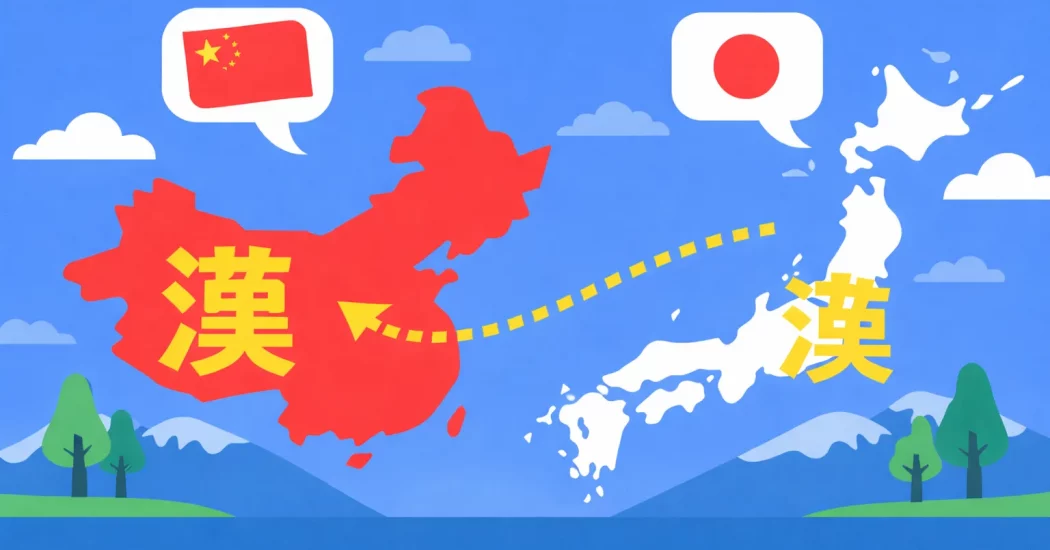
To understand onyomi and kunyomi, you only need one big idea: Japan borrowed Chinese characters, but it did not replace Japanese with Chinese.
That meant every imported character had to do two jobs. First, it carried over to a Chinese-style pronunciation. Second, it got matched with a Japanese word that people were already using in speech.
| Reading Type | What It Means | Quick Example |
| Onyomi 音読み | Chinese-derived reading | 学 → がく |
| Kunyomi 訓読み | Native Japanese reading | 山 → やま |
That is the whole origin story. No secret shrine rulebook. No curse. Just a writing system arriving in a place that already had a spoken language.
Two Readings for the Price of One
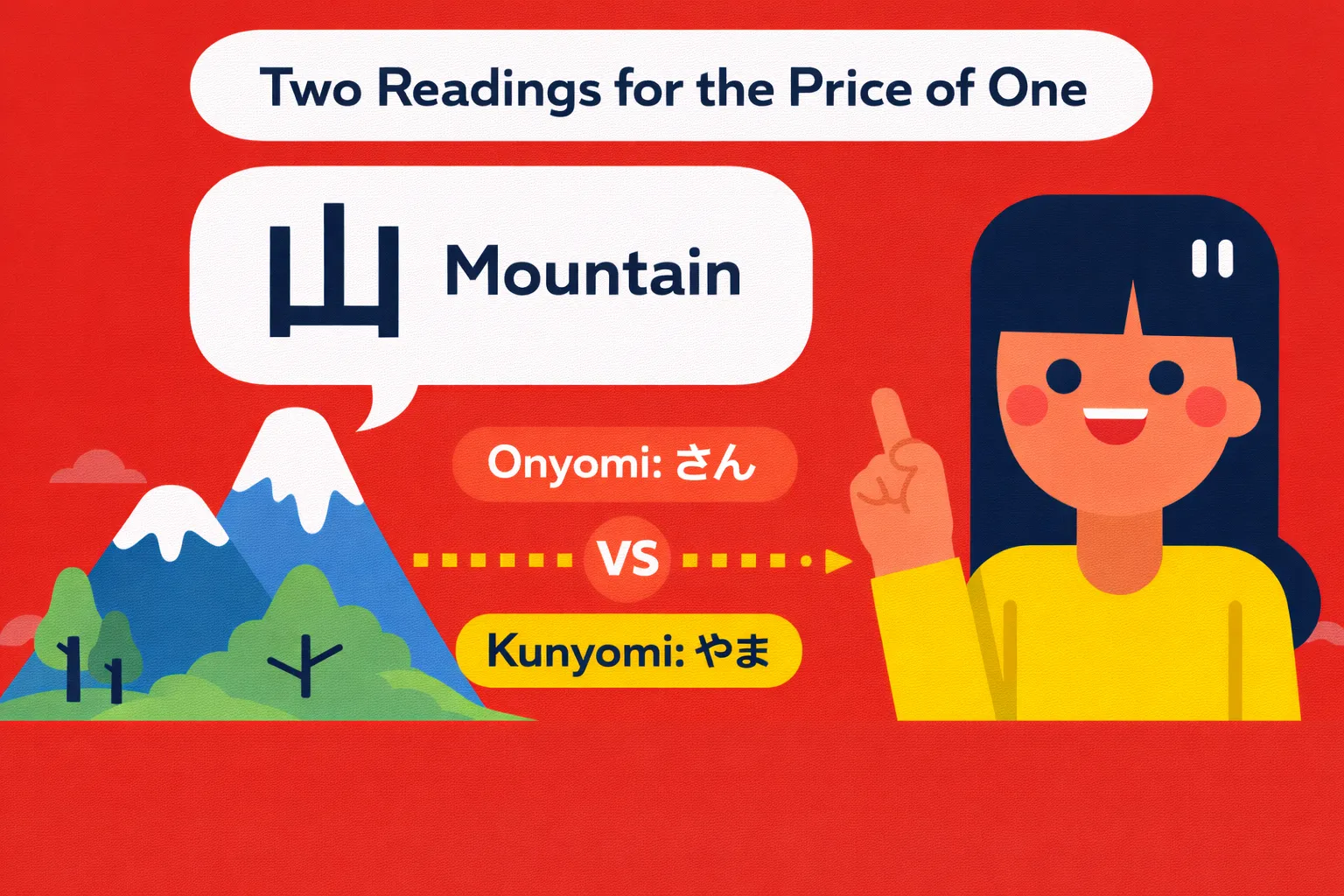
Most common kanji have at least one useful on’yomi and one useful kunyomi. Here is the beginner-friendly version of each.
Onyomi is the Chinese-style reading.
This is the reading that usually shows up in kanji compounds, especially the neat little two-kanji words that feel compact and formal.
| Kanji | On’yomi | Example Word |
| 学 | がく | 学生(がくせい) |
| 国 | こく | 国語(こくご) |
| 火 | か | 火山(かざん) |
Kunyomi is the native Japanese reading.
This is the reading that often appears in single-kanji words and in words that have hiragana attached. That attached hiragana is one of your best visual clues.
| Kanji | Kun’yomi | Example Word |
| 山 | やま | 山(やま) |
| 水 | みず | 水(みず) |
| 食 | た | 食べる(たべる) |
For the bigger picture of how to study kanji without drowning in readings, go read Learn Kanji the Smart Way after this. It fits very naturally with everything in this article.
Sometimes a Kanji Only Really Lives in One Lane
Here is where the tidy “one onyomi, one kunyomi” story starts getting messy. Some kanji mostly show up in on’yomi-heavy vocabulary. Others feel much more at home in kunyomi-heavy usage. And some just show up wherever they want, like they pay rent here.
The point is not to memorize that as trivia. The point is to stop assuming that every kanji is perfectly balanced. The reading that matters most is usually the one that appears in the words you actually meet.
With that in mind, here are examples of kanji that only have onyomi readings:
| Kanji | Meaning | On’yomi |
| 肉 | Meat | にく |
| 材 | Lumber | ざい |
| 感 | Feeling | かん |
| 点 | Point | てん |
| 医 | Doctor | い |
| 茶 | Tea | ちゃ |
| 胃 | Stomach | い |
| 職 | Work | しょく |
| 象 | Elephant | ぞう |
| 秒 | Second | びょう |
On the flip side, there are also kanji characters that only have kunyomi readings because they are kanji created in Japan. This means they (Japanese elite/scholars/priests) took pieces of kanji characters and put them together to create a new kanji, for a concept that was native to Japan. These are called Kokuji 国字 (literally “national characters”).
Here are examples of made-in-Japan kanji:
| Kanji | Meaning | Kun’yomi |
| 畑 | Field | はたけ |
| 姫 | Princess | ひめ |
| 匂い | Fragrant | におい |
| 峠 | Mountain Pass | とうげ |
| 枠 | Frame | わく |
| 籾 | Unhulled Rice | もみ |
| 鰯 | Sardine | いわし |
| 栃 | Horse Chestnut | とち |
| 込む | To Be Crowded | こむ |
| 咲く | To Bloom | さく |
Why Do Some Kanji Have So Many Readings?
Now for the part that makes beginners stare blankly at the wall. Some kanji have multiple onyomi. Some have multiple kunyomi. Some have both. And some, like 生, look like they are actively trying to test your emotional resilience.
Chinese did not arrive in Japan just once.
Different waves of contact brought different pronunciations into Japanese over time, so one kanji could collect more than one Chinese-derived reading.
Before writing, people were already speaking, and some native words later ended up grouped under the same character.
These language shifts had a direct effect on the types of Chinese language that were brought to Japan. And not every kanji was brought over at the same time or from the same place.
For example, one version of Chinese pronounces the character 下 as げ while another pronounces it as か, centuries later. The character and the concept stayed the same, but for some reason Japan thought it would be neat to just adopt both Chinese readings for the same kanji. In the case of this kanji, we end up with words that use the げ reading:
| Kanji | Reading | Meaning |
| 下品 | げひん | Crude, Vulgar |
| 下巻 | げかん | Last volume (in a series) |
| 下旬 | げじゅん | End of the month |
| 下駄 | げた | Geta, Japanese wooden clogs |
| 下痢 | げり | Diarrhea |
And words that use the か reading:
| Kanji | Reading | Meaning |
| 地下 | ちか | Underground |
| 以下 | いか | Less than, Below |
| 地下鉄 | ちかてつ | Subway |
| 廊下 | ろうか | Corridor, Hallway |
| 却下 | きゃっか | Rejection |
Can you guess which reading arrived in Japan later? (Hint: it’s the reading used with subway systems.)
So yes, one kanji can end up carrying multiple valid readings without anyone technically doing anything wrong. Annoying? Sometimes. Interesting? Also yes.
This Is the Part You Actually Need:
How to Guess the Reading

You are not guessing blind here. There are patterns. Good ones. They are not perfect. They are not magical. But they are useful enough that they will save you a lot of confusion.
| Pattern | Explanation | Examples |
| Onyomi compounds | When two or more kanji appear together with no hiragana attached, there is a good chance the reading is on’yomi. | 先生(せんせい), 東京(とうきょう), 地下鉄(ちかてつ) |
| Single-kanji kunyomi | When a single kanji stands alone as an everyday word, kunyomi is very common. | 山(やま), 手(て), 冬(ふゆ) |
| Single-kanji onyomi | Some single-kanji words also use onyomi, especially common nouns or Sino-Japanese vocabulary. | 本(ほん), 文(ぶん), 字(じ) |
| Kunyomi with okurigana | If the kanji has hiragana attached (okurigana), the reading is usually kunyomi. | 食べる(たべる), 大きい(おおきい), 行く(いく) |
| Kunyomi compounds | Not every compound is onyomi. Some compounds with a more native feel use kunyomi. | 朝日(あさひ), 虫歯(むしば), 南口(みなみぐち) |
In other words: patterns help a lot, but vocabulary still gets the final vote.
How to Learn Readings Without Frying Your Brain
This is where people accidentally make things ten times harder than they need to be. They look up a kanji, see six possible readings, and decide they now have to memorize all six immediately. Please do not do that to yourself.
1. Learn one reading first
Pick the reading from the most useful beginner word you know. That gives the kanji a real home in your memory.
2. Choose the word, not the list
For 学, do not try to “learn all readings of 学” as an abstract project. Learn 学校(がっこう) or 学生(がくせい) instead. Vocabulary is what makes the reading stick.
3. Let the other readings arrive later
The rest will come through vocabulary, reading, quizzes, and repeated exposure. That is not lazy learning. That is normal learning.
After reading this, go try a free JLPT N5 kanji test. Seeing readings inside actual questions is far more useful than rereading a list for the fifth time.
And if you want a second angle on beginner kanji study, Mochi also has a live basic kanji guide and a separate best way to learn kanji resource that pairs nicely with this article.
So What Should You Do Next?
If your Japanese foundation still feels fragmented, go spend some time with Mochi’s broader Japanese learning guide. It connects kana, kanji, vocabulary, and grammar into one cleaner path.
If your writing-system layer still needs work, circle back to MochiKana. Then pair this article with Learn Kanji the Smart Way and move into active practice on MochiKanji. That sequence makes a lot of sense: understand the system, test yourself, repeat before forgetting.
Final Thoughts
Onyomi and kunyomi are not here to ruin your life. They are just what happens when a writing system travels, lands in a new language, and has to coexist with words that were already there.
So do not try to brute-force every reading at once. Learn the useful word first, notice the pattern, and test yourself in context. That is how kanji starts feeling less like trivia and more like reading.
Ready to make this practical?
Start with the Kanji123 quiz hub, sharpen your kana base on MochiKana, and keep your review streak alive on MochiKanji.
FAQ
What is the difference between on’yomi and kunyomi?
Onyomi is the Chinese-derived reading of a kanji, while kunyomi is the native Japanese reading attached to that kanji in Japanese.
Should I memorize every reading of a kanji?
No. Start with one useful reading from a common word. The other readings are easier to learn through vocabulary and repeated exposure.
Is there a quick way to guess the reading?
Yes, but it is only a pattern guide: compounds often lean on’yomi, while single-kanji words and kanji with okurigana often lean kunyomi.
Why does one kanji have so many readings?
Because kanji entered Japanese in multiple historical waves, and native Japanese already had different spoken words that later got grouped under the same character.


Pingback: Japanese Grammar: Top 5 Free Online Resources - Kanji123
Pingback: Learn Japanese: A Smart Roadmap That Actually Works - Kanji123
Pingback: How Long Does It Take to Learn Japanese? - Kanji123
Pingback: Kanji Radicals and Mnemonics: The Only Strategy That Sticks.
Pingback: The Japanese Writing System: Hiragana, Katakana, and Kanji
Pingback: Kanji Stroke Order: The Beginner-Friendly Rules
Pingback: Best Kanji Learning Program for Beginners
Pingback: The "Zero Panic" Beginner Kanji List: 50 Must-Know Characters