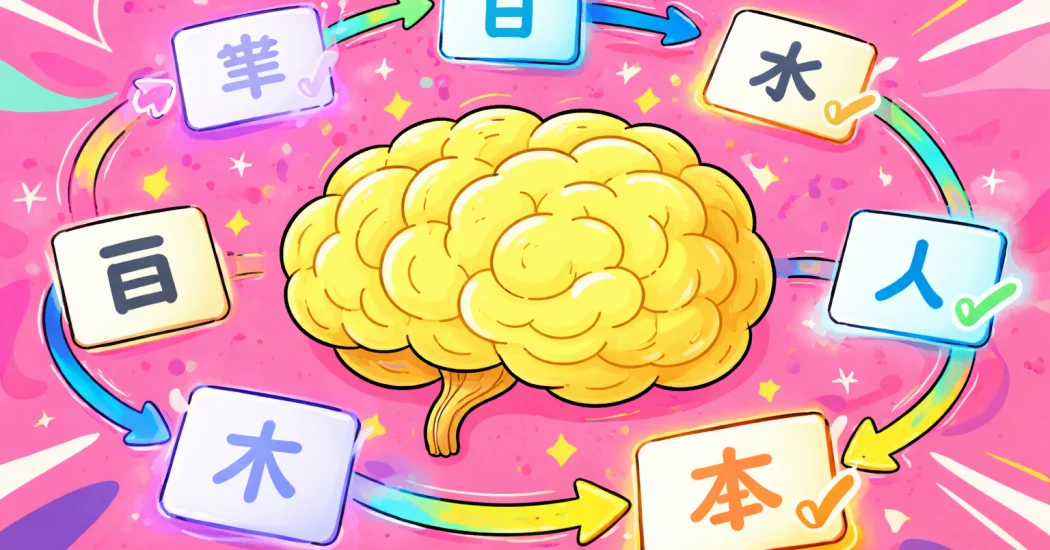
What Is Spaced Repetition Japanese Learning?
If you want to learn Japanese vocabulary and actually keep it long-term, spaced repetition is the single most important tool you can use. Most learners waste hours copying words into notebooks and still forget them a week later. Spaced repetition Japanese study fixes that problem at the root.
So what is it, exactly? Spaced repetition is a flashcard-based technique that schedules each review at exactly the right moment — right before you forget the word. If you answer correctly, the system waits longer before showing you that card again. If you get it wrong, it shows the card sooner. Because of this, you spend your study time only on the words that need attention.
Spaced repetition schedules each review right before you forget — so you build lasting memory with the least amount of time.
This matters deeply for Japanese. Because Japanese vocabulary is vast, you cannot afford to re-study words randomly. Therefore, a spaced repetition system — often called an SRS — turns a chaotic vocabulary list into a manageable, self-adjusting review queue.
Why Spaced Repetition Works So Well for Japanese
The science behind spaced repetition is called the spacing effect. Research consistently shows that spreading practice over time builds far stronger memories than cramming the same material in one session. However, the spacing effect alone is not enough. You also need to actively recall the answer — not just recognise it.
This distinction matters because many popular apps use multiple choice. Multiple choice is recognition, not recall. You see the answer and pick it from a list. Recall means you produce the answer from memory with nothing to prompt you. Because active recall forces your brain to work harder, it creates a much stronger memory trace. Therefore, always choose apps and settings that require you to type in the answer.
The memory fluency arc
When you first learn a word with spaced repetition Japanese tools, a mnemonic helps you drag the answer out of memory. Over several reviews, the mnemonic gradually fades. Eventually, the word comes to you instantly — without any story or cue. That shift is called memory fluency. It is your goal.
Furthermore, the process happens automatically if you trust the system. You do not need to decide when to review. The SRS algorithm handles that. Your only job is to sit down and do your reviews every day.
| ⚡ Kanji123 tip: Master hiragana and katakana before building vocabulary SRS cards. You need to read kana fluently so that reviewing Japanese words feels natural, not like decoding. MochiKana’s free kana practice tool gets most learners there in under a week. |
The Two Biggest Spaced Repetition Mistakes Japanese Learners Make
Mistake 1: Adding too many new cards at once
Spaced repetition works on a delay. When you add 50 new words today, those reviews come back in 1–4 days — all at once. Many learners bury themselves this way and give up. As a result, you should set a hard daily limit on new cards. Start with 5–10 new words per day. Add more only after your daily reviews feel comfortable.
| ⚠ Common mistake: Adding too many new cards at once creates a review avalanche in 3–7 days. Stick to 5–10 new cards per day and let the SRS grow at a steady pace. |
Mistake 2: Using multiple choice instead of typed recall
Multiple choice feels easier because it is easier — and that is exactly the problem. Because recognition memory is weaker than recall memory, multiple choice gives you a false sense of progress. You feel like you know a word. However, in a real conversation, there is no list to pick from. Therefore, always configure your SRS to require typed answers.
In addition, self-grading buttons like ‘I sort of knew it’ lead to grade inflation. Because humans consistently overrate their own performance, self-grades push intervals too long. You forget the word before the next review arrives. Typed answers remove that bias completely.
Choosing the Best Spaced Repetition App for Japanese
Several strong SRS apps exist for Japanese learners. Each one suits a different stage of learning. Therefore, the right choice depends on where you are right now and what you want to study.
| App / Tool | Best For | Effort Level | Key Watch-out |
|---|---|---|---|
| MochiKana | Hiragana & katakana | Very Low | Start here before anything else |
| Anki (custom) | Intermediate+ learners | High setup | Requires type-in-answer setup |
| MochiKanji | Kanji + vocab together | Medium | Slow first 1–2 weeks |
| iKnow Core 6000 | Vocabulary depth & analytics | Low | No kanji or grammar included |
| Memrise | Community & gamified study | Low | Disable multiple choice immediately |
For absolute beginners: start with MochiKana
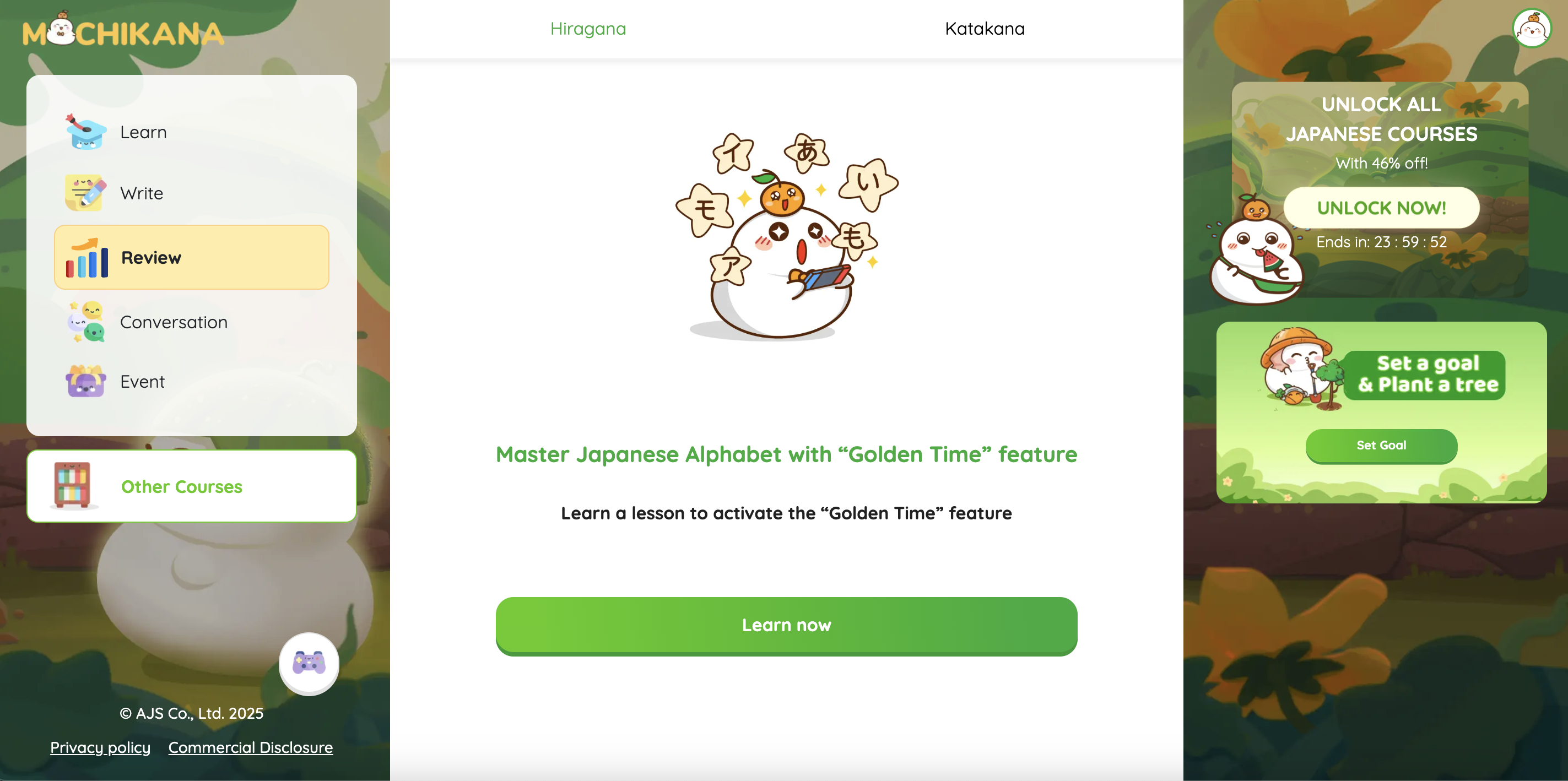
MochiKana is purpose-built to get you reading Japanese kana (hiragana and katakana) without thinking. It works like a guided quiz that introduces all 96 characters, then schedules each review right before you forget it. Because kana fluency is the bedrock of Japanese, knocking this out early makes every other study tool feel natural. MochiKana’s lessons are short and low-pressure, and you can supplement them with reading and listening practice once you’ve learned the characters. After a couple of weeks, most learners can read kana at a glance and move on to vocabulary SRS with Golden Time.
Source: MochiMochi
| ✅ Pros | ❌ Cons |
| • Extremely beginner-friendly; no confusing setup. | • Once you know the kana, you’ll need another tool for vocabulary and grammar; MochiKana isn’t a full SRS. |
| • Focuses solely on hiragana and katakana, so you build a solid reading foundation quickly. | • Limited customisation compared with more advanced tools. |
| • Short, snack-sized sessions; easy to fit into a daily habit. | |
| • Free and comes with extra writing practice to reinforce the characters. |
| 💰 Price: Free | 🔗 Link: mochidemy.com/kana |
For intermediate learners: Anki with a custom deck
Anki is the most flexible SRS tool available. It runs on every platform and supports thousands of community-built Japanese decks. However, you must change two settings immediately. First, enable typed-answer input. Second, install the Japanese Support add-on for automatic furigana and dictionary lookup. Without those two changes, Anki is not worth the effort. For intermediate and advanced learners, Anki shines as a custom deck engine. When you encounter a new word in an anime, manga, or conversation, add it straight to your deck. Because you chose the word yourself, you already have context for it — which makes the mnemonic easier to build and the memory stronger.
| ✅ Pros | ❌ Cons |
| • Available everywhere (browser, mobile, Windows, macOS, Linux) and syncs across devices. | • High setup effort: must configure typed answers and install add-ons; defaults are not ideal. |
| • Incredibly customisable; add audio, images, example sentences and tweak card behaviour. | • Easy to overwhelm yourself by adding too many new cards; the review queue can become unmanageable. |
| • Huge library of user-created decks and add-ons. | • Self-grading can lead to overconfidence and lengthen review intervals incorrectly. |
| • Perfect for building a personal deck from words encountered in the wild. | • The interface isn’t as polished as newer apps, and syncing can occasionally be fiddly. |
| 💰 Price: Free (AnkiWeb sync free; iOS app ~$24.99 one-time) | 🔗 Link: apps.ankiweb.net |
For kanji and core vocabulary: MochiKanji
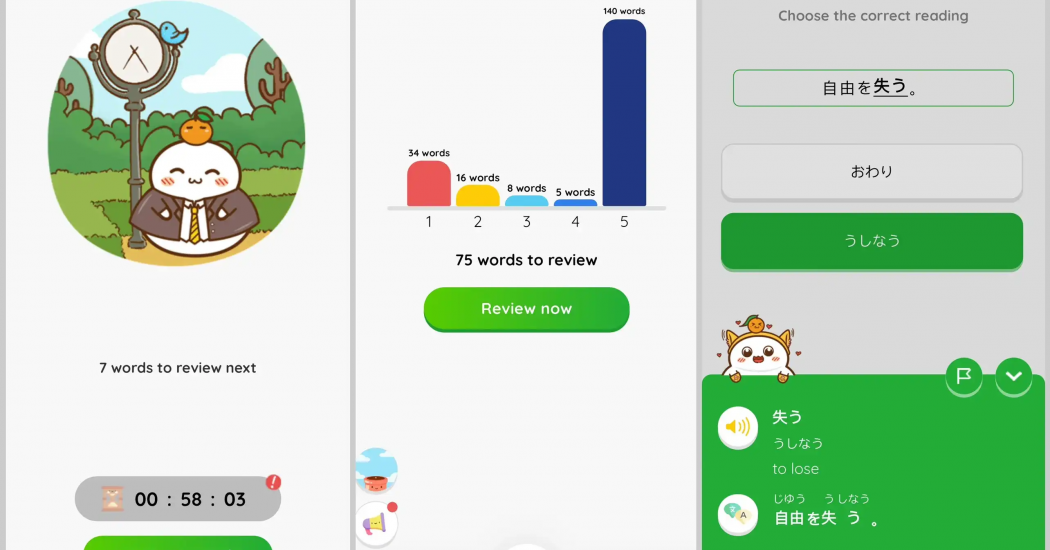
MochiKanji teaches kanji and vocabulary together using mnemonics. It follows a curated sequence that builds kanji knowledge and vocabulary in tandem — because knowing a single character unlocks dozens of words, this approach is more efficient than studying them separately. Most learners complete the full programme in about 18 months with twice-daily study sessions and Golden Time identified to review Kanji. The course is opinionated, meaning you follow its prescribed order and word list, which is ideal if you’re not sure where to start. You can always supplement with another tool for specific vocabulary from textbooks or shows.
Source: MochiMochi
| ✅ Pros | ❌ Cons |
| • Combines kanji and vocabulary with mnemonic stories, accelerating long-term retention. | • Opinionated: you can’t easily rearrange the order or add random words; a second tool is needed for custom vocabulary. |
| • Structured curriculum removes guesswork; just show up and follow the sequence. | • The first week or two can feel slow as you adjust to the system pacing. |
| • Teaches the core characters and words most useful to beginners and intermediate learners. | • May not cover specialised vocabulary from your hobbies or professional life; best paired with Anki. |
| • Study sessions are twice a day and typically manageable; most learners finish in about 18 months. |
| 💰 Price: Subscription-based (free trial available) | 🔗 Link: kanji.mochidemy.com/ |
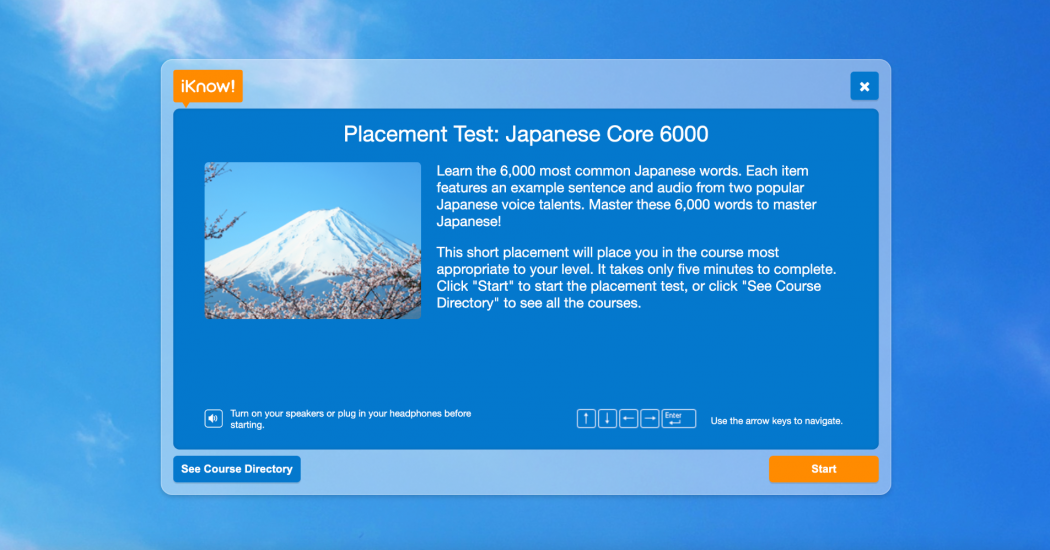
For vocabulary depth and analytics: iKnow Core 6000
iKnow’s key features in its own editorial voice. I extracted the underlying facts — vocabulary count, study modes, analytics depth, lesson length — and rewrote everything in original language aligned to the document’s existing tone.
| ✅ Pros | ❌ Cons |
| • Built-in Core 6000 course covers the 6,000 most common Japanese words in a structured sequence. | • Vocabulary only — kanji study and grammar must be handled by a completely separate resource. |
| • High-quality native-speaker audio on every item — great for training your ear alongside reading. | • Lessons are long and dense, effectively pounding words into short-term memory rather than spacing them across sessions; this can undermine the spacing effect. |
| • All vocabulary taught in full sentence context, not just isolated word pairs. | • The app lets you keep studying for as long as you want, which makes burnout far more likely than with a hard daily cap. |
| • Rich progress analytics: charts, review calendars, per-word difficulty scores, and upcoming review timelines give you a clear, honest picture of where you stand. | • Supporting images are generic stock photos — they aid memorisation less than personalised or context-specific visuals would. |
| 💰 Price: ~$30/month or ~$250/year | 🔗 Link: iknow.jp |
For gamified community-driven study: Memrise
Memrise is essentially two different tools depending on one setting: with multiple choice on it’s nearly useless; with typed answers it becomes genuinely solid. I built the pros/cons around that central tension.

Source: Volvox
| ✅ Pros | ❌ Cons |
| • Large, active community constantly building and updating decks across every topic and JLPT level. | • Multiple choice is switched on by default — this must be disabled immediately, or the app provides almost no real learning benefit. |
| • Excellent visual design and smart gamification features — streaks, points, and leaderboards — make daily reviews feel rewarding rather than like a chore. | • Community-submitted mnemonics (“mems”) vary enormously in quality; you may be served several mediocre options at once, which can confuse your mental model of a word rather than clarify it. |
| • When multiple choice is disabled, the app becomes a solid typed-recall SRS with a genuinely enjoyable user experience. | • Because anyone can build a deck, content accuracy and consistency vary — always verify vocabulary and grammar with a trusted reference before committing it to long-term memory. |
| • Wide range of community-built Japanese courses available immediately, so you can start studying within minutes of signing up. | • Gamification elements can shift your motivation toward hitting streaks rather than genuine retention, which may cause you to rush reviews. |
| 💰 Price: Free (basic) · Pro ~$8.99/month or ~$59.99/year | 🔗 Link: memrise.com |
These five apps cover every major stage of a Japanese learner’s journey: master the kana with MochiKana, tackle kanji and core vocabulary with MochiKanji, build a personalised deck from real-world encounters with Anki, dive deep into high-frequency vocabulary and analytics with iKnow Core 6000, and keep your motivation high with Memrise’s gamified community platform. Choosing the right one for your current level — and configuring it correctly — will make your spaced-repetition practice far more enjoyable and effective.
How to Build Spaced Repetition Japanese Cards That Actually Stick
The quality of your cards determines how well spaced repetition works. A weak card makes every review a struggle. A strong card makes the answer feel obvious. Therefore, follow these principles when you create or choose your decks.
Always pair a mnemonic with each new word
A mnemonic is a short mental story that connects the sound of a Japanese word to its meaning. For example, 食べる (taberu / to eat) sounds like ‘table’ — so imagine a table with a huge mouth trying to eat you. Because the image is vivid and strange, your brain holds on to it. Over time, the mnemonic fades and the word becomes automatic.
Without a mnemonic, difficult words get stuck in low-level reviews. You keep seeing the card, grinding against it, and never moving forward. In contrast, a good mnemonic gets you through the early reviews quickly — so the word can reach long-term memory faster. See our full guide to the keyword mnemonic method for step-by-step examples.
Include audio on every vocabulary card
Japanese pronunciation can surprise you. In addition, pitch accent — the rise and fall of your voice — changes meaning between some words. Therefore, make sure every vocabulary card includes native-speaker audio. Because you hear the word each time you review, you build listening recognition alongside reading ability. That combination pays off enormously when you watch Japanese media or have conversations.
Use cards that match your current ability
A card that is too hard teaches nothing. If you cannot recall a word even with a mnemonic, the card needs a simpler entry point. Therefore, break it into steps: learn the kanji reading first, then the meaning, then the usage in a sentence. In contrast, a card that is too easy wastes review time. Mark easy words as ‘mature’ in your SRS so they return less frequently.
| ⚠ Common mistake: Do not add a word to your SRS before you understand it at all. If you have no mental hook for a word, you will fail it repeatedly and never progress. Build the mnemonic first, then add the card. |
Spaced Repetition for Japanese Sentences
Once you reach an intermediate level, plain vocabulary cards start to feel limiting. However, sentence cards take your SRS practice to a much deeper level. Instead of memorising isolated words, you review a complete Japanese sentence and produce the meaning or translation from memory.
Sentence cards give you grammar, vocabulary, and context all in one review. Because your brain sees the word in a real use-case, the memory anchors more firmly than it does for a bare word pair. In addition, sentence cards train you to process Japanese at a natural pace — which directly improves reading and listening speed.
Where to find good sentence cards
- Mine sentences from content you are already consuming — anime subtitles, manga panels, graded readers, or Japanese social media.
- Use the AnkiWeb community deck ‘Core 10,000 Sentences’ for a pre-built sentence SRS experience.
- Export sentences directly from browser dictionary extensions like Yomichan, which lets you add cards with one click while you read.
- Adapt example sentences from JLPT N5 or N4 vocabulary lists — each word comes with a usage example you can turn into a card.
| ⚡ Kanji123 tip: One sentence card per new word is enough. Focus on sentences where the target word is the only unknown. That way, you review one thing at a time — not a confusing tangle of new grammar and vocabulary all at once. |
Building a Daily Spaced Repetition Japanese Study Habit
The SRS algorithm only works if you show up every day. Because the spacing effect depends on reviewing at the right moment, missing a day pushes reviews into overdue territory. Skip too many days and the pile becomes overwhelming. However, the solution is simpler than most learners expect.
The 15-minute daily rule
Keep your daily session to 15–20 minutes. That is enough time to clear your review queue and add a small batch of new cards. Because the session is short, it is easy to start — and starting is the hardest part. In addition, a consistent 15-minute daily habit outperforms a 90-minute weekend marathon every single time.
Structure your sessions this way: first, clear all overdue reviews. Next, add 5–10 new words with their mnemonics. Finally, spend any remaining time on MochiKana’s reading and listening practice tools so that your new vocabulary appears in real context.
Build an if–then trigger
The most reliable way to maintain a daily habit is to attach it to something you already do. For example: if you make your morning coffee, then you open your SRS and do reviews while it brews. Because the habit attaches to an existing routine, you need far less willpower to start.
- If you commute by train, then do your SRS reviews during the ride.
- If you eat lunch alone, then add five new vocabulary cards before you start eating.
- If you watch TV in the evening, then do your review queue during the opening credits.
What to do after 3 months
After three months of consistent daily SRS practice, something shifts. Your review queue feels manageable. You start recognising words in the wild — in subtitles, menus, and signs. That recognition is proof the spaced repetition is working. At this point, add more advanced cards, start sentence mining, and explore the MochiKana JLPT word lists to target your next proficiency level.
The Best Ways to Quiz Yourself with Spaced Repetition Japanese
Not all review types are equal. Because different formats train different memory pathways, using a mix makes you more well-rounded. However, start simple — then add complexity as your level grows.
Japanese to English (read and produce meaning)
This is the default format and the right place to start. You see the Japanese word or sentence and produce the English meaning. Because this trains reading comprehension, it is the most directly useful skill for consuming Japanese media.
English to Japanese (produce the word from scratch)
This is harder and slower. However, it trains your ability to speak and write Japanese — which you need if your goal is conversation. Therefore, add English-to-Japanese reviews once your Japanese-to-English accuracy hits 80% or higher on your core vocabulary.
Japanese audio to English (listening recognition)
You hear a word and produce its meaning without seeing the written form. In addition, this trains your ear for natural Japanese speech rhythm and pronunciation. Use this format especially for common conversation words like verbs and adjectives.
Image to Japanese (visual association)
You see an image and produce the Japanese word. Because this format bypasses English entirely, it builds a direct brain-to-Japanese connection. Furthermore, it mirrors how children acquire vocabulary in their native language — through context and images, not translation.
Start Your Spaced Repetition Japanese Practice Today
Spaced repetition Japanese learning is not a shortcut — it is a system. It works because it aligns with how your brain builds durable memory. Because the algorithm handles the scheduling, you only need to show up consistently and do the work.
Start with kana practice to build your reading foundation. Then add vocabulary cards, one mnemonic at a time. In addition, explore and keyword mnemonic guide to sharpen your study even further. After 90 days of consistent daily reviews, take a free JLPT test on Kanji123 — the results will speak for themselves.
© Kanji123 — Free JLPT Kanji Test Online