The Test That Finally Proves Your “Anime Research” is Actually Educational
At some point in Japanese study, the letters JLPT show up and the mood changes immediately. Suddenly everyone is talking about N5, N3, N1, pass rates, test centers, score reports, and whether they should be “on track” by next December. Meanwhile, you may still be trying to stop katakana from attacking your confidence at random moments.
That is normal. The JLPT has a way of making learners feel like there is an invisible syllabus they were supposed to know about all along. There was not. There is just a test, five levels, and a huge amount of internet noise built around them.
So let’s do the useful version of this conversation. This guide explains what the JLPT is, what the levels actually mean, what the test measures, who it helps, and when beginners should care. More importantly, it explains how to use the JLPT as a tool without letting it move into your head and redecorate the place.
And yes, we are going to keep this practical. If you want to live in Japan at some point, the JLPT is one tool that can help you do that. If you want to apply for certain jobs, schools, or visas later, the JLPT may matter even more. At the same time, if you are still building your foundation, the best thing the JLPT can do right now is give you a roadmap—not a stress disorder.
If your writing-system basics still feel shaky, start by cleaning those up with MochiKana, Japanese Alphabet for Beginner, or Japanese Alphabet. Your exam anxiety will be much more manageable when the script itself stops feeling like a surprise attack.
What is the JLPT, exactly?
JLPT stands for Japanese-Language Proficiency Test. It is the most widely recognized standardized Japanese test in the world, and it is used to measure reading, listening, vocabulary, and grammar ability.

That sounds straightforward, which is good, because it is. The exam has five levels: N5, N4, N3, N2, and N1. N5 is the easiest level, and N1 is the hardest. Officially, N5 and N4 cover basic Japanese, N3 bridges the gap, and N2 to N1 move into much broader real-world language use.
The part beginners often miss is this: the JLPT does not test everything. It does not test speaking. It does not test natural conversation. It does not ask whether you can order ramen without freezing. It tests whether you can understand Japanese in the ways the exam is designed to measure.
In plain English:
The JLPT is a useful benchmark. It is not a complete definition of your Japanese ability, your future, or your worth as a learner.
Why people care about the JLPT so much
Because unlike many study milestones, the JLPT has a name, a date, a score, and paperwork. That makes it feel very official, which means people love attaching emotional significance to it.
In real life, learners care about the JLPT for a few different reasons.
Some want a clear goal. Others want a credential for a resume. Some need it for school applications or work opportunities. And some simply want a way to measure progress that feels more concrete than “I think I’m getting better, probably.”
Those are all valid. What matters is knowing which reason is yours. Otherwise, you can end up chasing the exam because it sounds impressive rather than because it actually serves your goal.
What the JLPT levels actually feel like
The official descriptions are useful, but they are also a little polite. So let’s translate them into something a beginner can actually feel.
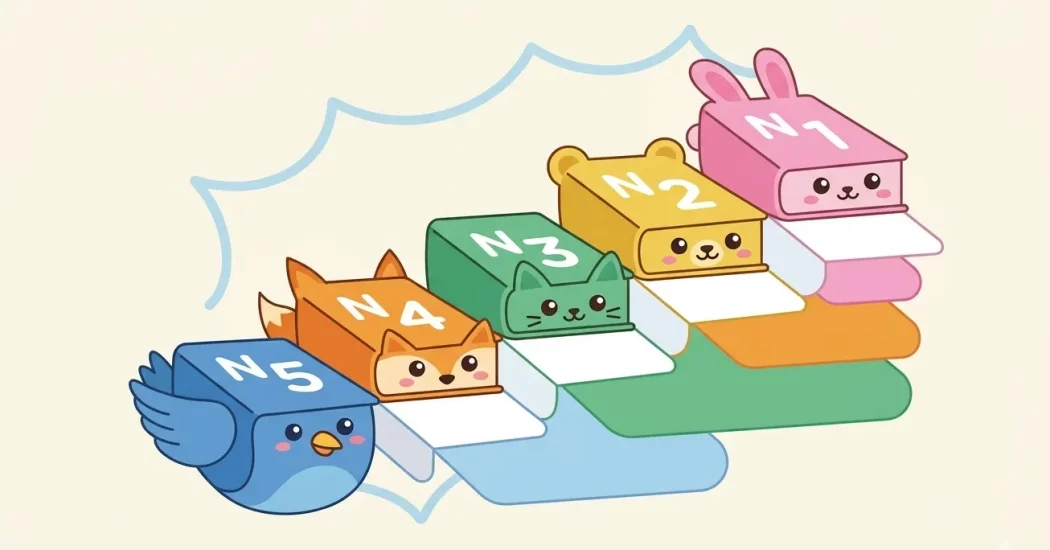
N5 is the point where very basic Japanese starts becoming usable. You know hiragana. Katakana is hopefully not haunting you every other day. You can read simple expressions, pick out basic grammar, and work with very common vocabulary.
N4 feels sturdier. You are still a beginner in the bigger sense, but you can process more language without stopping every five seconds to renegotiate with the sentence.
N3 is where things stop being cute. That is not meant as an insult. It is just where the bridge starts showing its actual architecture. More reading stamina, more inference, more real-world language, less protection.
N2 and N1 are where the exam starts mattering much more for certain jobs, schools, and formal goals. They are also where many learners realize that passing an exam and feeling comfortable in life are related, but not identical, achievements.
A practical way to think about it:
N5 and N4 help you map the beginning. N3 is the transition. N2 and N1 start becoming relevant when Japanese is moving from “study topic” into “life tool.”
Should beginners care about the JLPT yet?
Yes, but mostly as a map before it becomes a mission.
If you are very early in Japanese, the JLPT is helpful because it gives you a rough structure. It tells you that there is an N5 layer of material, that N4 is not the same thing, and that the levels mean something beyond “harder than before.”
However, if you are still building basic kana, beginner vocabulary, and your first round of common kanji, turning the JLPT into your main source of pressure is usually a bad trade.
For beginners, a much healthier relationship with the JLPT sounds like this: “Good, now I know where N5 fits. Let me build the skills first.”
That skill-building layer is where hiragana learning, learn katakana, Kanji for Beginners, and Learn Kanji the Smart Way become much more useful than obsessing over exam dates too early.
What the JLPT actually tests
This is where the test gets useful—and also where a lot of beginner misunderstandings begin.
The JLPT measures a specific kind of Japanese proficiency.
It focuses on four broad areas:
· vocabulary
· grammar
· reading comprehension
· listening comprehension
That means the exam is strong at measuring how well you can understand Japanese on paper and through audio under timed conditions. It is not designed to evaluate your speaking ability, your conversation recovery skills, your handwriting stamina, or whether you can survive a landlord explaining a plumbing issue in very fast Japanese.
That distinction matters. A learner can pass the JLPT and still feel uncomfortable speaking. Another learner can speak fairly well and still dislike the exam because test-style reading is its own skill. Neither case is strange.
Where kanji fits into the JLPT
This is the point where many learners realize why the JLPT keeps showing up in kanji conversations. The test is not a dedicated kanji exam, but kanji is deeply embedded in the vocabulary and reading sections.
In practice, that means weak kanji ability becomes visible very quickly. If you do not know the common characters, reading slows down. If reading slows down, grammar questions get harder. If grammar questions get harder, the whole experience starts feeling suspiciously rude.
That is why building a solid kanji foundation early matters. Articles like Kanji Radicals Explained and Onyomi vs Kunyomi help because they make the system underneath the test feel less random.
Meanwhile, if you want a low-friction way to check whether your beginner kanji is actually sticking, Kanji123 – Free JLPT Kanji Test Online is useful precisely because it turns “I think I know this” into something you can actually verify.
If you want to live in Japan at some point, the JLPT can help
This is the practical example a lot of articles leave too abstract.
If you want to live in Japan at some point, the JLPT is one tool that can help you do that. Not because passing a level suddenly gives you a magical key to the country, but because JLPT results can support applications for schools, jobs, and other opportunities where a formal Japanese benchmark is helpful.
For example, some employers may ask for N2 or N1. Some schools may want proof of Japanese ability. Even when it is not strictly required, having a JLPT score can make your level easier to communicate than saying, “I’m kind of intermediate, emotionally speaking.”
That said, living in Japan is obviously bigger than a test. You also need listening stamina, reading ability, real vocabulary, daily-life language, and the ability to function outside multiple-choice question formats. So the JLPT can help, but it should be part of your toolkit—not the entire toolkit.
Good benchmark, not full blueprint:
The JLPT can help you study, apply, and communicate your level. It cannot replace real-world practice, daily reading, or the ability to survive fast conversations and messy paperwork.
When should you start thinking about N5?
Usually once the basics are actually basics.
If you can read hiragana comfortably, handle katakana without visible suffering, and work through beginner vocabulary and grammar without everything feeling brand new, then N5 starts making sense as a real target.
If you are not there yet, that is fine. You do not win a prize for rushing into an exam while your foundation is still negotiating the terms of its existence.
A practical beginner path often looks like this: Learn Hiragana Online Free → Learn Katakana lessons → Japanese Writing System → Learn Kanji & Japanese Vocabulary → small JLPT-style checks.
That order is much kinder than trying to make the exam your first meaningful structure.
The healthy way to use the JLPT
The JLPT works best when it gives your study shape without taking over your identity.
A healthy beginner approach usually looks like this:
1. Use the levels to understand rough difficulty.
2. Let them guide material selection a little.
3. Build skill outside the exam too.
4. Use test-style practice as a checkpoint, not as your entire relationship with Japanese.
In other words, the JLPT can tell you where you are on the map. It should not become the map, the vehicle, and the weather report at the same time.
What beginners usually get wrong about the JLPT
A few mistakes show up again and again.
First, learners assume the JLPT is the only goal that matters. It is not.
Second, they assume passing a level means comfort in every skill. Also not true.
Third, they start worrying about level labels before they have built a study routine that can support those labels.
Finally, they treat exam stress as if it were study progress. It is not. It is just stress wearing a productivity costume.
If that sounds familiar, step back for a minute with Japanese learning resource or Learning Japanese – Guideline for beginner. The broader study picture often fixes what exam panic breaks.
A better beginner plan than obsessing over the exam
If you are early in Japanese, this sequence tends to work much better:
5. build your kana foundation
6. understand the writing system
7. start learning common kanji through real words
8. use JLPT-style material as a guide, not a religion
9. test progress in small, repeatable ways
That is why the combination of MochiKana, MochiKanji, and Kanji123 makes sense for beginners. It gives you a foundation, a system, and a way to check whether your “I think I know this” feeling is actually true.
One last practical thought
A lot of learners ask, “Do I need the JLPT?” The more useful question is, “What would the JLPT do for me right now?”
If the answer is “give me a rough direction,” great. If the answer is “help me qualify for something later,” also great. But if the answer is “make me feel like I’m doing Japanese correctly,” then you may be asking the exam to solve a problem that belongs to your study routine instead.
The test can guide your progress. It cannot replace it.
Final thoughts
The JLPT is useful, respected, and genuinely helpful for many learners. It is also not the first thing that needs to control your study life.
For beginners, the smartest move is to understand what the exam is, what the levels mean, and how the test fits into a larger study plan. Then, build your actual Japanese ability through kana, kanji, vocabulary, reading, and listening.
So yes, care about the JLPT. Just do it in the right order. Start with the basics, keep your progress practical, and use MochiKanji and Kanji123 when you want a next step that actually turns “I should study more” into something concrete.
Alright. Now you know what the JLPT is. The next move is much less glamorous, but much more effective: go build the skills the exam is actually testing.
FAQ
What is the JLPT?
The JLPT is the Japanese-Language Proficiency Test, a standardized exam with five levels from N5 to N1.
What JLPT level should a beginner start with?
Most beginners who want a concrete test goal start by looking at N5, because it is the easiest level and focuses on basic Japanese.
Does the JLPT test speaking?
No. The JLPT mainly tests reading, listening, vocabulary, and grammar. It does not directly test speaking.
Is the JLPT useful if I want to live in Japan?
Yes. The JLPT can help with school and job applications and makes it easier to communicate your Japanese level, although it does not replace real-world language ability.
Do I need to take the JLPT to learn Japanese?
No. The JLPT can be a helpful benchmark, but you do not need it in order to study Japanese effectively.